

AI coaching delivers the highest ROI for first-time managers because they face frequent, high-stakes decisions during a critical 90-day window when bad habits form and HR resources get consumed. Mid-sized companies (200–4,000 employees) see the fastest returns by starting here, then expanding to high-potential individual contributors and distributed teams.
First-time managers deliver the fastest ROI because they face the steepest learning curve and make the most frequent mistakes during their first 90 days—yet traditional support systems fail them precisely when they need help most.
The critical window determines everything. Managers promoted for individual contribution suddenly face performance reviews, difficult conversations, delegation, and conflict resolution without training. Quarterly training programs miss the moment of need. HR business partners can't scale to every new manager.
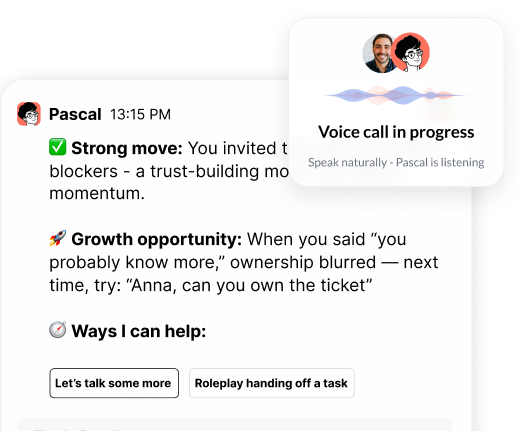
AI coaching provides feedback during actual conversations when stakes are highest. Platforms join meetings, provide immediate post-conversation feedback, spot blind spots (micromanaging, unclear expectations, avoiding difficult topics), and suggest specific language for upcoming conversations.
The ROI compounds quickly. New managers who receive immediate feedback avoid costly mistakes that damage team morale, create legal exposure, or drive turnover. They build confidence faster and develop leadership skills during the transition period when they're most receptive to coaching.
Data Breakdown:
• Challenge: Needs help during conversation | Traditional Approach: Schedule coach for next week | AI Coaching Approach: Real-time feedback in Slack/Teams
• Challenge: Doesn't know what they don't know | Traditional Approach: Wait for 360 review (6 months) | AI Coaching Approach: Proactive blind spot identification
• Challenge: Inconsistent application of frameworks | Traditional Approach: One-time training, then forgotten | AI Coaching Approach: Reinforcement at every interaction
The accessibility gap creates the urgency. Traditional coaching reaches only 3–5% of employees, typically C-suite executives, leaving 95% of managers without support during critical moments. Human coaches book weeks out, but managers need help during the conversation, not after it fails. According to Gallup research cited in Fortune, 70% of team engagement variance comes down to the manager, making manager effectiveness the highest-leverage investment for organizational performance.
High-potential individual contributors in technical roles benefit from AI coaching because they're developing leadership skills while still in IC roles, creating a smoother transition when promoted and reducing the "accidental manager" problem that plagues tech companies.
The preparation advantage changes career trajectories. Engineers, scientists, and analysts need coaching that respects technical depth while developing people skills. AI coaching helps ICs practice stakeholder management, cross-functional collaboration, and persuasive communication—all critical for influence without authority.
A principal scientist at a life sciences company used Pascal to prepare for difficult conversations with cross-functional stakeholders, practicing influence strategies before critical meetings. The scientist was promoted to team lead within 6 months.
High-performers leave when they don't see growth paths. AI coaching demonstrates investment in their development, providing career acceleration through leadership readiness. Employees who demonstrate leadership skills before promotion get promoted faster and succeed more often, reducing the risk of failed transitions that cost organizations both talent and productivity.
Managers of distributed teams see outsized value from AI coaching because remote work amplifies every management mistake. Unclear communication becomes project failure. Delayed feedback becomes disengagement. Cultural misalignment becomes turnover.
The visibility problem creates blind spots. Remote managers can't read body language, overhear conversations, or sense team morale through office presence. Asynchronous communication requires different skills than in-person management. Tone, clarity, and context matter more in written communication across Slack and email.
Meeting fatigue compounds the challenge. Remote managers conduct more meetings but often less effectively. AI coaching improves meeting quality without adding more meetings, analyzing communication patterns and providing feedback on effectiveness.
Timezone complexity demands 24/7 coaching access, not scheduled sessions. Pascal analyzes written communication patterns, provides feedback on meeting effectiveness, suggests improvements for asynchronous updates, and identifies engagement signals across distributed teams.
Start with first-time managers to prove value quickly, then expand to high-potential ICs and distributed teams to build organizational momentum. This sequencing maximizes early ROI while creating advocates who drive adoption across the organization.
The pilot strategy determines success. Launch during performance season when managers face high-stakes conversations and need immediate support. Target 20–50 first-time managers who are vocal about challenges and likely to engage with new tools. Measure specific outcomes: direct report feedback scores, time saved on HR escalations, manager confidence ratings.
Expand to high-potential ICs once you've proven value with managers. These employees become your next cohort of managers, and starting their leadership development before promotion reduces transition costs. Track promotion readiness, cross-functional influence, and retention of high-performers.
Add distributed teams as a third wave, using lessons learned from earlier cohorts. Remote managers face different challenges but benefit from the same real-time feedback model. Measure meeting effectiveness, asynchronous communication quality, and team engagement scores.
Avoid company-wide rollouts before proving value. Targeted deployments generate better data, create stronger champions, and allow you to refine the implementation before scaling. The goal is sustained behavior change, not maximum headcount coverage.
• First-time managers deliver fastest ROI because they face the steepest learning curve during their critical first 90 days when bad habits form and HR resources get consumed
• High-potential ICs benefit from pre-promotion leadership development, reducing the "accidental manager" problem and accelerating career progression
• Distributed teams need AI coaching because remote work amplifies every management mistake and requires 24/7 access to feedback
• Pilot with 20–50 first-time managers during performance season to prove value quickly, then expand strategically to high-performers and distributed teams
Pascal by Pinnacle delivers proactive, personalized AI coaching embedded in the tools your managers already use—Slack, Teams, Zoom, and 1:1s. Built by ICF-certified coaches, protected by SOC2 compliance, and trusted by organizations scaling leadership development without scaling costs. Learn how Pascal transforms manager effectiveness.
Header photo by Annie Spratt on Unsplash



“Thank you for setting the great foundation for my promotion; now I have a plan!"

Curious to see how AI Coaching can 10X the impact and scale of your development initiatives. Book a demo today for: