

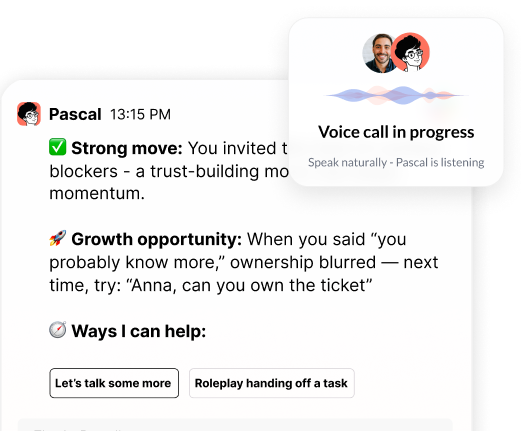
An embedded AI coach lives inside the communication tools your managers use daily (Slack, Microsoft Teams, Zoom, Google Meet) rather than requiring a separate login. The coach observes work, provides guidance in context, and reaches out during critical moments instead of waiting to be asked.
Three levels of embedding exist. Surface-level integration puts a chatbot in Slack with no context about your organization or team dynamics—essentially ChatGPT with a different interface. Workflow-integrated coaches connect to your HRIS, calendar, and goal systems, pulling basic data about roles and objectives. Deeply embedded coaches accompany managers to meetings, sit in communication channels, and build a record of interactions, team dynamics, and ongoing challenges.
Standalone portals require managers to context-switch, manually explain situations, and remember to visit. That friction kills adoption within 8–12 weeks. Gartner research shows 75% of HR leaders report managers are overwhelmed—embedding coaching where work happens eliminates the "one more thing" problem.
Data Breakdown:
• Deployment Model: Standalone Portal | Context Awareness: Generic, user-provided | Adoption Friction: High (separate login) | Proactive Capability: None (reactive only) | Behavioral Data: Self-reported only
• Deployment Model: Workflow-Connected | Context Awareness: Basic (HRIS, calendar) | Adoption Friction: Medium (still separate) | Proactive Capability: Limited (scheduled nudges) | Behavioral Data: System data only
• Deployment Model: Deeply Embedded | Context Awareness: Rich (meetings, interactions) | Adoption Friction: Low (existing tools) | Proactive Capability: High (real-time observation) | Behavioral Data: Behavioral and contextual
Managers adopt tools they encounter in their existing workflow, not tools they must remember to visit. The "context tax" of standalone tools is massive. Managers must re-explain situations, team dynamics, and history every time they seek guidance. A manager dealing with a difficult performance conversation needs to describe the employee's background, previous feedback, team context, and organizational policies before getting advice. That setup cost happens every single time with standalone tools.
Proactive coaching becomes possible only with embedding. An AI coach can observe a difficult meeting and reach out afterward: "That conversation seemed tense. Want to debrief?" Traditional coaching platforms like BetterUp and Ezra require managers to schedule sessions and explain context, creating 30–45 minutes of overhead per coaching interaction. When the barrier to coaching is that high, managers only seek help during crises—missing the hundreds of smaller moments where guidance prevents problems.
MIT research shows 95% of AI projects fail to deliver expected results primarily due to adoption barriers, not technology limitations.
Contextual awareness transforms coaching from generic advice to personalized guidance managers trust and apply. An AI coach that observes your meetings, knows your team dynamics, and understands your organization's leadership framework (the specific skills and behaviors your company values in managers) delivers different value than one operating in isolation.
Generic AI tools like ChatGPT, Claude, and Copilot lack organizational context. They don't know your company values, leadership frameworks, or the specific challenges your managers face. A manager asking "How do I give feedback to an underperforming team member?" gets textbook advice that might contradict your organization's approach to performance conversations.
Deeply embedded coaches integrate company-specific documentation (values, culture decks, leadership frameworks, training materials) and individual data (performance reviews, 360 feedback, career goals). This means guidance aligns with your organization's leadership philosophy rather than generic best practices. When a manager at a company that values "radical candor" asks for feedback advice, the coach reinforces that cultural norm rather than suggesting softer approaches.
Real-time observation enables coaching on actual behavior, not hypothetical scenarios. A coach can say "I noticed you interrupted Sarah three times in that meeting" versus "here's general advice about interrupting." Gallup research shows 70% of variance in team engagement comes from the manager—but only when managers receive specific, timely feedback on real interactions.
No deployment model is perfect. Embedded coaches require deeper technical integration and raise more privacy questions, while standalone tools offer faster deployment but lower engagement.
Embedded advantages: Higher adoption, proactive coaching capability, richer behavioral data, eliminates context tax, builds daily habits.
Embedded challenges: Requires IT collaboration for Slack/Teams/Zoom integration, raises privacy concerns (addressed through SOC2 compliance and opt-out mechanisms), may face resistance in heavily regulated industries. Integration timeline runs 2–3 weeks: Slack/Teams connection takes 1–2 days, HRIS integration 3–5 days, meeting observation setup 1 week.
Standalone advantages: Faster initial deployment (days versus weeks), clearer privacy boundaries, works in regulated environments with recording restrictions. Companies like Ripple use standalone mode for regulatory reasons, proving value through integration with leadership development programs, goal-setting rituals, and performance reviews.
Standalone challenges: Low sustained adoption, requires manual context provision, reactive-only coaching, competes with dozens of other tools for manager attention. Without proactive capability, coaching becomes crisis-only rather than developmental.
Data Breakdown:
• Criteria: Privacy Complexity | Embedded: Higher (requires clear policies) | Standalone: Lower (explicit opt-in)
• Criteria: IT Lift | Embedded: 2–3 weeks integration | Standalone: Days (minimal setup)
• Criteria: Coaching Quality | Embedded: High (contextual, behavioral) | Standalone: Medium (generic, self-reported)
• Criteria: Proactive Capability | Embedded: Yes (observes work) | Standalone: No (reactive only)
• Criteria: Regulatory Fit | Embedded: Requires compliance review | Standalone: Works in restricted environments
The integration effort for deeply embedded coaching pays off when you need to scale manager effectiveness across 50+ managers, drive measurable behavior change, or prove ROI through adoption metrics. For smaller pilots or heavily regulated environments, standalone deployment may be the right starting point.
Consider your organizational readiness. Do managers already use Slack or Teams as their primary communication platform? Is your IT team open to integrating new tools? Do you have clear policies around meeting recording and data privacy? Companies with strong digital adoption cultures and collaborative IT partnerships see faster time-to-value from embedded coaching.
For regulated industries like financial services or healthcare, start with standalone deployment to prove value, then expand to embedded mode once you've established trust and compliance frameworks. This phased approach reduces risk while building momentum for broader adoption.
• Embedding location determines adoption: Coaches in Slack, Teams, and Zoom eliminate friction and build daily habits where managers already work.
• Contextual awareness drives coaching quality: AI coaches that observe meetings and integrate organizational knowledge deliver personalized guidance managers trust, while generic tools provide advice that often contradicts company culture.
• Integration effort pays off at scale: The 2–3 week setup for embedded coaching delivers value for organizations with 50+ managers who need to scale manager effectiveness.
• Privacy and compliance require clear policies: Embedded coaches need SOC2 compliance, opt-out mechanisms, and transparent data handling to build trust—but these are solvable challenges, not showstoppers.
• Phased deployment reduces risk: Start with standalone mode in regulated environments or small pilots, then expand to embedded mode once you've proven value and established compliance frameworks.
Ready to see how embedded AI coaching transforms manager effectiveness? Explore how Pascal works inside Slack, Teams, and Zoom to deliver proactive, contextual coaching at scale—or start with standalone mode if regulatory constraints require it.
Header photo by Cherrydeck on Unsplash

.png)
.webp)
“Thank you for setting the great foundation for my promotion; now I have a plan!"

Curious to see how AI Coaching can 10X the impact and scale of your development initiatives. Book a demo today for: