

AI coaches embedded in managers' existing workflows (Slack, Teams, meetings) drive higher adoption than standalone portals. Placement determines whether coaching becomes a daily habit or expensive shelfware.
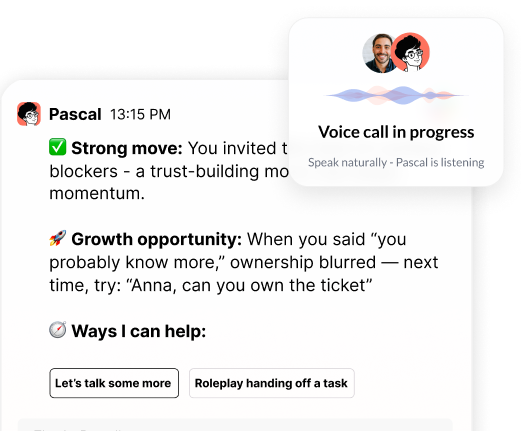
Embedded means your AI coach lives inside the tools managers already use—Slack, Microsoft Teams, Zoom, Google Meet—rather than requiring them to visit a separate portal. Pascal accompanies managers to meetings, sits in their messaging channels, and provides real-time feedback without requiring behavior change.
This integration creates observation of actual work interactions, building context that generic chatbots can't access. Workflow integration means coaching operates where decisions happen. Destination tools require managers to remember, log in, and context-switch.
Embedded systems surface insights automatically after meetings or before difficult conversations. Portals wait for managers to ask. Integration across multiple systems (calendar, communications, meetings) builds accumulated understanding of relationships, challenges, and patterns that deepens over time.
When coaching appears in existing workflows, usage becomes automatic. Managers don't need to remember to seek help. The coach is already there.
Embedded AI coaching drives adoption rates of 60-80% compared to 15-25% for standalone portals that require separate logins. The difference comes down to friction: managers already overwhelmed with tools won't add another destination to their workflow, but they will engage with guidance that appears automatically where they're already working.
Research on workplace tool adoption shows applications requiring separate logins see 70% drop-off within 90 days, while integrated tools maintain 65%+ engagement. The "remember to use it" problem kills most coaching initiatives. Standalone coaching requires conscious effort. Embedded coaching becomes ambient, appearing when managers need it without requiring them to seek it out.
Time-to-value acceleration matters too. Embedded coaches deliver immediate value from meetings already happening. Portals require setup and practice scenarios before managers see benefits.
Initial curiosity drives portal usage for 2-3 weeks. Embedded tools maintain engagement for months.
Embedded vs. Standalone AI Coaching: Feature Comparison
Data Breakdown:
• Feature: Access point | Embedded Coach: Slack, Teams, Zoom | Standalone Portal: Separate login required
• Feature: Context awareness | Embedded Coach: Observes meetings, messages, interactions | Standalone Portal: Only knows what user shares
• Feature: Adoption friction | Embedded Coach: None—already in workflow | Standalone Portal: High—must remember to visit
• Feature: Feedback timing | Embedded Coach: Real-time, proactive | Standalone Portal: Reactive, delayed
• Feature: Manager effort required | Embedded Coach: Zero setup | Standalone Portal: Ongoing context explanation
Embedded coaches produce better outcomes by observing real behavior rather than relying on self-reported scenarios. Pascal's integration into meetings and communications lets it reference specific interactions, identify blind spots managers don't recognize, and provide feedback grounded in actual team dynamics.
Standalone coaches can only work with the information managers choose to share. Embedded systems see what happened in meetings. Standalone tools only know what managers tell them.
Blind spot identification becomes possible when the coach observes real interactions. Patterns managers don't recognize in themselves become visible through behavioral data. Feedback specificity improves: "In yesterday's standup, you interrupted Sarah twice" versus "Here's how to handle interruptions."
In Pascal's customer base of 47 companies, 83% of direct reports notice improvement in their managers' effectiveness within 90 days. This measurable behavior change stems from coaching grounded in actual observed interactions, not hypothetical scenarios.
Managers save 150+ hours annually by eliminating the need to explain context repeatedly. The embedded coach already knows the situation, the people involved, and the history.
Standalone deployment works in specific contexts:
Small organizations (under 50 people) where managers already have tight communication loops and don't need automated observation to stay connected with their teams.
Pilot programs testing AI coaching appetite before committing to full integration. A 30-day standalone pilot with 10 managers costs less and moves faster than negotiating IT access across your tech stack.
Privacy-sensitive environments (healthcare, legal, financial services) where regulatory constraints make meeting observation and message integration legally complex. Standalone coaching with manager-initiated conversations avoids compliance landmines.
Organizations without Slack or Teams that rely on email and in-person communication. Embedding requires modern collaboration tools. If your company runs on Outlook and hallway conversations, standalone makes more sense.
Budget constraints that make integration cost prohibitive. Standalone pilots run $5,000-15,000 for 90 days. Full embedded deployment with IT integration, security review, and change management runs $50,000-100,000 in year one.
The tradeoff: standalone deployment tests interest but won't produce the adoption rates or behavioral data needed to prove ROI. Use it to build executive buy-in, then plan for embedded deployment in year two.
Start with embedded deployment if your goal is sustained adoption and measurable impact. Standalone pilots create false negatives—low usage gets blamed on coaching quality when the real problem is placement.
The false negative problem derails AI coaching initiatives before they start. Standalone pilots fail due to placement, not product quality, leading to wrong conclusions about whether AI coaching works.
Modern APIs make embedded deployment faster than building adoption campaigns for standalone tools. Pascal's integration into Slack, Teams, and Zoom from day one eliminates adoption friction and provides the behavioral data needed to demonstrate ROI.
Change management timing matters. Embedding from the start means one change event. Standalone-then-integrate means two separate rollouts, doubling the organizational disruption.
Data richness requirements for proving ROI demand behavioral data that only embedded systems can capture. Without observing actual meetings and interactions, you can't measure whether managers improve their feedback quality, reduce interruptions, or handle difficult conversations better.
When evaluating vendors, ask about their integration capabilities before assessing coaching quality. A brilliant coaching model trapped in a standalone portal will fail. A good coaching model embedded in workflow will succeed.
After a 1:1 with a struggling report, Pascal DMs you in Slack: "I noticed you gave three pieces of critical feedback in 12 minutes. Here's how to follow up tomorrow to ensure Sarah heard your core message without feeling attacked."
Before a difficult performance conversation, Pascal sends a message: "You're meeting with James in 30 minutes. Based on your last four 1:1s, he responds better to questions than directives. Here are three opening questions to try."
During a team meeting where tension surfaces, Pascal observes but doesn't interrupt. Fifteen minutes after the meeting ends, you get a private message: "That exchange between Maria and Tom showed signs of unresolved conflict from last week's project deadline. Here's how to address it in your next 1:1 with each of them."
The coach doesn't require you to log in, explain context, or remember to ask for help. It observes your work (with your consent), identifies moments where coaching would help, and reaches out proactively. You can ignore suggestions, ask follow-up questions, or request deeper guidance on specific situations.
All coaching conversations remain private to you unless you choose to share insights with your manager or HR. The system never reports your conversations to leadership or uses them for performance evaluation.
AI coaching should sit within a cross-functional committee including HR, IT, and business leaders to align coaching with priorities and ensure technical integration. This placement model creates the accountability and resources needed for successful deployment.
HR owns the coaching strategy, competency frameworks, and success metrics. IT handles technical integration, security compliance, and system maintenance. Business leaders ensure coaching aligns with operational priorities and manager pain points.
Avoid siloing AI coaching within HR alone. Without IT partnership, integration stalls. Without business leader buy-in, managers don't prioritize usage.
Clear ownership prevents the "everyone's responsibility becomes no one's responsibility" problem. Designate an executive sponsor who reports progress to leadership and removes blockers. Assign a program manager who coordinates across functions and drives adoption.
The committee should meet biweekly in the first 90 days, then monthly. The executive sponsor (typically CHRO or COO) chairs meetings and makes final decisions on scope, budget, and rollout timeline. The program manager (typically senior HR business partner or L&D leader) owns day-to-day execution, vendor management, and adoption tracking.
Success metrics should include adoption rates, engagement patterns, manager feedback quality improvements, and direct report satisfaction changes. Track leading indicators monthly, not just annual survey results.
Adoption metrics tell the immediate story. Track daily active users, messages sent to the coach, and meeting integrations enabled. Embedded coaches should see 60%+ weekly active usage within 30 days. Standalone tools rarely exceed 25%.
Engagement depth matters more than surface-level usage. Measure conversation length, follow-up questions asked, and action items completed. Managers who engage deeply show 3x higher improvement rates than those who check in occasionally.
Behavioral change indicators include manager feedback quality scores, direct report engagement survey results, and performance review consistency. Pascal customers track whether managers give more specific, actionable feedback after coaching interventions.
Time savings quantify efficiency gains. Managers using embedded AI coaching report 150+ hours saved annually by eliminating repeated context explanation and getting immediate guidance instead of scheduling coaching sessions.
Business impact metrics connect coaching to outcomes. Track manager retention rates, team productivity measures, and promotion readiness for high-potential managers. Organizations using AI coaching see 20% increases in manager NPS within six months.
Data access negotiations with IT require clear value propositions. Explain exactly what data the AI coach needs (meeting transcripts, Slack messages, calendar information) and why. Emphasize SOC2 compliance and data protection guarantees.
Security and privacy concerns demand transparent answers. Pascal never trains on customer data. Information stays within your organization's instance. Managers can opt out of specific data collection (meeting observation, message monitoring) while still accessing coaching through direct conversation.
What data gets collected: meeting transcripts (with participant consent), Slack/Teams messages in channels where the coach is added (not DMs unless manager initiates), calendar metadata (meeting frequency, duration, participants—not content), and HRIS data (org structure, tenure, role). What doesn't get collected: personal DMs, emails, documents, or any communication where the coach isn't explicitly added.
Consent is obtained at three levels: organizational (leadership approves deployment), team (managers decide whether to add coach to team channels), and individual (each manager controls whether coach observes their meetings and 1:1s).
Change management with managers resistant to observation requires positioning AI coaching as support, not surveillance. Coaching insights remain private to each manager unless they choose to share. The goal is development, not performance monitoring. HR leaders should emphasize that coaching data never feeds into performance reviews or promotion decisions.
Technical integration timelines vary by organization. Plan for 4-8 weeks for full deployment including Slack, Teams, Zoom, and HRIS connections. This timeline includes security review (1-2 weeks), API configuration (1 week), pilot group testing (2 weeks), and phased rollout (2-3 weeks). Phased rollouts reduce risk and allow for adjustment based on early feedback.
Vendor selection criteria should prioritize integration capabilities over coaching model sophistication. A brilliant coach that can't integrate with your tech stack won't drive adoption. Ask vendors for reference customers with similar tech environments and security requirements.
• Embedded AI coaches drive 60-80% adoption compared to 15-25% for standalone portals by eliminating the "remember to use it" problem
• Embedded coaches observe real behavior and identify blind spots managers don't recognize, producing measurably better outcomes than self-reported coaching scenarios
• Standalone deployment makes sense for small organizations, pilot programs, privacy-sensitive environments, and budget-constrained initiatives—but won't produce the data needed to prove ROI
• Cross-functional governance including HR, IT, and business leaders ensures AI coaching aligns with priorities and receives the resources needed for successful integration
• Privacy and consent require three-level opt-in (organizational, team, individual) with clear boundaries on what data gets collected and how it's used
Pascal lives where your managers work—Slack, Teams, Zoom—delivering real-time coaching without requiring them to change their workflow. See how embedded AI coaching transforms manager effectiveness at scale.
Header photo by Vitaly Gariev on Unsplash

.png)
.webp)
“Thank you for setting the great foundation for my promotion; now I have a plan!"

Curious to see how AI Coaching can 10X the impact and scale of your development initiatives. Book a demo today for: