

Most AI coaching tools fail because of placement, not features. Managers don't use tools that require separate logins, extra steps, or remembering to "go somewhere" for help. The question isn't whether AI coaching works—it's whether you'll deploy it where managers actually work.
Placement has two components: technical integration (where the tool lives) and organizational ownership (who runs it).
Technical integration: The platforms managers use 50+ times daily—Slack, Teams, Zoom, email. Coaching embedded here happens in real-time, not as a separate activity.
Data connections: HRIS systems (Workday, BambooHR), performance tools, calendars. These provide context that makes coaching relevant instead of generic.
Organizational ownership: HR/Talent Development owns most deployments. Some companies use joint HR-IT ownership. A few embed coaching within business units. Each model has tradeoffs.
Metrics ownership: Who tracks adoption, behavior change, and ROI. Without clear accountability, you can't prove value at renewal time.
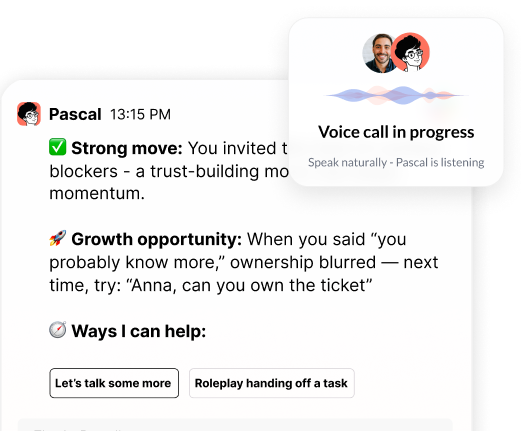
Pascal by Pinnacle joins meetings, sits in Slack and Teams, and pulls signals from your tech stack to deliver coaching when managers need it.
A Forrester study found 78% of enterprise software goes underutilized because of access friction, not missing capabilities. Managers make hundreds of decisions daily. "Remember to check the coaching portal" loses to 47 competing priorities.
The best coaching happens within minutes of the triggering event, not hours later when context fades. An AI coach in Slack can intervene during a difficult conversation. A portal-based tool can't.
Pascal joins your meetings, observes team dynamics, and offers feedback without requiring a separate login.
HR owns coaching strategy, competency frameworks, and success metrics. IT owns security, integration architecture, and data governance. This partnership must start before vendor selection, not after.
Companies that treat AI coaching as "just an HR tool" face delays when IT discovers data access requirements, SSO integration needs, and compliance questions that should have been addressed during procurement.
HR owns: Coaching use cases, competency frameworks, success metrics, change management, user training.
IT owns: Security review (SOC2 compliance, data handling, access controls), technical integration (SSO, HRIS, calendar), infrastructure support.
Joint ownership: Vendor evaluation, pilot design, data privacy policies, escalation protocols for sensitive topics.
Pascal is SOC2 compliant, never trains on customer data, and includes guardrails that escalate sensitive topics to HR.
Warning sign: Vendors who can't explain their data handling, security posture, and integration architecture in the first conversation.
HR/Talent-led (75% of deployments): Works when HR has strong executive sponsorship and can drive adoption through existing talent programs. Excels at consistent manager development and cultural transformation. Can struggle with technical integration and cross-functional adoption.
Joint HR-IT (20% of deployments): Achieves faster deployment and stronger technical integration. Requires more coordination overhead. Works best for companies with strong technical infrastructure and data-driven cultures.
Business unit-embedded (5% of deployments): Delivers contextualized coaching for specific functions (sales, engineering). Proves value quickly. Makes enterprise-wide scaling harder.
Hybrid approach: Start with HR ownership for strategy and metrics, IT partnership for deployment, then expand to business unit champions.
At this scale, you have enough complexity to need consistent coaching standards but not so much bureaucracy that deployment requires 18-month rollouts.
HR leads deployment with strong IT partnership, 2-3 business unit pilots, and a 90-day path to enterprise rollout. Companies with 200-1,000 employees can deploy in 30-60 days. Companies with 1,000-4,000 employees need 60-90 days for phased rollout.
Mid-market HR teams average 1 HR person per 80 employees. AI coaching must reduce HR workload, not add to it.
Integration priorities: HRIS, Slack or Teams, calendar access, performance management system. These four deliver most of the contextual value.
Pilot strategy: Start with 50-100 managers across 2-3 functions. Measure adoption and impact for 60 days, then scale based on data. Pilot with your best managers to prove value, not your weakest.
Portal-first deployment: Launching an AI coach as a separate portal that managers need to remember to visit. This ignores how managers work and kills adoption within 90 days.
HR-only ownership: Deploying without IT involvement leads to security reviews that halt rollout, integration delays that frustrate users, and data access limitations that make coaching generic.
No connection to existing rituals: Failing to embed AI coaching into performance reviews, 1:1s, goal-setting cycles, or leadership development programs. Managers need coaching to feel like part of their existing workflow, not another new initiative.
Launching without champions: Rolling out enterprise-wide without identifying people who will share successes and use cases. Adoption spreads through peer influence, not top-down mandates.
Track three metrics within 90 days: active usage rates above 70%, manager satisfaction improvement, and observable behavior change from direct reports. If you're not seeing these numbers, adjust your placement strategy before you scale.
Active usage: Track weekly active users, not total sign-ups. Embedded AI coaches see 85-94% monthly active usage. Portal-based tools drop to 12-18%.
Manager feedback: Survey managers on whether the AI coach helps them be more effective.
Direct report feedback: The ultimate test is whether direct reports observe improved management behaviors.
HR time saved: AI coaching should reduce HR's routine guidance workload. Measure hours saved on manager support, coaching requests, and performance conversation prep.
• AI coaches embedded in Slack, Teams, and Zoom achieve 85-94% adoption versus 12-18% for portal-based tools
• HR owns coaching strategy and success metrics, IT owns security and integration—the partnership must start before vendor selection
• Mid-market companies (200-4,000 employees) see fastest ROI with HR-led deployment, IT partnership, 2-3 business unit pilots, and 60-90 day rollout
• The three adoption killers: portal-first deployment, HR-only ownership without IT partnership, and failing to connect coaching to existing talent rituals
• Measure placement effectiveness through 90-day metrics: 70%+ active usage, manager satisfaction improvement, and observable behavior change from direct reports
The placement question isn't about where the AI coach sits on your org chart. It's about whether coaching becomes a daily habit or another abandoned tool. See how Pascal works inside Slack to deliver coaching where your managers actually work.
Header photo by Vitaly Gariev on Unsplash

.png)
.webp)
“Thank you for setting the great foundation for my promotion; now I have a plan!"

Curious to see how AI Coaching can 10X the impact and scale of your development initiatives. Book a demo today for: