

Organizations should choose AI coaching when they need scalable manager development that drives measurable behavior change, not when they need compliance training or technical skills transfer. The decision depends on whether learning must happen during actual work, whether personalization matters more than standardization, and whether you need ROI proof within 90 days.
AI coaching provides real-time guidance during actual work situations. Traditional training delivers standardized content in scheduled sessions disconnected from daily challenges.
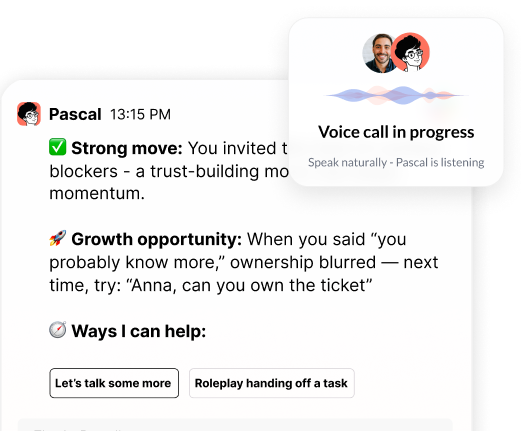
Traditional training follows a scheduled event model: quarterly workshops, annual programs, passive content consumption. Application happens weeks or months after learning, if at all. AI coaching is available 24/7 in Slack, Teams, and Zoom. It delivers personalized guidance based on individual context, enables practice with immediate feedback, and provides application during the actual meeting or decision.
The learning science difference: traditional training shows 10-20% knowledge retention after 6 weeks. AI coaching embeds learning in the moment of need, when retention peaks. Traditional executive coaching costs $300-500 per hour and reaches only senior leaders. AI coaching costs 1% of traditional coaching while scaling to every manager.
Consider a new manager facing a difficult performance conversation. She can't wait for next quarter's workshop. She needs guidance now—before the meeting, during it, and in the follow-up. AI coaching meets her in that moment.
AI Coaching vs. Traditional Training
Data Breakdown:
• Dimension: Availability | Traditional Training: Scheduled (quarterly/annual) | AI Coaching: 24/7, in-the-flow
• Dimension: Personalization | Traditional Training: Standardized curriculum | AI Coaching: Adapts to individual context
• Dimension: Cost per person | Traditional Training: $300-500/hour (executive coaching) | AI Coaching: $8-15/month
• Dimension: Retention rate | Traditional Training: 10-20% after 6 weeks | AI Coaching: Applied immediately in real situations
• Dimension: Reach | Traditional Training: Senior leaders only | AI Coaching: Every manager and employee
• Dimension: Feedback timing | Traditional Training: Weeks/months after learning | AI Coaching: Real-time, during actual work
Your organization is ready for AI coaching when managers face high-frequency, context-dependent challenges that require personalized guidance, not standardized knowledge. Three signals indicate AI coaching will outperform traditional training: your managers need help with real-time decisions rather than foundational concepts, your training utilization rates are below 30%, and your CHRO is being asked to prove L&D ROI within a fiscal quarter.
Signal 1: High-frequency, low-stakes practice needs. New managers need to practice delegation, feedback, and conflict resolution dozens of times before mastering them. Traditional training offers 2-3 role-plays in a workshop. AI coaching provides practice in actual work situations, creating 20-30 coaching moments per week per manager.
Signal 2: Training utilization crisis. If your LinkedIn Learning completion rates are below 30% or your LMS shows 15% active usage, you have a utilization problem, not a content problem. AI coaching solves this by embedding guidance where work happens—Slack, Teams, Zoom—rather than requiring employees to "go somewhere" to learn.
Signal 3: Distributed or hybrid workforce. When managers and teams work across time zones or locations, synchronous training becomes impossible and expensive. AI coaching provides development regardless of geography. Organizations with 200-4,000 employees in tech, professional services, and life sciences see the fastest ROI here.
Signal 4: Manager effectiveness is your top engagement survey issue. If "quality of management" or "career development" rank as top concerns, traditional training hasn't solved the problem. Melinda Wolfe, former CHRO at Bloomberg, Pearson, and GLG, notes: "If we have an innovation right now, it's incumbent upon us as HR leaders to show our companies an economic and effective way to help managers."
Signal 5: You need behavior change, not knowledge transfer. Traditional training excels at compliance, onboarding, and technical skills. AI coaching excels at behavioral competencies—communication, leadership presence, emotional intelligence—that require repeated practice and personalized feedback.
Traditional training remains the right choice for compliance requirements, foundational technical skills, company-wide culture initiatives, and situations where human connection is the primary goal.
Harassment prevention training, safety protocols, and regulatory compliance need standardized delivery and documentation. Software training, process documentation, and technical onboarding benefit from structured curriculum. Company-wide culture initiatives requiring shared experience work better in person.
The key distinction: traditional training works when everyone needs the same information delivered the same way. AI coaching works when individuals need different guidance based on their context, challenges, and development stage.
Budget limitations, HRBP capacity constraints, and speed-to-impact requirements make AI coaching the only viable option for scaling manager development in mid-sized organizations.
Budget constraint: Traditional coaching costs $15,000-25,000 per manager annually. At 200 managers, that's $3-5M—impossible for most mid-market companies. AI coaching costs $8-15 per user per month, or $1,800-3,600 annually for 200 managers.
HRBP capacity constraint: The typical HRBP-to-employee ratio is 1:100. At a 500-person company, that's 5 HRBPs trying to support 75-100 managers. They can't provide real-time coaching at scale. AI coaching handles routine guidance—delegation questions, feedback preparation, meeting support—allowing HRBPs to focus on complex, high-stakes situations.
Speed-to-impact constraint: Traditional training programs take 6-12 months to design, pilot, and scale. AI coaching can be deployed in 30-45 days and shows measurable behavior change within 60-90 days.
Utilization constraint: Companies invest in learning platforms like LinkedIn Learning, Udemy, and internal LMS that show 10-20% active usage. AI coaching achieves 70-85% utilization because it meets people where they work.
AI coaching ROI shows up in three measurable areas: reduced spending on underutilized learning platforms and coaching programs, improved manager effectiveness scores in engagement surveys, and decreased time-to-competency for new managers. Establish baseline metrics before implementation and track changes quarterly.
Cost replacement metrics: Calculate current spending on executive coaching, learning platforms with low utilization, and external training programs. AI coaching replaces 40-60% of these costs while reaching 10x more employees. A 500-person organization spending $200K annually on learning platforms with 15% utilization can redirect that budget to AI coaching reaching 300+ managers.
Manager effectiveness metrics: Track engagement survey scores on "quality of management" and "career development" before and after AI coaching implementation. Track direct report feedback on manager communication, delegation, and feedback quality.
Time-to-competency metrics: Measure how long new managers take to demonstrate proficiency in core competencies like delegation, feedback delivery, and conflict resolution. AI coaching reduces time-to-competency by 30-40% by providing practice and immediate feedback.
Business impact metrics: Connect manager development to business outcomes. Track team productivity, retention rates, and promotion readiness.
Start with a focused pilot targeting 20-30 managers facing the highest-frequency coaching needs, measure behavior changes over 90 days, and scale based on proof points. Organizations that succeed with AI coaching treat it as a behavior change initiative, not a technology deployment.
Phase 1: Pilot (30-60 days). Select managers who are motivated to improve—new managers, high-performers taking on bigger roles, or managers with development needs identified in performance reviews. Provide clear guidance on how to use the AI coach and what behaviors to practice. Set goals like "practice delegation in 5 conversations" or "get feedback on 3 difficult conversations."
Phase 2: Measure (60-90 days). Track usage data, collect qualitative feedback from managers and their direct reports, and measure behavior change through 360 feedback or manager effectiveness surveys. Look for leading indicators like increased feedback frequency, improved meeting effectiveness, and higher team engagement.
Phase 3: Scale (90-180 days). Share success stories and examples of behavior change. Train HRBPs and L&D teams to support AI coaching adoption. Integrate AI coaching into existing manager development programs and onboarding processes. Make it the default support tool for managers, not an optional add-on.
Critical success factors: Executive sponsorship from the CHRO or Chief People Officer, clear communication about privacy and data use, integration with existing workflows rather than creating new ones, and reinforcement through manager communities and peer learning.
Enterprise-grade AI coaching requires SOC2 compliance, clear data governance policies, and transparency about how employee data is used and protected. The most critical question: does the vendor use your company's data to train their models? The answer must be no.
Address three key concerns with employees: what data the AI coach accesses, how that data is used and protected, and who can see individual coaching conversations. The answer to the last question should be "no one except the individual employee." HR teams see only aggregated trends, not individual interactions.
• AI coaching delivers ROI when organizations need scalable manager development that drives measurable behavior change within 90 days
• Choose AI coaching over traditional training when managers face high-frequency, context-dependent challenges requiring personalized guidance in the flow of work
• Budget constraints, HRBP capacity limitations, and speed-to-impact requirements make AI coaching the only viable option for mid-sized organizations scaling manager development
• Traditional training remains the right choice for compliance requirements, foundational technical skills, and company-wide culture initiatives requiring standardized delivery
• Implementation starts with a focused 20-30 manager pilot, measures behavior changes over 90 days, and scales based on proof points
• Enterprise-grade AI coaching requires SOC2 compliance, clear data governance, and a privacy-first approach where customer data never trains models
We built Pinnacle to solve this problem. Our AI coaching platform works inside Slack, Teams, and Zoom to deliver real-time coaching at scale. Visit heypinnacle.com to learn more.
Header photo by Vitaly Gariev on Unsplash

.png)
.webp)
“Thank you for setting the great foundation for my promotion; now I have a plan!"

Curious to see how AI Coaching can 10X the impact and scale of your development initiatives. Book a demo today for: