

Most AI coaching pilots succeed. Most enterprise rollouts fail. The difference isn't the technology—it's whether the vendor can maintain quality, relevance, and security as you expand from 50 users to 5,000.
Scale-ready vendors demonstrate five capabilities: coaching expertise grounded in behavioral science, contextual awareness of your people and workflows, integration into daily tools, guardrails for sensitive topics, and proof of sustained adoption beyond 90 days.
Scale-ready means the platform maintains coaching quality as you expand across departments, locations, and seniority levels. Three factors determine readiness:
Infrastructure: The system handles concurrent users, meeting integrations, and real-time processing without performance degradation. A vendor supporting 50 pilot users may collapse at 500.
Customization: The platform adapts to different departments, competency frameworks, and role-specific needs without separate implementations. Engineering managers need different coaching than sales leaders.
Support model: The vendor provides implementation resources, change management guidance, and ongoing optimization. Successful deployment requires partnership, not just software.
Ask vendors: How many concurrent users have you supported? What's your largest single deployment? How long did implementation take?
Yes. Generic AI tools mimic coaching language but lack structured methodologies that drive behavior change.
Purpose-built platforms are trained on coaching frameworks (situational leadership, growth mindset, psychological safety) by credentialed professionals. When a manager asks how to deliver critical feedback, a generic tool provides surface-level tips. A purpose-built platform guides them through a structured approach grounded in behavioral science.
Former Bloomberg CHRO Melinda Wolfe notes that effective coaching "makes it easier not to make mistakes and gives you frameworks to think through problems before you act." Frameworks versus conversation—that's the difference.
Ask vendors: Who trained your coaching models? What frameworks does your platform reference? Show me how you handle a nuanced scenario like navigating team conflict.
Managers abandon tools that don't understand their reality. Without context, AI coaching becomes generic advice they ignore.
Contextual awareness means the platform knows:
• Your competency models, values, and internal frameworks
• Team dynamics, performance history, and relationship patterns
• Current challenges (upcoming 1-on-1s, performance review cycles, detected tension)
Advanced platforms observe actual interactions (meetings, communications) rather than relying on self-reported information. They ingest performance review data, career goals, and role-specific requirements to build a knowledge graph of your organization.
A manager preparing for a difficult conversation needs guidance that reflects their team's history, the individual's performance trajectory, and your company's values—not generic conflict resolution tips.
Ask vendors: How do you gather context? What data sources do you integrate? Show me an example of context-specific guidance versus generic advice.
If managers must leave their workflow to access coaching, usage plummets within weeks. Scale-ready vendors meet managers where they work.
Look for platforms that:
• Operate within Slack or Microsoft Teams (not separate apps)
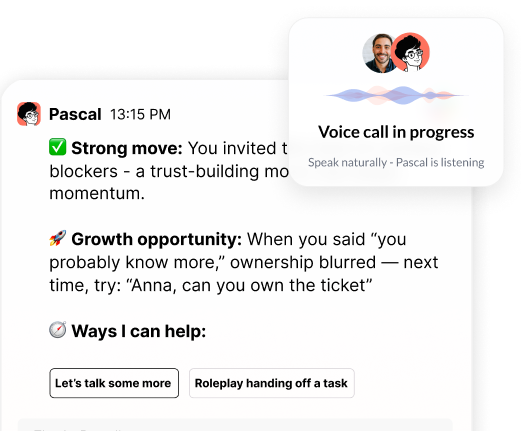
• Join video calls to observe interactions and provide real-time feedback
• Surface proactive guidance based on observed situations (not just reactive Q&A)
• Pull data from your HRIS, performance management system, and learning platforms
Workflow-embedded coaching achieves 3-4x higher adoption than standalone apps because it eliminates friction and creates consistent habits.
Ask vendors: Where does your platform live? How do managers access coaching during their workday? Show me what proactive engagement looks like.
Guardrails separate responsible AI deployment from organizational risk. Scale-ready vendors have explicit protocols for situations requiring human expertise: harassment claims, mental health crises, legal concerns, ethical dilemmas.
The system should:
• Automatically detect sensitive topics and escalate to appropriate experts (HR business partners, legal counsel, employee assistance programs)
• Meet SOC2 compliance standards for enterprise-grade security
• Never train models on your company's data (your conversations remain confidential)
This isn't about limiting AI's capabilities—it's about deploying it responsibly.
Ask vendors: What topics trigger escalation? Who receives escalated issues? Are you SOC2 compliant? Do you train models on customer data?
Proof points separate marketing claims from measurable impact. Scale-ready vendors provide specific metrics: percentage improvement in direct report satisfaction, hours saved per manager, changes in performance review quality.
Look for evidence of:
• Deployment across at least 200 employees (pilot success doesn't predict scale success)
• Sustained engagement beyond 90 days (60-70% is strong; most tools see abandonment after initial curiosity)
• Behavioral outcomes measured through 360 feedback, time tracking, and engagement data (not survey responses about intent)
Ask vendors: Show me case studies at my scale. What's your 90-day engagement rate? How do you measure behavior change?
Generic frameworks conflict with your existing programs. Scale-ready vendors let you embed company-specific competencies, values, training materials, policies, and internal frameworks.
The platform should:
• Incorporate your performance review templates, career progression frameworks, and leadership models
• Tag content by department and function level (individual contributors need different support than executives)
• Speak your company's language (not force managers to translate between the platform's terminology and your internal vocabulary)
Ask vendors: Can I upload company documents? How do you handle department-specific needs? Show me how you incorporate our competency model.
Vendors building enterprise-ready AI coaching surround themselves with practitioners who've led large-scale transformations. Advisory boards composed of experienced CHROs provide reality checks on product direction and deployment strategy.
When you evaluate vendors, ask: Who guides your product roadmap? Have those advisors led deployments at our scale? Are your coaching models trained by credentialed professionals?
The combination of practitioner guidance and coaching expertise creates platforms that work in real organizational contexts. Generic AI tools built by engineers without HR input miss the nuances that determine whether managers trust and apply the guidance.
Pricing models reveal whether vendors expect sustained engagement or anticipate high churn. Scale-ready vendors offer company-wide licensing that reduces per-person costs as you expand.
Traditional executive coaching costs $200-500 per hour, limiting access to senior leaders. AI coaching platforms make it economically feasible to provide coaching to every manager, not just executives.
Ask vendors: How does pricing change at scale? What's your pilot structure? Do you offer flexible expansion based on results?
• Scale-ready vendors prove it: Look for deployments across 200+ employees, 60-70% sustained engagement at 90 days, and measurable behavior change through 360 feedback—not pilot testimonials.
• Context drives adoption: Platforms that observe actual interactions and ingest company-specific frameworks provide relevant guidance managers use consistently. Context-free tools get abandoned.
• Integration predicts success: Coaching embedded in Slack, Teams, and meetings achieves 3-4x higher adoption than standalone apps because it eliminates friction.
• Guardrails protect organizations: SOC2-compliant platforms with explicit escalation protocols enable responsible AI deployment without legal or ethical risks.
• Expertise matters: Platforms trained on coaching frameworks by credentialed professionals deliver guidance managers trust and apply, unlike generic AI tools.
Most AI coaching vendors make similar promises. The ones ready to scale demonstrate these capabilities through customer proof points, not marketing claims. They've built platforms managers actually use because the coaching happens in the flow of work, understands your specific context, and provides guidance grounded in behavioral science.
See how AI coaching scales across organizations at Pinnacle.
Header photo by Vitaly Gariev on Unsplash

.png)
.webp)
“Thank you for setting the great foundation for my promotion; now I have a plan!"

Curious to see how AI Coaching can 10X the impact and scale of your development initiatives. Book a demo today for: