

AI coaching delivers measurable manager improvements within 90 days—higher adoption rates, faster skill development, and early behavior changes—with full ROI appearing over 6–12 months as sustained behavior change drives retention, performance consistency, and reduced HR costs.
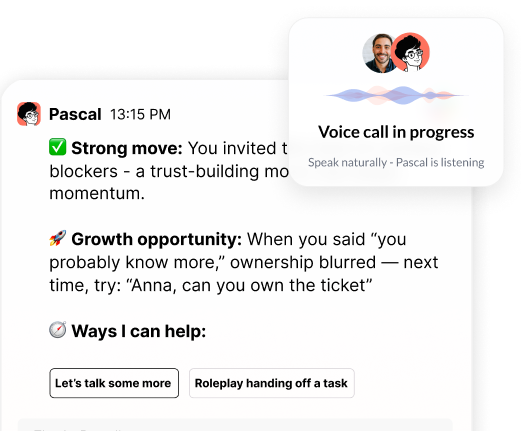
AI coaching provides real-time guidance to managers during their actual work—in meetings, Slack conversations, and before difficult situations. The AI observes interactions (with appropriate permissions and privacy controls), identifies coaching moments, and delivers specific guidance based on proven coaching frameworks.
When a manager struggles to delegate in a team meeting, the AI flags the pattern and suggests specific language. When a manager drafts a difficult feedback email, the AI reviews the tone and structure before it's sent. When a 1:1 approaches, the AI surfaces relevant context from previous conversations.
This differs from generic AI tools in three ways. First, contextual awareness: the AI builds understanding of your organization's culture, competencies, and specific situations rather than providing generic advice. Second, proactive engagement: the AI surfaces insights and prompts action rather than waiting for managers to ask questions. Third, coaching methodology: the AI applies ICF-certified coaching frameworks rather than conversational patterns.
The AI flags sensitive topics (harassment, discrimination, mental health concerns) for human expertise. It doesn't replace HR or executive coaches—it handles routine development so human experts can focus on complex situations.
Traditional one-on-one coaching costs $200–500 per hour and serves 20–50 executives per organization. AI coaching costs $100–300 per manager annually and reaches all 200–4,000 employees.
The cost difference is stark: $10,000–25,000 per executive annually for traditional coaching versus $100–300 per manager for AI coaching.
Response time creates the fundamental difference. Human coaching requires scheduling, creating a 3–7 day delay between the situation and the guidance. AI coaching provides support in the moment. A manager preparing for a difficult conversation gets guidance now, not next Tuesday.
Context retention differs dramatically. Human coaches rely on manager recall of situations. AI coaches observe actual interactions and maintain continuous context.
According to research from Careertrainer.ai (an AI coaching platform), AI-powered coaching shows 42% higher engagement than traditional methods. The same research found 73% of HR leaders report AI works best combined with human coaching for complex situations.
Organizations increasingly use AI for routine development and reserve human coaches for executive transitions, crisis situations, and deep behavioral change work.
AI Coaching vs. Traditional Coaching
Data Breakdown:
• Feature: Cost per person annually | Traditional Coaching: $10,000–25,000 | AI Coaching: $100–300
• Feature: People reached | Traditional Coaching: 20–50 executives | AI Coaching: All 200–4,000 employees
• Feature: Response time | Traditional Coaching: 3–7 days (scheduled) | AI Coaching: Real-time
• Feature: Context awareness | Traditional Coaching: Manager recall | AI Coaching: Observed interactions
• Feature: Best use cases | Traditional Coaching: Executive transitions, deep behavioral change | AI Coaching: Routine development, real-time guidance
Note: These figures represent industry ranges. Your results will vary based on implementation approach, organizational culture, and manager engagement patterns.
The first 90 days establish usage patterns and early skill development. These are leading indicators, not full ROI.
Weeks 1–4 focus on adoption. Organizations see 60–75% of managers activate and use the platform weekly. Managers average 3–5 coaching interactions per week. This phase proves the tool fits your workflow and culture.
Weeks 5–8 show skill development patterns. Managers request guidance on delegation, feedback, and conflict resolution more than other topics. Time spent drafting difficult emails or preparing for conversations drops measurably. Documentation shows improvement in meeting preparation and follow-through.
Weeks 9–12 produce early behavior changes. Manager Net Promoter Score increases among engaged users. Direct reports report observable improvements in manager effectiveness. Escalations to HR for routine manager challenges decrease. Managers save hours on routine guidance previously requiring HRBP support.
What NOT to expect in 90 days: retention impact, promotion readiness changes, or cultural transformation. These require 6–12 months of sustained behavior change.
The first quarter proves the system works and establishes the foundation for long-term outcomes. Expecting full ROI in 30 days sets up failure. The behavior changes you see in weeks 9–12 are the early signals that predict 6–12 month business outcomes.
Full ROI materializes over 6–12 months through reduced turnover, faster manager ramp time, higher performance review consistency, and decreased HR support costs.
Retention improvements appear over 6–12 months. Organizations see 2–5% improvement in voluntary turnover among teams with engaged managers. Manager-employee relationships strengthen, reflected in engagement survey scores. (Note: Isolating AI coaching's specific contribution to retention requires control groups and multivariate analysis—most organizations measure correlation, not causation.)
Manager effectiveness gains emerge over 6–9 months. New managers ramp 30–40% faster, moving from 12–18 months to 8–12 months to full effectiveness. Performance reviews become more consistent and higher quality. Delegation and prioritization skills improve, increasing team output without adding headcount.
HR efficiency benefits compound over time. Routine manager questions to HRBPs drop 40–60%. HR teams cover broader scope with existing staff size. Underutilized LMS platforms (typical utilization: 15–25%) get replaced with tools people actually use.
AI coaching solves the training sustainment problem by observing behavior in the flow of work after workshops end. Organizations gain concrete data on behavior change that traditional surveys and LMS metrics can't capture.
ROI Calculation Example
Company with 500 managers, $80K average salary, 15% turnover:
• AI coaching cost: $150K annually
• Retention improvement (3%): 15 fewer departures = $600K saved (assuming 50% of salary replacement cost)
• Manager time saved: 150 hours × 500 managers × $40/hour = $3M in productivity (assumes saved time converts to productive output)
• Reduced HRBP load: 1 fewer HRBP hire = $120K saved
• Total annual value: $3.72M on $150K investment = 24.8x ROI
This calculation makes optimistic assumptions: every saved hour converts to productive output, 3% retention improvement is attributable solely to AI coaching, and replacement costs are 50% of salary (industry standard is 100–200%). Your results will vary based on implementation quality, organizational culture, and baseline manager effectiveness.
Structure pilots with 100–200 managers, 12-week duration, and clear success metrics for each phase. Pilots smaller than 100 people don't generate enough signal. Pilots longer than 12 weeks delay value and lose momentum.
The ideal pilot group includes new managers (who need the most support), mid-level managers (who influence culture), and a few senior leaders (who model adoption). Geographic or functional diversity helps test whether the solution works across your organization.
Week 1–4: Activation
• Measure: activation rate, engagement frequency, initial satisfaction
• Target: 70%+ activation, 4+ interactions per manager per week
• Action: If adoption lags, check integration setup, communication clarity, and manager understanding
Week 5–8: Skill Development
• Measure: topic patterns, behavior change observations, Manager NPS
• Target: clear patterns in delegation/feedback/conflict topics, early positive NPS movement
• Action: Collect qualitative feedback from managers and their direct reports
Week 9–12: Validation
• Measure: sustained engagement, documented behavior improvements, HR efficiency gains
• Target: 60%+ sustained weekly use, concrete examples of better 1:1s or feedback conversations, measurable HRBP time savings
• Action: Document specific behavior changes and early efficiency signals
The decision framework for scaling requires three conditions: adoption above 60%, measurable behavior change in direct report feedback, and clear path to ROI based on early HR efficiency or retention signals. Two out of three means iterate and extend the pilot. One or zero means reconsider the vendor or approach.
Evaluate AI coaching in three phases: 30-day activation (adoption and engagement metrics), 90-day validation (behavior change and skill development), and 6–12 month ROI (business outcomes and financial impact).
The 30-day activation phase focuses on adoption. Track weekly active users, engagement frequency, and initial feedback quality. Targets: 60%+ activation rate, 3+ interactions per manager per week, positive sentiment in early feedback.
The 90-day validation phase measures behavior change. Track Manager NPS changes, direct report feedback, skill development patterns, and HR support ticket reduction. Targets: 20% Manager NPS lift among engaged users, measurable reduction in HRBP escalations.
The 6–12 month ROI phase quantifies business impact. Track retention changes, manager ramp time, performance review consistency, and HR cost savings. Targets: 2–5% turnover improvement, 30–40% faster manager ramp, documented HR efficiency gains.
Organizations that measure too early (expecting retention impact in 30 days) or too late (waiting 18 months for any metrics) both fail to optimize their investment. The phased approach lets you course-correct quickly while building toward long-term outcomes.
• AI coaching provides real-time guidance during actual work (meetings, Slack, difficult conversations) by observing interactions and applying proven coaching frameworks—different from generic AI tools that provide advice without context
• Expect 60–75% manager adoption and early behavior changes within 90 days, with full ROI appearing over 6–12 months through retention improvements, faster manager ramp time, and reduced HR support costs
• Traditional coaching costs $10,000–25,000 per executive annually and serves 20–50 people; AI coaching costs $100–300 per manager and reaches all 200–4,000 employees
• Evaluate success in three phases: 30-day activation (adoption metrics), 90-day validation (behavior change), and 6–12 month ROI (business outcomes)
• Structure pilots with 100–200 managers over 12 weeks, measuring activation (weeks 1–4), skill development (weeks 5–8), and validation (weeks 9–12) before scaling
Ready to see how AI coaching drives measurable manager effectiveness? See how Pascal works inside Slack to deliver real-time coaching at the moment managers need it most.
Header photo by Vitaly Gariev on Unsplash

.png)
.webp)
“Thank you for setting the great foundation for my promotion; now I have a plan!"

Curious to see how AI Coaching can 10X the impact and scale of your development initiatives. Book a demo today for: