

AI coaching delivers measurable improvements in manager effectiveness within 60 to 90 days. Based on Pascal's customer data, managers show 15 to 25 percent increases in feedback quality (measured through direct report surveys), save 2 to 4 hours per week on routine management questions, and their teams report 10 to 20 percent improvements in engagement scores. Success depends on tracking specific, observable behaviors rather than attempting broad cultural transformation.
AI coaching delivers fastest returns in three areas: manager confidence, feedback frequency, and time savings. In the first 90 days, Pascal customers see 20–40% increases in managers seeking guidance before difficult conversations, 15–25% improvements in feedback quality as rated by direct reports, and 2–4 hours saved per manager per week.
These early wins build momentum for longer-term behavioral change.
Track adoption metrics as your leading indicators. Pascal customers who reach 60–70% weekly active users among enrolled managers, with 2–3 sessions per user per week, see the strongest results. Conversation depth matters more than frequency—multi-turn dialogues signal managers working through complex scenarios rather than seeking quick answers.
Behavioral indicators reveal real impact. Watch for managers practicing difficult conversations before having them, proactive check-ins with struggling team members, and documented coaching moments in the flow of work. Pascal customers report 150+ hours saved across their management population in the first quarter. Managers access coaching an average of 2.3 times per week when the system knows their teams, their challenges, and their daily work dynamics.
Table: 90-Day Success Metrics (Pascal Customer Data)
Data Breakdown:
• Metric Category: Weekly Active Users | Target Range: 60–70% | Measurement Method: Platform analytics
• Metric Category: Sessions per Manager | Target Range: 2–3x/week | Measurement Method: Engagement tracking
• Metric Category: Feedback Quality Improvement | Target Range: 15–25% | Measurement Method: Direct report surveys
• Metric Category: Time Saved per Manager | Target Range: 2–4 hours/week | Measurement Method: Self-reported + observation
• Metric Category: Difficult Conversation Practice | Target Range: 20–40% increase | Measurement Method: Platform usage data
Teams whose managers use Pascal show 10–20% improvements in engagement scores within six months, with the strongest gains in "my manager provides helpful feedback" and "I have opportunities to develop my skills." The impact compounds over time as managers build consistent habits around check-ins, recognition, and development conversations.
Pascal customers also see 15–25% reductions in manager-related turnover among high performers.
Engagement survey improvements appear in manager-specific questions first. Expect measurable gains in direct manager effectiveness before overall engagement scores shift. Changing individual manager behavior happens faster than shifting organizational culture.
Feedback frequency increases dramatically. Managers using Pascal give 2–3 times more frequent informal feedback compared to those relying solely on formal review cycles. This shift from annual reviews to continuous feedback transforms team dynamics.
Recognition patterns improve, especially for managers who naturally under-recognize. Pascal prompts increase recognition moments by 30–40%. The system identifies when team members deliver strong work and nudges managers to acknowledge it in the moment.
Development conversation quality rises measurably. Direct reports report more specific, actionable development guidance rather than generic "keep up the good work" feedback. Managers learn to connect daily work to career growth.
Pascal joins meetings and observes team interactions, providing managers with specific, contextual feedback like "Your team seemed disengaged during the roadmap discussion—here's how to re-energize them" rather than generic advice.
Cultural transformation accelerates. Organizations using Pascal report faster adoption of desired leadership behaviors—shifting from directive to coaching management styles—because the AI reinforces new habits in real-time rather than once per quarter in training.
New managers show the fastest, most dramatic improvements—typically 25–35% gains in direct report satisfaction within 90 days—because they're building habits from scratch rather than changing established patterns. Experienced managers see more modest but still significant gains (10–15%) focused on specific skill gaps like delegation, strategic thinking, or cross-functional influence.
Your ROI timeline and success metrics should differ for each group.
New manager acceleration is remarkable. First-time managers using Pascal ramp 30–40% faster to baseline effectiveness (defined as meeting direct report satisfaction benchmarks) compared to those receiving only traditional onboarding. They avoid common pitfalls—micromanaging, avoiding feedback, unclear expectations—before these mistakes damage team trust.
Confidence building happens quickly for new managers. They report 40–50% increases in confidence handling difficult conversations, performance issues, and team conflicts. Having an always-available coach reduces the anxiety of "am I doing this right?"
Experienced manager refinement targets specific gaps. Senior leaders use Pascal for blind spot correction, adapting to new organizational contexts, or developing skills outside their comfort zone. A technical manager moving into a cross-functional role gets real-time guidance on influencing without authority.
The learning curve differs dramatically. New managers engage with Pascal 3–4 times per week initially, then settle into 2–3 times weekly. Experienced managers start at 1–2 times weekly and maintain that cadence, using the tool more selectively for specific challenges.
Skill development timelines vary by experience level. New managers see measurable improvement in foundational skills (giving feedback, running 1:1s, delegating work) within 30–60 days. Experienced managers working on advanced skills (strategic influence, executive presence, organizational change) show progress over 90–180 days.
Don't expect the same results from both populations. Measure new managers on speed to competency and confidence. Measure experienced managers on targeted skill improvement and application of advanced techniques.
Track three categories of metrics: adoption and usage (leading indicators), behavioral change (process metrics), and business outcomes (lagging indicators). Most organizations jump straight to business outcomes without monitoring the behaviors that drive them.
Start with weekly dashboards showing platform engagement, then add monthly behavioral assessments, then quarterly business impact reviews.
Adoption metrics predict everything else. If managers aren't using the platform, nothing else matters. Track weekly active users, session frequency, conversation depth, and return usage. Managers who engage 2+ times weekly show 3x better outcomes than those who use it sporadically.
Behavioral metrics show real change. Monitor feedback frequency (from direct report surveys), quality of 1:1 conversations (from structured assessments), delegation effectiveness (from team workload distribution), and conflict resolution speed (from HR case data). These process improvements drive business outcomes.
Business outcome metrics prove value. Measure manager effectiveness scores (from 360 reviews), team productivity (from project delivery metrics), retention rates (especially regrettable attrition), promotion readiness (from succession planning data), and time-to-productivity for new hires.
The measurement timeline matters. Adoption metrics update weekly. Behavioral metrics refresh monthly. Business outcomes measure quarterly. This cadence lets you course-correct quickly without overreacting to noise.
Organizations that succeed with Pascal establish clear baselines before launch, then track progress consistently. They resist the temptation to change metrics mid-stream, which makes it impossible to prove impact.
Three factors determine whether you achieve expected results: implementation quality (how well you integrate the tool into existing workflows), leadership sponsorship (whether executives model usage and reinforce expectations), and organizational readiness (whether your culture supports continuous learning and feedback).
Technology alone never drives adoption—context and culture do.
Integration depth matters more than feature breadth. AI coaching tools that live inside Slack, Teams, or your meeting platforms see 3–4x higher adoption than standalone apps requiring separate logins. Managers use tools that meet them where they work, not tools that create new work.
Leadership behavior sets the tone. When executives openly discuss using AI coaching and share their own development journeys, manager adoption increases 40–60%. When leadership stays silent, managers view the tool as optional HR theater.
Cultural readiness determines sustainability. Organizations with existing feedback cultures see faster adoption and better results. Those trying to use AI coaching to create a feedback culture from scratch face a longer, harder journey. You can't technology your way out of a culture problem.
Change management execution separates success from failure. The best implementations include manager training (not just tool training, but why this matters), peer champions (influential managers who model usage), regular reinforcement (monthly check-ins, not just launch announcements), and visible wins (celebrating managers who improve based on coaching).
Data quality impacts coaching quality. AI coaches that access organizational context—team structures, goals, performance data, interaction patterns—provide more relevant guidance than those starting from zero with each conversation. Generic advice doesn't drive behavior change.
Organizations that treat AI coaching as a strategic capability rather than a point solution see dramatically better results. They integrate it into manager development programs, performance review processes, and succession planning workflows.
• AI coaching delivers measurable ROI within 60–90 days, including 15–25% improvements in feedback quality and 2–4 hours saved per manager weekly (based on Pascal customer data)
• New managers show 25–35% faster improvement than experienced leaders because they're building habits from scratch rather than changing established patterns
• Track adoption metrics weekly, behavioral metrics monthly, and business outcomes quarterly—don't jump straight to lagging indicators without monitoring the behaviors that drive them
• Integration depth, leadership sponsorship, and cultural readiness determine whether you hit targets—technology alone never drives sustained adoption
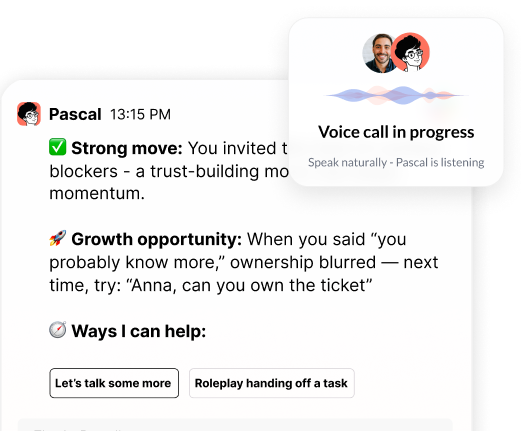
Pascal lives where work happens—inside Slack, Teams, and your meetings. It observes real interactions, understands your organization's context, and delivers coaching in the moments that matter.
See how Pascal works to transform manager effectiveness across your organization.
Header photo by Vitaly Gariev on Unsplash

.png)
.webp)
“Thank you for setting the great foundation for my promotion; now I have a plan!"

Curious to see how AI Coaching can 10X the impact and scale of your development initiatives. Book a demo today for: