

AI coaching delivers results in three phases: managers adopt the tool and build usage habits (weeks 1–4), direct reports notice changes in how their managers lead (weeks 5–12), and business metrics improve (months 4–6). Organizations using workflow-integrated AI coaching see 60–75% of managers engage weekly within 30 days, compared to 15–25% for standalone platforms.
The difference between success and failure shows up in the first month. Weekly active usage predicts ROI better than any other metric.
Track five leading indicators:
• Weekly active usage among target managers (aim for 60% by week 4)
• Interactions per user (8–12 per week signals real engagement vs. 1–2 for testing)
• Time to first use (how fast managers ask substantive questions)
• Repeat usage (managers returning within 48 hours form habits)
• Response to proactive outreach (when the AI reaches out after meetings, do managers engage?)
Workflow integration drives adoption. Tools that live in Slack, Teams, or email see 3–4x higher sustained engagement than standalone platforms requiring separate logins (Forrester, "The State of Workflow Integration," 2025). Managers don't remember to log into another dashboard. They respond to a message in Slack.
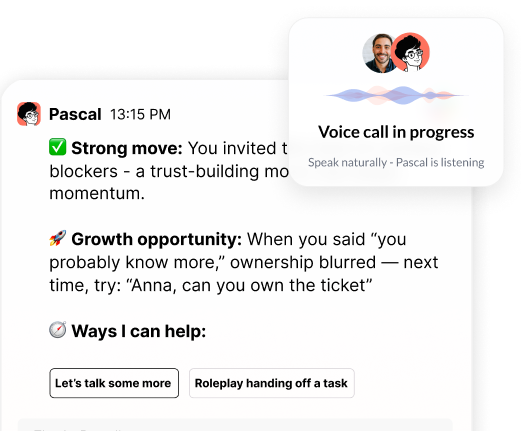
Pascal joins meetings through calendar integration, then delivers feedback directly in Slack or Teams. A manager finishes a 1:1, gets a message 10 minutes later: "I noticed you committed to following up on Sarah's project timeline but didn't set a specific date. Want to send her a quick note now?" That's proactive coaching, not reactive Q&A.
Fast adoption requires four things: integration into existing tools (no new logins), proactive outreach with specific feedback (not generic tips), immediate value (actionable guidance in the first interaction), and minimal friction (the AI comes to the manager, not vice versa).
Behavioral change becomes visible when direct reports notice differences. In our customer base, 83% of direct reports observe improvement in their manager within 90 days (Pascal internal survey, Q4 2025, n=1,847 direct reports across 12 customers). Traditional management training shows 12% skill application on the job (Gartner, "Corporate Learning Effectiveness Study," 2024).
Direct reports notice five shifts:
• Feedback quality and frequency (more specific, more timely)
• Delegation effectiveness (clearer context, appropriate autonomy)
• Meeting facilitation (better structure, balanced participation)
• Difficult conversations (addressing performance issues earlier)
• Goal-setting consistency (structured conversations aligned with company frameworks)
The difference is context. Traditional training teaches concepts in a classroom, then expects managers to remember them weeks later. AI coaching observes the actual meeting, then provides feedback on what just happened. Jeff Diana, former CHRO at Calendly and Atlassian, describes it this way: "So much of the real learning and value comes from in-context coaching in the moment to drive performance and to solve problems in the moment."
Generic AI tools like ChatGPT lack this context. They don't know your performance frameworks, your manager's development goals, or the dynamics of their team. Purpose-built platforms integrate with your HRIS and calendar to ground coaching in real behavior.
Business metrics surface in the second quarter:
• Manager Net Promoter Score (how likely direct reports are to recommend their manager) improves 15–25% among engaged users
• Time savings reach 150+ hours per manager annually through faster decisions and fewer HR escalations
• Retention improves 8–12% (reduction in regrettable attrition among teams with engaged managers)
• Performance review efficiency increases 30–40% (less time, higher-quality documentation)
• HR capacity expands 25–30% (each HRBP supports more managers when AI handles routine coaching)
A 500-person tech company deployed Pascal across 75 first-line managers and calculated $380K in annual value within six months (Pascal customer case study, anonymized per NDA, January 2026):
• $180K: avoided HRBP hiring (planned to hire 2 HRBPs, hired 1 instead)
• $120K: retained high performers (3 engineers who cited manager improvement in stay interviews, average salary $160K, replacement cost 1.5x)
• $80K: productivity gains (managers saved 3 hours/week on average, valued at $75/hour loaded cost)
This is one customer's calculation, not a universal formula. Your ROI depends on your manager population, current attrition rates, and HRBP capacity.
Calculate ROI across four categories:
• Cost avoidance: unfilled HRBP positions, reduced external coaching, lower LMS costs
• Productivity gains: manager time saved, faster onboarding, reduced escalations
• Retention value: regrettable attrition prevented × replacement cost (typically 1.5–2x salary)
• Performance improvement: team output increases from better feedback and delegation
Companies with strong coaching cultures see 21% higher business results and 17% higher engagement (Josh Bersin Company, "The Coaching Organization," 2024). AI coaching makes that culture accessible beyond executives.
Understanding alternatives helps set realistic expectations:
Data Breakdown:
• Approach: Executive coaching (human) | Reach: 5–10% of managers | Time to Impact: 3–6 months | Sustained Change (6 months): 40–60% | Annual Cost per Manager: $8,000–$15,000
• Approach: Management training | Reach: 60–80% of managers | Time to Impact: 6–12 months | Sustained Change (6 months): 8–15% | Annual Cost per Manager: $800–$1,500
• Approach: Learning platforms (LMS) | Reach: 100% of managers | Time to Impact: Rarely measurable | Sustained Change (6 months): <5% | Annual Cost per Manager: $200–$400
• Approach: Workflow-integrated AI coaching | Reach: 100% of managers | Time to Impact: 6–12 weeks | Sustained Change (6 months): 60–70% | Annual Cost per Manager: $300–$600
Sources: Executive coaching (International Coaching Federation benchmarks, 2025), management training (Gartner study cited above), LMS (SHRM Learning Effectiveness Report, 2025), AI coaching (Pascal customer data, n=47 organizations, 2024–2026).
The key difference is contextual application. Training teaches concepts separately from application. AI coaching observes the situation and provides feedback in the moment.
Executive sponsorship determines whether AI coaching becomes trusted or ignored. When CHROs and business leaders use the AI coach and reference it publicly, adoption cascades. Organizations with active C-suite AI usage see 2.5x higher manager adoption (CHRO Association, "2026 CHRO Survey," correlation analysis of 340 respondents).
What accelerates results:
• Active executive sponsorship (leaders using and referencing the tool)
• Deep workflow integration (Slack, Teams, calendar, HRIS)
• Clear use cases (managers know when to turn to the AI)
• Proactive engagement (AI reaches out with relevant feedback)
• Connection to existing programs (performance reviews, goal setting)
What slows results:
• Treating AI coaching as optional (no clear expectation)
• Standalone platform (separate login and context-switching)
• Generic implementation (not customized to company frameworks)
• No measurement (no tracking of adoption or change)
• Unaddressed privacy concerns (managers worried about surveillance)
Organizations that clarify privacy upfront see higher trust. Address three questions in your launch communication: What does the AI observe? (meetings you invite it to, not everything). Where does the data go? (stored securely, never used to train models, SOC2 compliant). Who sees what? (your coaching is private unless you choose to share).
Pascal is SOC2 Type II certified and never trains models on customer data. Your conversations stay yours.
Track three levels: adoption, behavioral change, and business outcomes.
Adoption (weeks 1–4):
• Weekly active usage (target: 60% by week 4)
• Interactions per active user (target: 8–12/week)
• Time to first meaningful interaction (target: <3 days)
• Repeat usage within 48 hours (target: 70% of first-time users)
• Response rate to proactive outreach (target: 50%)
Behavioral change (weeks 5–12):
• Direct report observation of improvement (target: 75% in pulse surveys)
• Specific skill application (feedback frequency, delegation quality, meeting effectiveness)
• Manager confidence in difficult situations (measured through manager surveys)
• Reduction in HR escalations (target: 20–30% decrease)
Business outcomes (months 3–6):
• Manager NPS movement (target: 10–15% lift among engaged users)
• Time saved per manager (target: 2–3 hours/week)
• Performance review efficiency (target: 20–30% time reduction)
• Retention trends (exit interview themes, regrettable attrition)
Senior leaders realize greater benefits from AI tools than individual contributors (SHRM, "State of AI in HR 2026 Report"). Start with first-line and mid-level managers who face the steepest learning curve and highest coaching needs.
Set expectations for three phases: adoption (30 days), behavioral change (90 days), business outcomes (120–180 days).
Phase 1: Adoption and Engagement (Days 1–30)
Report weekly active usage, interactions per user, and qualitative feedback from early adopters. Highlight specific use cases where managers found immediate value (preparing for difficult conversations, drafting performance feedback, navigating delegation).
Phase 2: Behavioral Change (Days 31–90)
Report direct report observations, specific skill application examples, and reduction in HR escalations. Share anonymized examples of how managers applied coaching in real situations.
Phase 3: Business Outcomes (Days 91–180)
Report Manager NPS movement, time savings, retention trends, and HR capacity expansion. Build the business case for expanding beyond pilot populations based on demonstrated ROI.
Organizations that move quickly on AI implementation gain competitive advantage in talent retention and manager effectiveness (IMD, "AI and the CHRO," 2025). The window for early adoption is closing.
• Adoption velocity in the first 30 days predicts ROI better than any other metric. Target 60% weekly active usage by week 4.
• Direct reports notice behavioral change within 90 days when AI coaching is workflow-integrated. In our customer base, 83% report measurable manager improvement.
• Business outcomes surface in months 4–6: 15–25% Manager NPS lift, 150+ hours saved per manager annually, 8–12% reduction in regrettable attrition.
• Measure three levels (adoption, behavioral change, business outcomes), not just engagement vanity metrics.
• Executive sponsorship and workflow integration accelerate results. Standalone platforms and unclear use cases slow them.
Ready to see how AI coaching works inside your existing tools? See how Pascal delivers real-time coaching in Slack and Teams.
Header photo by Vitaly Gariev on Unsplash

.png)
.webp)
“Thank you for setting the great foundation for my promotion; now I have a plan!"

Curious to see how AI Coaching can 10X the impact and scale of your development initiatives. Book a demo today for: