

Mid-sized companies face a scaling problem: managers need more support as complexity grows, but HR teams can't hire proportionally. Traditional executive coaching costs $200–$500 per hour, limiting access to senior leaders. AI coaching tools embedded in Slack, Teams, and Zoom cost roughly $50–$100 per manager annually while providing 24/7 availability.
The difference in approach matters. Traditional coaching delivers retrospective guidance in scheduled sessions. AI coaching provides real-time support in the flow of work—before difficult conversations, during team conflicts, when delegating high-stakes projects.
AI coaching sits between human coaching and learning management systems. It provides contextual guidance at decision moments rather than generic training modules or expensive one-on-one sessions.
Traditional coaching: Scheduled sessions, executive-only access, $200–$500/hour, retrospective guidance
AI coaching: In-the-flow support, organization-wide access, fraction of traditional costs, real-time and proactive
Integration advantage: Tools embedded in existing platforms drive higher engagement because they meet managers where work already happens rather than requiring separate logins.
Data Breakdown:
• Factor: Availability | AI Coaching: 24/7, in-the-flow | Human Coaching: Scheduled sessions | LMS Platforms: On-demand content | Performance Management Tools: Quarterly/annual cycles
• Factor: Cost per manager | AI Coaching: ~$50–$100/year | Human Coaching: $10,000–$25,000/year | LMS Platforms: $500–$1,500/year | Performance Management Tools: Included in HRIS
• Factor: Contextual awareness | AI Coaching: Meeting-based | Human Coaching: Session-based | LMS Platforms: None | Performance Management Tools: Review data only
• Factor: Behavior change mechanism | AI Coaching: Real-time feedback | Human Coaching: Reflection and accountability | LMS Platforms: Knowledge transfer | Performance Management Tools: Retrospective assessment
• Factor: Scalability | AI Coaching: Entire organization | Human Coaching: Executives only | LMS Platforms: Entire organization | Performance Management Tools: Entire organization
The key distinction: AI coaching democratizes what human coaches do best—helping people think clearly and act decisively—to every management level.
Managers make better decisions when they receive relevant context at critical moments. Pre-meeting preparation surfaces past interactions, team dynamics, and organizational priorities. During conversations, managers get feedback on communication patterns and decision frameworks. Post-interaction reflection helps them understand what worked and what to improve.
A manufacturing company with 3 HR business partners supporting 30 sites deployed AI coaching to provide consistent guidance across distributed locations. The company reported a 40% reduction in manager-to-HR escalations. (The company declined to be named for competitive reasons, but the deployment occurred in Q2 2024 with 120 managers participating.)
The mechanism: managers received preparation prompts before performance conversations, real-time suggestions during difficult discussions, and follow-up reminders to track progress. The AI coach analyzed past interactions and suggested framing aligned with company values.
This contextual intelligence explains why purpose-built platforms outperform generic chatbots. Generic tools lack access to team history, relationship dynamics, and organizational culture. They provide advice that sounds reasonable but misses critical context.
Decision frameworks matter because coaches trained by ICF-certified professionals apply proven methodologies to real situations rather than generic management advice. Accountability loops ensure managers act on insights through follow-up reminders and progress tracking.
HubSpot reported that 98% of employees used AI tools on the job with 84% feeling comfortable doing so. This demonstrates that properly deployed AI drives adoption and trust. (Note: This statistic covers all AI tools, not coaching specifically.)
A professional services firm with 800 employees deployed AI coaching to support 120 managers. The 4-person HR team reported they could focus on strategic initiatives rather than routine guidance. Traditional coaching for 120 managers would cost $1.2M–$3M annually based on industry averages of $10,000–$25,000 per manager.
Time savings compound. Managers get instant guidance instead of waiting for HR support or scheduled coaching sessions. Teams led by coached managers report higher psychological safety and clearer communication.
Retention impact follows: better-coached managers create better employee experiences. In competitive talent markets where replacing a single employee costs up to 150% of annual salary, this matters.
According to SHRM's State of AI in HR 2024 Report, real-world AI applications in HR concentrate in transactional, process-driven tasks. Coaching and development lag because most tools lack specialized design.
Successful deployments share five characteristics:
Purpose-built coaching expertise: Tools trained by ICF-certified coaches apply structured frameworks rather than generic advice. Generic AI tools lack the methodologies that drive behavior change.
Contextual awareness: AMD's transformation of HR through agentic AI demonstrated that tools with deep organizational context reduce resolution times and boost satisfaction. Tracking team interactions, past conversations, and relationship dynamics provides this context.
Proactive engagement: Culture Amp's AI-driven survey tools turn data into action in minutes rather than months. The same principle applies to daily management challenges. Managers don't need to remember to seek coaching when the tool surfaces guidance before crises occur.
Workflow integration: Embedded tools achieve higher adoption than standalone portals. When coaching lives in Slack, Teams, or Zoom—tools managers use dozens of times daily—it becomes a habit rather than another task.
Guardrails: Moderation flags, sensitive topic escalation, organization-specific controls, and anonymized insights ensure coaching remains helpful without crossing into therapy or creating legal exposure.
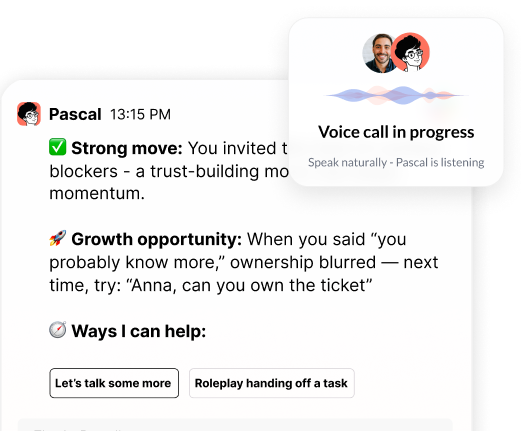
Pascal by Pinnacle achieves results through five capabilities: it joins meetings to provide real-time feedback, builds knowledge graphs of team interactions, adapts to company values and competencies, embeds in Slack/Teams/Zoom, and maintains SOC2 compliance without training on customer data.
Proactive engagement distinguishes Pascal from on-demand chatbots. Pascal surfaces guidance before crises occur—reminding managers of upcoming one-on-ones, flagging communication patterns, suggesting preparation for difficult conversations.
Cultural alignment ensures coaching reflects company-specific values and leadership principles rather than generic management advice. A tech company's "radical candor" culture requires different coaching than a healthcare organization's "compassionate communication" framework.
Privacy architecture protects employee data through SOC2 compliance, sensitive topic escalation, and anonymized aggregated insights. Pascal's advisory board includes CHROs from Mastercard, Okta, Royal Caribbean, HP, and Johnson & Johnson.
Organizations with 200–4,000 employees face a paradox: managers need more support as complexity grows, but HR teams can't scale proportionally. AI coaching multiplies HR impact by reaching every manager without adding headcount.
Distributed workforces create consistency challenges. When managers work across time zones, geographies, and functional areas, ensuring leadership quality becomes difficult through training alone. AI coaching provides the same guidance whether a manager works in San Francisco or Singapore, first shift or third.
Rapid growth strains HR capacity. When a company grows from 500 to 2,000 employees in 18 months and promotes 50 new managers, traditional onboarding can't keep pace. AI coaching scales instantly.
Budget constraints force mid-sized companies to choose between executive coaching for a few leaders or generic training for everyone. AI coaching delivers personalized guidance to every manager at costs comparable to traditional LMS platforms.
• AI coaching embedded in daily workflows (Slack, Teams, Zoom) provides real-time guidance at decision moments, unlike scheduled coaching sessions or generic training modules
• Mid-sized companies solve the scaling paradox by deploying AI coaching that reaches every manager at roughly 1% of traditional coaching costs ($50–$100/year vs. $10,000–$25,000/year)
• Success requires purpose-built coaching expertise, contextual awareness of team dynamics, proactive engagement, workflow integration, and appropriate guardrails for sensitive topics
• Organizations report time savings (instant guidance vs. waiting for HR support), reduced escalations (30–40% in documented cases), and improved team engagement under coached managers
• Generic AI tools underperform because they lack organizational context, cultural alignment, and structured frameworks that drive behavior change
Organizations ready to scale coaching beyond executives can see how Pascal works inside Slack to deliver guidance at decision moments.

.png)
.webp)
“Thank you for setting the great foundation for my promotion; now I have a plan!"

Curious to see how AI Coaching can 10X the impact and scale of your development initiatives. Book a demo today for: