

Ask vendors to demonstrate their coaching expertise, contextual awareness, integration depth, proactive engagement capabilities, and guardrails for sensitive topics. These criteria determine whether managers will trust the guidance enough to change behavior.
Before evaluating vendors, clarify your problem: Do managers lack coaching skills? Do they avoid difficult conversations? Are development plans gathering dust? AI coaching solves specific problems—not all management challenges. If your issue is compensation structure or unclear expectations, coaching won't help.
The market includes purpose-built coaching platforms, general AI tools with coaching prompts, fine-tuned language models, human coaching, and hybrid approaches. Each has tradeoffs. This guide helps you evaluate claims and identify what matters for your context.
Purpose-built platforms train on coaching frameworks. General AI tools apply conversational patterns to workplace topics. Ask: "Who designed your coaching approach, and what frameworks guide your responses?"
Request a live demo where the vendor coaches through a difficult performance conversation. Does guidance follow the GROW model (Goal, Reality, Options, Will) or SBI feedback structure (Situation, Behavior, Impact)? Or does it provide generic advice?
Test whether the platform explains why it recommends specific approaches, not just what to do. Compare responses to the same scenario across vendors—methodology-driven coaches demonstrate consistency while general tools vary.
Verify the system reinforces your leadership competencies, not one-size-fits-all guidance. Pascal's coaching models follow ICF frameworks and cost less than traditional coaching while maintaining professional standards.
The platform should know your company's values, leadership competencies, performance data, organizational structure, and individual goals. Without this context, coaching becomes theoretical. Ask: "Show me how your platform incorporates our culture, competencies, and employee data."
Request a demonstration of how the platform ingests your leadership framework documents, competency models, and cultural values. Ask how it accesses performance review data, development plans, and goals from your HRIS. Test whether coaching adapts based on role, tenure, team dynamics, and past interactions.
Verify the platform references your internal policies, escalation pathways, and company resources during coaching. Does it remember previous conversations and build on them, or start fresh each time?
Pascal integrates with Workday and other HRIS platforms to pull performance reviews, development plans, and goals, then combines this with meeting observations to deliver coaching that reflects your culture and each manager's development needs.
Context Layers That Separate Effective AI Coaches from Chatbots
Data Breakdown:
• Context Layer: Company culture & values | Generic AI Tool: Generic workplace advice | Purpose-Built AI Coach: Reinforces your specific values
• Context Layer: Performance data | Generic AI Tool: No access | Purpose-Built AI Coach: Integrates reviews, goals, development plans
• Context Layer: Team dynamics | Generic AI Tool: Assumes generic org structure | Purpose-Built AI Coach: Knows reporting relationships, team composition
• Context Layer: Individual history | Generic AI Tool: Conversation resets each session | Purpose-Built AI Coach: Builds understanding over time
• Context Layer: Company resources | Generic AI Tool: Links to external articles | Purpose-Built AI Coach: Deep-links to your policies, templates, frameworks
AI coaching that requires managers to open another app will see 10-20% engagement within months. Effective platforms meet managers where they work—in Slack, Teams, email, and meetings. Ask: "Where does your coaching happen, and how does it reach managers?"
Request a demonstration of the platform joining a live meeting on Zoom, Teams, or Google Meet and providing post-meeting feedback. Ask how managers access coaching in their daily communication tools without context-switching. Test whether the system surfaces relevant guidance based on observed situations, or only responds when asked.
Verify integration depth with your existing tech stack—is it real-time bidirectional data flow or occasional batch syncing? Examine whether the platform can push targeted messages to specific manager cohorts during critical moments like performance review season.
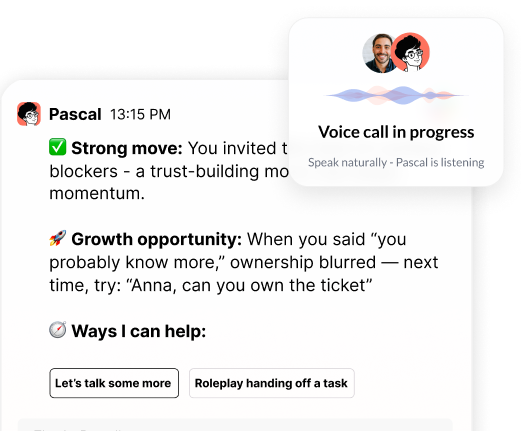
Pascal joins meetings on Zoom and Teams, sits in Slack and Teams channels, and engages based on observed interactions rather than waiting to be asked.
Managers need coaching most when they don't realize they need it. Ask: "How does your platform identify coaching moments and intervene without being prompted?"
Request examples of how the system identifies coaching opportunities from meeting observations, communication patterns, or calendar events. Ask whether the platform detects when a manager is preparing for a difficult conversation and offers pre-meeting guidance. Test if it provides post-meeting feedback based on what happened, not generic follow-ups.
Verify the platform recognizes patterns across multiple interactions and suggests developmental themes. Does proactive coaching feel helpful or intrusive? Does it respect manager autonomy while driving engagement?
Pascal joins your meetings, observes team interactions, and provides personalized feedback based on conversations—not abstract scenarios.
Reactive vs. Proactive AI Coaching Approaches
Data Breakdown:
• Approach: Reactive (chatbot-style) | Engagement Pattern: Manager must remember to ask | Behavior Change Impact: Low—coaching happens during crises | Retention After 3 Months: 10-20%
• Approach: Proactive (observation-based) | Engagement Pattern: System identifies coaching moments | Behavior Change Impact: High—builds consistent habits | Retention After 3 Months: 85-95%
• Approach: Hybrid | Engagement Pattern: Combines both approaches | Behavior Change Impact: Moderate—depends on implementation | Retention After 3 Months: 40-60%
AI coaching platforms will encounter performance issues, interpersonal conflicts, potential legal matters, and mental health concerns. Ask: "What happens when your AI detects a topic that requires human expertise, and how do you protect employee safety and organizational compliance?"
Request a demonstration of how the platform handles a scenario involving potential harassment, discrimination, or mental health crisis. Ask whether the system has content moderation that flags sensitive topics in real-time. Test if the platform escalates to appropriate human resources when needed—HR partners, legal counsel, or external support services.
Verify the platform provides organization-specific controls that let you define escalation pathways aligned with your policies. Does the system maintain appropriate boundaries around clinical topics like therapy or mental health counseling? Ask how the platform protects employee privacy while providing aggregated insights to HR leaders.
Confirm the vendor is SOC2 compliant and doesn't use your customer data to train models. Pascal includes moderation flags, sensitive topic escalation, organization-specific controls, and anonymous aggregated insights—all while maintaining SOC2 compliance.
Most vendors showcase vanity metrics like login counts or session duration. Ask: "What leading and lagging indicators do you track, and how do you connect coaching usage to business outcomes?"
Request examples of how the platform measures skill development and behavioral outcomes. Ask whether the system can correlate coaching interactions with performance review improvements, retention rates, or team engagement scores. Test if the vendor provides real-time dashboards showing which managers are engaging and which need support.
Verify the platform can demonstrate ROI through quantitative metrics (time saved, performance improvements) and qualitative feedback (manager testimonials, direct report surveys). Does the vendor offer benchmarking data from similar organizations or industries? Ask how long it takes to see measurable results—beware of vendors promising overnight transformation.
The challenge: most vendors can't show controlled studies or customer data linking coaching usage to business outcomes. Ask for reference customers you can contact directly. Test the product yourself with a pilot group before committing.
The gap between contract signature and value realization depends on implementation quality. Ask: "What does your implementation process look like, and how do you drive manager adoption?"
Request a detailed timeline showing integration setup, customization work, pilot program structure, and full rollout phases. Ask how the vendor handles change management and communication to drive adoption. Test whether the vendor provides training resources, launch templates, and ongoing support beyond initial deployment.
Verify the vendor assigns a dedicated customer success manager who understands your industry and organizational context. Does the platform include admin tools that let your team customize content, send targeted messages, and track usage without vendor involvement? Ask about the product roadmap and how customer feedback influences development priorities.
• Clarify your problem before evaluating vendors. AI coaching solves specific management skill gaps—not all leadership challenges. If your issue is compensation structure or unclear expectations, coaching won't help.
• Coaching methodology matters more than underlying AI models. Platforms trained on established frameworks (GROW, SBI) deliver guidance managers trust. General AI tools provide inconsistent advice.
• Context determines whether coaching feels relevant. The best platforms integrate with your HRIS, observe actual work, and remember each manager's development journey.
• Proactive engagement drives sustained behavior change. Coaching that waits to be asked sees 10-20% retention. Platforms that identify coaching moments and intervene appropriately achieve 85-95% sustained engagement.
• Workflow integration predicts adoption success. Managers won't open another app. Coaching must happen in Slack, Teams, meetings, and email where work already flows.
• Guardrails de-risk AI adoption. Platforms need content moderation, sensitive topic detection, and clear pathways to human expertise for legal, HR, and safety concerns.
• Verify vendor claims skeptically. Ask for reference customers you can contact. Test the product with a pilot group. Request controlled studies or customer data linking coaching to business outcomes.
Ready to see how AI coaching works in practice? See how Pascal delivers contextual coaching inside Slack, Teams, and meetings to drive manager effectiveness at scale.
Header photo by Christina @ wocintechchat.com M on Unsplash

.png)
.webp)
“Thank you for setting the great foundation for my promotion; now I have a plan!"

Curious to see how AI Coaching can 10X the impact and scale of your development initiatives. Book a demo today for: