

You're evaluating AI coaching platforms because your managers need better support, but demos showcase features while hiding what drives results. The vendors who can't answer these five questions will waste your budget and fail to change manager behavior.
Ask vendors: "What coaching methodology grounds your AI's guidance?" and "Who designed your coaching models—engineers or certified coaches?"
Platforms built by ICF-certified coaches (International Coaching Federation, the industry's credentialing body that sets standards for professional coaching practice) apply behavioral science frameworks like GROW (Goal, Reality, Options, Will) and solution-focused coaching. Generic tools like ChatGPT generate plausible responses without understanding developmental psychology or adult learning theory.
Test this claim. Give the vendor a complex scenario: a manager needs to deliver critical feedback to a defensive team member. Ask the AI to explain why it recommends a specific approach. Can it cite coaching principles? Does it adjust advice based on the manager's experience level or the employee's tenure?
Purpose-built platforms are trained on curated datasets of real coaching conversations, validated by professional coaches. They recognize nuances around power dynamics, organizational politics, and developmental readiness. Generic AI treats each query as isolated, without maintaining context across multiple interactions.
Request a demo using your actual management challenges, not the vendor's prepared examples. Ask the AI to handle follow-up questions that dig deeper into a manager's specific situation. Can it identify when someone repeatedly avoids difficult conversations? Does it notice when a manager's language suggests micromanaging rather than delegating?
Ask: "What guardrails prevent the AI from providing inappropriate guidance on sensitive topics?" and "When does the system escalate to human expertise?"
The most critical coaching moments involve performance problems, interpersonal conflicts, potential legal concerns, and mental health disclosures. Generic AI tools often provide confident-sounding advice on topics where they should recommend consulting HR or legal counsel. This creates liability exposure for your organization.
Present scenarios that test the platform's boundaries. Describe a situation where an employee discloses suicidal thoughts during a one-on-one meeting. Does the AI provide crisis resources and immediately escalate to HR? Or does it attempt to coach the manager through handling a mental health crisis—a situation requiring professional intervention?
Ask how the platform handles potential legal issues. If a manager describes behavior that might constitute harassment or discrimination, the AI should recognize the legal implications and route the situation appropriately. Verify the vendor consulted with employment law experts in developing these guardrails.
Request specific examples of moderation flags, sensitive topic detection, and escalation protocols. Ask who gets notified, how quickly, and what information is shared. Verify the vendor's security certifications (SOC2, GDPR compliance).
Data privacy protections are equally critical. Managers discuss confidential performance issues, personal employee circumstances, and sensitive business information during coaching conversations. Ask where this data is stored, whether it's encrypted at rest and in transit, who within the vendor organization can access it, and how long it's retained. Ensure the vendor commits contractually to never using your organization's coaching data for model training.
Ask: "What organizational data does your platform ingest?" and "How does the coaching adapt to our specific culture and values?"
Without integration into your HRIS, performance management systems, and internal documentation, AI coaching delivers generic advice. The platform needs to know your company's values, competencies, performance frameworks, and individual employee goals.
Test this during the demo. Ask how the platform incorporates your leadership competencies into coaching guidance. Request a walkthrough of the onboarding process—how long until the AI understands your culture well enough to reference your specific policies or frameworks?
Present a scenario that requires knowledge of your specific organizational structure. If your company has a matrix reporting structure, ask how the platform would coach a manager navigating conflicting priorities from multiple stakeholders. If your organization values radical transparency, verify the AI's guidance aligns with that cultural norm rather than suggesting traditional hierarchical communication approaches.
Verify the platform can pull data from your core systems (Workday, BambooHR, Culture Amp, Lattice). Some vendors claim context awareness but only allow manual document uploads that quickly become outdated. Others build dynamic knowledge bases that learn from your organization's evolving practices.
Here's what separates basic tools from purpose-built solutions:
Capability | Generic AI Tools | Basic AI Coaching | Purpose-Built Solutions
Company values integration | None | Manual upload | Automated HRIS sync
Performance data access | None | Limited API | Full two-way sync
Meeting observation | None | None | Real-time attendance
Communication pattern analysis | None | None | Learns from interactions
Individual goal tracking | None | Manual entry | Automated system pull
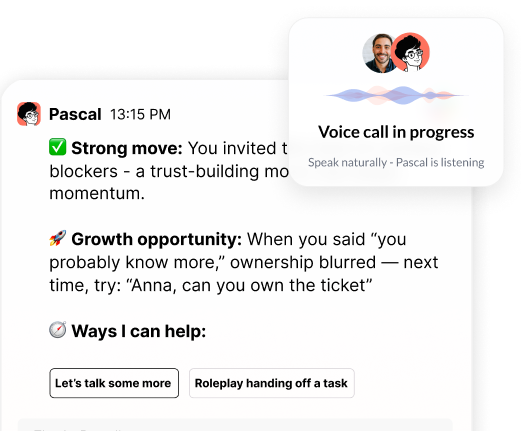
Ask: "Does your platform observe actual work and offer coaching proactively, or does it only respond when prompted?"
Reactive tools require managers to remember to seek help. Proactive platforms surface guidance at the moments that matter—after a tense meeting, before a performance conversation, when communication patterns suggest team friction.
Request demonstration of proactive coaching scenarios: post-meeting feedback, pre-conversation preparation, goal progress check-ins. Ask how the platform identifies coaching moments without creating alert fatigue.
Verify the platform can recognize patterns that indicate emerging challenges before they become crises. If a manager's one-on-ones with a particular team member have become shorter and less frequent, this pattern might signal a relationship issue that needs attention. Proactive platforms surface these observations with coaching on how to re-engage.
Ask vendors to explain their approach to balancing proactivity with user autonomy. Overly aggressive notifications create fatigue and lead managers to ignore or disable the platform. Systems that work learn individual preferences, adjusting their outreach based on which types of coaching moments each manager finds most valuable.
Test whether the system anticipates needs based on calendar events, performance cycles, or team dynamics. Verify managers can control the frequency and type of proactive outreach they receive. Platforms that join meetings, analyze communication patterns, and deliver real-time feedback create consistent coaching habits because managers don't need to remember to open another app.
Ask: "What leading and lagging indicators demonstrate your platform drives behavior change?" and "How do you measure manager effectiveness improvement?"
Polished demos don't predict real-world results. Completion rates and satisfaction scores tell you whether managers use the platform, not whether it improves their effectiveness. Demand evidence of actual performance improvement.
Look for vendors who track adoption metrics (daily active users, coaching sessions per manager), engagement depth (conversation length, follow-through on recommendations), and behavioral outcomes (direct report feedback scores, performance review quality, team retention).
Request case studies with specific metrics: adoption rates at 30, 60, and 90 days, behavior change indicators, and business impact measurements. Ask how the platform measures whether managers actually apply coaching recommendations in real situations.
Ask vendors to explain their measurement framework. Leading indicators might include frequency of coaching conversations, diversity of topics addressed, and manager confidence scores before difficult conversations. Lagging indicators should connect to business outcomes: team engagement scores, voluntary turnover rates, promotion rates for team members, and performance rating distributions.
Request access to the analytics dashboard during your demo. Can you identify which managers are struggling and need additional support? Can you see which coaching topics are most frequently accessed, suggesting common skill gaps? Can you track improvement over time for individual managers or cohorts?
Verify the platform can integrate measurement data from your existing systems. Manager effectiveness shows up in multiple places: engagement survey results, performance review quality, team productivity metrics, and retention rates. The platform should correlate its usage data with these external measures to demonstrate impact.
Ask about the vendor's approach to control groups and causal inference. The best vendors conduct research comparing outcomes for managers who use the platform versus those who don't, controlling for factors like team size, department, and prior performance.
• Purpose-built platforms trained by ICF-certified coaches apply behavioral science frameworks, while generic chatbots generate plausible responses without understanding developmental psychology
• Sensitive topic handling (moderation flags, escalation protocols, SOC2 compliance) is the highest-stakes evaluation criterion—poor guardrails create legal liability
• Contextual awareness requires deep HRIS integration, performance data access, and organizational knowledge to deliver trusted guidance instead of generic advice
• Proactive engagement that surfaces guidance at critical moments drives higher adoption than reactive tools requiring managers to remember to seek help
• Measurable outcomes should include adoption metrics, engagement depth, and behavioral change indicators tied to business results like retention and team performance
The right AI coaching platform becomes a trusted daily resource that managers rely on for their most challenging moments. The wrong one becomes another underutilized tool that looked impressive in the demo but failed to drive real behavior change.
Bring these five questions to your next vendor demo. Test the platform with your actual management challenges, not the vendor's prepared scenarios. Verify integrations with your existing systems. Request case studies with specific metrics tied to business outcomes. Your evaluation process should include managers who will use the platform daily, HR business partners who will handle escalations, IT teams who will maintain integrations, and executives who will evaluate ROI.
Consider running a pilot program before full deployment. Select a diverse group of managers across different departments, experience levels, and team sizes. Track their usage patterns, gather qualitative feedback, and measure early indicators of effectiveness. A successful pilot provides internal proof points that drive broader adoption.
Negotiate contract terms that protect your interests during the evaluation period. Ensure you can exit without penalty if the platform doesn't deliver promised results. Request clear service level agreements for uptime, support response times, and integration reliability.
See how this works in practice at https://www.heypinnacle.com
Header photo by Bluestonex on Unsplash

.png)
.webp)
“Thank you for setting the great foundation for my promotion; now I have a plan!"

Curious to see how AI Coaching can 10X the impact and scale of your development initiatives. Book a demo today for: