

In the first three months, a new manager needs help with the handful of skills the role tests right away: letting go of work they used to do themselves, delegating with clear owners and deadlines, holding the first hard conversations, and knowing which issues belong with HR. Help lands best in the week each skill is needed.
Most people move into management because they were strong individual contributors. Their technical judgment is excellent, and the company trusts them with a team because of it. The skills the new role asks for on the first day are different ones, and few people have practiced them before they need them.
The pressure arrives quickly. A new manager inherits a team with its own history, a backlog of decisions and often a few relationships that need care. They also keep some of their old work, which makes it tempting to keep doing the tasks they know best and to postpone the people side of the job.
Leaders in moments of transition show some of the strongest appetite for support. Newly promoted managers, people leading a team for the first time and leaders who recently moved into new roles all have a deep thirst for help during these periods. The first three months are when that appetite is highest and when habits form fastest.
The early months test a short list of skills again and again. Naming them helps a new manager and their boss agree on where to focus.
A plan for the first quarter keeps a new manager focused without adding another course to their week.
Month one: listen and learn the team. Hold a 1:1 with every direct report, ask what is working and what gets in their way, and learn the team's priorities and commitments. Agree with your own boss on what success looks like by the end of the quarter.
Month two: set the rhythm. Make 1:1s a regular habit, hand off at least one piece of your old work with a clear owner and deadline, and give specific feedback soon after the moments that call for it. This is usually when the first hard conversation arrives.
Month three: build for the next quarter. Review what you delegated and what came back, ask the team for feedback on how you lead, and choose one or two skills to keep working on. Bring any people issue that touches policy or wellbeing to HR early.
A new manager in those early months has very little spare time. Content delivered weeks before a situation tends to fade by the time the situation arrives, and a busy manager rarely goes back to look it up. The most useful support shows up right before a hard conversation and right after the meeting where a skill was tested.
That timing matters most for the skills on the list above. Rehearsing a first difficult conversation the day before it happens builds more confidence than reading about difficult conversations in general. Feedback that arrives right after a meeting is easier to act on than a review months later.
Pascal is an AI coach for every manager: a leadership companion who accompanies them in their meetings and work, and coaches from what actually happened. He sits in Slack or Microsoft Teams, connects to the manager's calendar and joins their meetings.
For a new manager, Pascal can start the morning with a preview of the meetings ahead and preparation suggestions for specific conversations. He can close the day with a summary of patterns across those meetings, and each manager chooses which of these updates they receive.
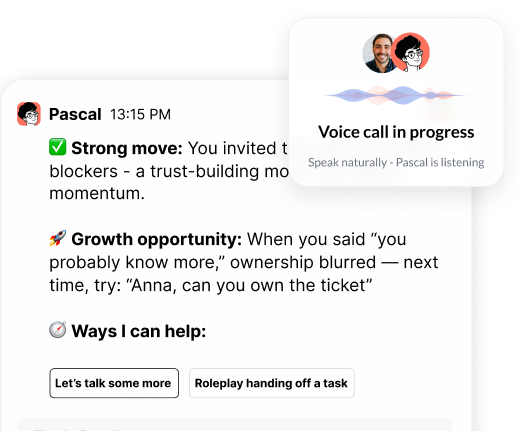
Pascal coaches proactively before meetings with preparation and practice, and he answers when the manager asks him something during a meeting. His personalized feedback arrives after the meeting, so the manager can act on it while the details are fresh.
A new manager can also rehearse a first difficult conversation with Pascal ahead of time. When a topic such as termination, a medical issue, a grievance or harassment comes up, he raises the HR or EAP boundary and then helps the manager plan the outreach and the questions to ask.
Each person's coaching conversations with Pascal stay private. HR and leaders see aggregated, anonymized insights, and only for groups large enough to protect anonymity.
HR and the manager's own boss shape how quickly a new manager finds their footing. A few habits make a large difference during the first quarter.



“Thank you for setting the great foundation for my promotion; now I have a plan!"

Curious to see how AI Coaching can 10X the impact and scale of your development initiatives. Book a demo today for: