

Real-world AI coaching implementations are proving that contextual, proactive guidance drives measurable improvements in manager decision-making and team engagement. Organizations from hardware startups to global hospitality companies report that managers using purpose-built AI coaching show 83% observable improvement from direct reports, with 20% average lifts in Manager Net Promoter Score among highly engaged users. These outcomes stem not from generic AI tools, but from platforms that understand organizational context, integrate into daily workflows, and provide support at the exact moments managers need it most.
Quick Takeaway: Real-world implementations show AI coaching delivers measurable ROI through three mechanisms: it reduces time spent on routine coaching questions, improves the quality of manager-to-employee interactions, and accelerates behavior change because guidance arrives in the flow of work rather than days later. The organizations seeing the strongest outcomes prioritize contextual awareness, proactive engagement, and workflow integration over feature count or vendor reputation.
At Pinnacle, we've learned through building and deploying Pascal across diverse organizations that the gap between overpromised AI coaching and genuinely transformative solutions comes down to five critical factors. Understanding these distinctions helps CHROs cut through vendor marketing and select platforms that actually improve how managers lead.
Managers make better decisions when they have immediate, contextual guidance tailored to their specific team and situation. Generic advice gets ignored; personalized coaching informed by performance data and team dynamics gets applied.
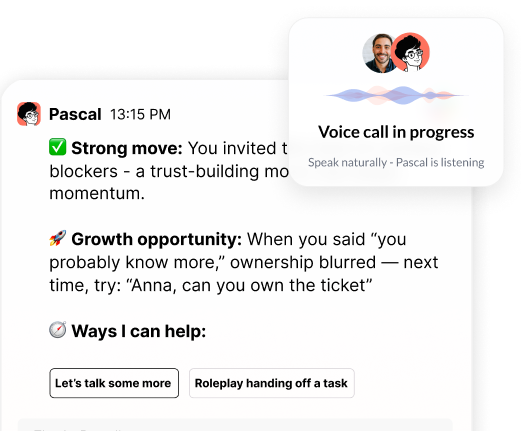
When a manager prepares for a difficult feedback conversation with AI coaching, they're more specific and fair because guidance accounts for that employee's communication style, recent feedback, and career goals. Real-time meeting feedback allows managers to adjust communication patterns in the moment rather than weeks later when the learning opportunity has faded. Structured guidance for complex situations helps managers handle them more effectively, showing up directly in direct report engagement and retention metrics.
Workflow integration removes friction: managers receive guidance in Slack and Teams rather than switching tools, making coaching a natural extension of work. Organizations achieving 80%+ weekly active users see measurable behavior change because consistent coaching creates habit loops. One technology company with 50 initial users saved 150 hours in the first month through reduced escalations to HR and faster performance review preparation.
Team engagement improves when managers receive consistent coaching on feedback quality, delegation clarity, and psychological safety. Direct reports notice and experience these behavioral improvements directly.
83% of direct reports report observable improvement in their manager's effectiveness when managers use AI coaching consistently. 20% average lift in Manager Net Promoter Score among highly engaged users indicates sustained behavior change, not just satisfaction with the tool. 94% monthly retention indicates managers maintain consistent engagement because coaching feels relevant and immediately applicable. Average of 2.3 coaching sessions per week suggests habit formation rather than sporadic tool use; this sustained engagement matters because behavior change requires practice and reinforcement.
Improvements show up in specific behaviors: more frequent feedback, clearer delegation, more developmental one-on-ones—the exact behaviors that drive team engagement and performance. HubSpot discovered that when managers receive contextual coaching, they're more specific and fair in their decisions, with underperformers who embraced AI improving performance more than peers because they received more personalized guidance.
Leading organizations embed AI coaching into the employee lifecycle from day one, creating cultural acceptance that enables widespread adoption and measurable manager effectiveness improvements.
HubSpot introduced AI tools within the first two days of new hire onboarding and created visible peer proof through weekly demonstrations; 98% of employees used AI tools on the job and 84% felt comfortable doing so. Zapier integrated AI fluency directly into hiring, onboarding, and performance reviews, making coaching part of how people work rather than optional; 75% of knowledge workers adopted AI when supported by clear expectations. Marriott embedded AI coaching in mobile-first learning hubs delivering personalized micro-lessons to frontline associates; this accessibility model democratizes coaching at true organizational scale.
Proactive delivery ensures coaching reaches people at the right moment with the right guidance; when coaching appears in tools managers already use, engagement becomes natural rather than requiring willpower. These organizations all prioritize cultural integration over technology sophistication, treating AI adoption as a change management challenge rather than a software deployment.
Managers make better decisions when the AI coach understands their specific team, organizational culture, and individual goals rather than offering generic frameworks. Contextual awareness eliminates the friction of repeatedly explaining situations; managers don't need to provide backstory every time they need guidance.
Purpose-built platforms integrate with performance reviews, 360 feedback, career aspirations, competency frameworks, and organizational values to shape guidance that reflects how your organization actually operates. When Pascal understands both the manager and the employee receiving feedback, coaching becomes specific rather than theoretical. One tech company with 50 employees using AI coaching estimated saving 150 hours in their initial rollout through reduced escalations to HR and faster performance review preparation.
Escalation protocols ensure sensitive topics reach human expertise while routine coaching remains accessible 24/7; aggregated insights surface organizational patterns that individual managers miss. This combination of contextual depth and appropriate human oversight creates coaching that managers trust because it reflects their actual reality rather than abstract principles.
Generic AI tools fail at workplace coaching because they lack understanding of specific team dynamics, organizational culture, and individual relationships that make guidance relevant and actionable. Managers waste significant time explaining background information before receiving useful guidance; after the third time explaining team structure and context, most managers abandon the tool.
Generic AI provides advice that may work somewhere but doesn't work here; feedback approaches and leadership expectations vary dramatically across organizations and industries. Without proper guardrails, managers might receive step-by-step instructions for sensitive situations (terminations, harassment, medical issues) that require HR involvement and legal expertise. ChatGPT can draft your performance review template, but it cannot coach your manager through a difficult termination conversation with appropriate consideration for your company's severance policies and legal obligations.
The friction of context repetition kills adoption more effectively than any technical limitation. When managers need to repeatedly explain their situation, team dynamics, and organizational context before getting useful guidance, they stop using the tool. This pattern repeats across organizations regardless of how sophisticated the underlying AI model might be.
The business case for contextual AI coaching extends beyond soft metrics to concrete time and cost savings alongside quality improvements. Organizations implementing purpose-built coaching platforms see significant improvements in coaching relevance and manager confidence.
| Outcome Category | Metric | Real-World Result |
|---|---|---|
| Manager Effectiveness | Direct reports seeing improvement | 83% |
| Manager Perception | Manager Net Promoter Score lift | +20% (highly engaged users) |
| User Retention | Monthly retention rate | 94% |
| Engagement Frequency | Avg. coaching sessions per week | 2.3 |
| Time Savings | Hours saved (50-person rollout, month 1) | 150 hours |
These metrics matter because they directly address the business challenges CHROs need to solve: proving ROI of HR programs, scaling manager effectiveness, and de-risking AI adoption. Faster manager ramp time reduces the productivity cost of promotions. Improved feedback quality correlates with higher engagement and retention. High retention rates indicate managers trust the system enough to return consistently.
"So much of the real learning and value that comes from this comes from in-context coaching in the moment to drive performance and to solve problems in the moment."
These patterns hold across organization size, industry, and geography. Whether managing 50 people or 400,000, whether in hardware or software, whether distributed or co-located, the organizations seeing strongest outcomes prioritize contextual awareness, proactive engagement, and workflow integration. Those are the factors that determine whether AI coaching becomes transformative or decorative.
Purpose-built AI coaching delivers measurable improvements because it understands organizational context while knowing when to escalate sensitive topics to human expertise. Generic tools miss both dimensions, creating risk and limited value.
Pascal includes moderation that politely refuses to respond to toxic behavior, harassment inquiries, or requests indicating mental health concerns while flagging issues to HR. Escalation protocols ensure sensitive employee topics like medical issues, grievances, or terminations reach appropriate human expertise while helping managers prepare for those conversations. Organization-specific controls allow you to define what Pascal will and won't respond to, creating a walled garden where you choose where the walls go.
"If we can finally democratize coaching, make it specific, timely, and integrated into real workflows, we solve one of the most chronic issues in the modern workplace."
This protective layer matters because managers often don't recognize which situations require specialized expertise versus peer coaching. The worst-case scenario isn't AI giving bad advice—it's AI providing guidance on topics that require human judgment, documentation, and legal consideration. Purpose-built platforms prevent this through built-in escalation and clear boundaries.
Ready to see how contextual AI coaching drives measurable manager effectiveness improvements? Book a demo to explore how Pascal delivers real-time, personalized guidance grounded in your company's culture and actual team dynamics. Discover how other organizations are using AI coaching to accelerate manager effectiveness and prove ROI through measurable adoption and behavior change.

.png)
.webp)
“Thank you for setting the great foundation for my promotion; now I have a plan!"

Curious to see how AI Coaching can 10X the impact and scale of your development initiatives. Book a demo today for: