

AI coaching bridges the gap between knowing what to say and actually saying it by meeting managers in the moment they need help most, with personalized guidance grounded in real team dynamics. Traditional training happens weeks before the actual conversation, when context is lost and anxiety is high. AI coaching eliminates this timing gap by providing just-in-time support tailored to each employee's communication style, performance history, and team dynamics.
Quick Takeaway: Difficult feedback conversations fail because managers lack real-time support and don't understand the specific person they're talking to. AI coaching solves this by providing contextual guidance at the exact moment managers need it, integrated into their daily workflow, with proactive feedback that turns conversations into genuine learning moments.
Most feedback conversations fail because managers lack real-time support and don't understand the specific person they're talking to. Managers rarely need help in a workshop; they need it when preparing for a tough one-on-one or in the middle of team conflict. When those moments go wrong, the costs ripple: broken trust, bad decisions, legal exposure, or disengaged teams.
Only 25% of managers are considered highly effective at coaching and feedback delivery. Traditional annual training programs see adoption drop dramatically after the first week because guidance doesn't connect to real situations. The problem isn't that managers don't want to improve. It's that support arrives at the wrong time, in the wrong format, without the context that makes it relevant.
As former CHRO Melinda Wolfe explains, "Managers rarely need help in a workshop—they need it when preparing for a tough 1:1 or in the middle of a team conflict." AI coaching meets managers where they work by eliminating the friction that kills adoption. Rather than requiring them to log into another platform or wait for scheduled sessions, Pascal integrates directly into Slack, Teams, and meeting tools, delivering guidance at the moment it matters most.
Purpose-built AI coaching platforms integrate performance data, communication patterns, and team dynamics to provide guidance specific to each relationship, not generic talking points. This personalization transforms feedback from theoretical exercise into actionable conversation strategy.
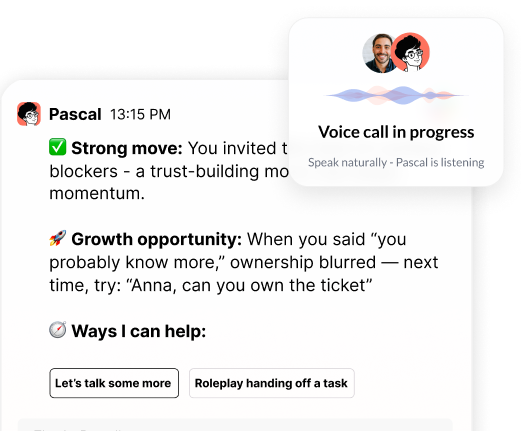
Pascal accesses performance reviews, 360 feedback, meeting transcripts, and career aspirations to understand both the manager and the employee involved in a conversation. Rather than generic advice like "be direct but supportive," contextual coaching provides specific language: "When you said 'you probably know more,' ownership blurred. Next time, try: 'Anna, can you own the ticket?'" This guidance reflects that specific employee's communication style, their recent performance, and the organizational context.
Managers receive guidance calibrated to their communication style, team culture, and organizational values, not one-size-fits-all best practices. Real-time feedback after actual meetings helps managers reflect on what worked and what to adjust next time, creating a feedback loop that drives behavior change far beyond what annual training programs achieve.
AI coaching enables low-stakes roleplay where managers practice difficult conversations before the real interaction, building confidence and refining their approach without emotional risk. This practice translates directly into better outcomes when the actual conversation happens.
Managers can rehearse feedback conversations with AI that simulates how the specific employee might respond based on their communication preferences and past interactions. Structured feedback on tone, clarity, and empathy helps managers identify gaps they wouldn't notice alone. Iterative practice—trying different approaches and seeing how each affects the outcome—builds lasting skill development rather than one-time training events.
The ability to practice at 2 AM before an anxious meeting addresses the timing problem that makes traditional coaching inaccessible. Research on the Accountability Dial shows that managers who can roleplay difficult conversations beforehand deliver significantly clearer, more empathetic feedback when it matters.
Coaching that waits for managers to ask for help rarely drives lasting change. Proactive AI coaches identify moments when guidance would help and surface it automatically, creating consistent development habits rather than crisis-only support.
Pascal joins meetings, analyzes team dynamics, and delivers feedback immediately after interactions while context is fresh. Proactive nudges after challenging conversations help managers reflect and adjust their approach for next time. Consistent weekly check-ins and goal tracking create habits that traditional quarterly coaching misses. Research shows that 83% of direct reports report measurable improvement in their managers when those managers engage regularly with purpose-built AI coaching.
This proactive engagement drives the 94% monthly retention rate and 2.3 average coaching sessions per week we observe across implementations. Managers don't need to remember to seek help—the system identifies coaching moments and surfaces them automatically, creating the consistent practice that transforms behavior.
Difficult conversations often involve sensitive topics—performance issues, potential conflict, or interpersonal dynamics—that require appropriate escalation to HR. Purpose-built AI coaching recognizes these boundaries and ensures human expertise gets involved when it matters.
When conversations touch terminations, harassment, or medical issues, AI coaching escalates to HR while helping managers prepare for those conversations appropriately. Guardrails prevent the risky scenario where managers receive advice on sensitive topics without involving human experts. Clear escalation protocols maintain trust by showing employees that sensitive situations get appropriate human attention. This hybrid approach delivers both scale and safety.
Pascal includes moderation systems that detect toxic behavior, self-harm language, or harassment indicators. When sensitive employee topics surface, Pascal escalates to HR while helping the manager understand why human expertise is needed. This approach protects both the organization and employees while ensuring appropriate oversight of high-stakes situations.
AI coaching handles 90% of routine feedback and conversation preparation. The remaining 10%—situations requiring legal awareness, deep emotional complexity, or organizational context—requires human expertise. The best organizations build clear protocols for when to escalate.
Routine feedback, delegation challenges, career development conversations, and communication skill-building are ideal for AI coaching. Performance issues with legal implications, harassment concerns, and complex interpersonal dynamics involving power imbalances require human HR involvement. Clear decision frameworks help managers understand which conversations benefit from AI coaching and which need escalation.
Organizations that define these boundaries before deployment see faster adoption and better outcomes. Veteran CHROs advising on AI implementation consistently emphasize that clarity about escalation builds trust in the system rather than creating friction.
"It makes it easier not to make mistakes. And it gives you frameworks to think through problems before you act."
The most successful implementations treat AI coaching as augmentation to human expertise, not replacement. Managers use AI for skill development and real-time guidance, while HR professionals focus on complex situations requiring judgment, legal awareness, and deep organizational understanding. This division of labor makes both more effective.
Implementation success depends on change management, integration, and clear communication about how AI coaching complements existing programs. Organizations should start with specific use cases where AI provides obvious value, measure both adoption and behavioral outcomes, and iterate based on real feedback rather than waiting for perfect solutions.
Jeff Diana, former CHRO at SuccessFactors and Calendly, emphasizes that the speed of decision-making matters more than waiting for perfect clarity. Organizations that pilot quickly, learn from real usage, and expand based on results achieve better outcomes than those attempting organization-wide launches without testing.
Difficult conversations don't have to be anxiety-inducing guesses. Book a demo to see how Pascal transforms how your managers navigate feedback, conflict, and growth conversations. Pascal meets your managers in the moment—before meetings, during conflicts, when stakes are highest—with personalized guidance grounded in their actual team dynamics and company culture. Rather than generic talking points, managers get specific language calibrated to each relationship, practice opportunities to build confidence, and real-time feedback after actual conversations to drive continuous improvement.

.png)
.webp)
“Thank you for setting the great foundation for my promotion; now I have a plan!"

Curious to see how AI Coaching can 10X the impact and scale of your development initiatives. Book a demo today for: