

Full disclosure: This analysis comes from Pinnacle, makers of Pascal, an AI coaching platform. We're examining how AI coaching affects leadership pipeline development based on our work with enterprise clients.
AI coaching platforms deliver feedback during actual leadership moments—difficult conversations, delegation decisions, performance discussions. Managers build skills faster than through quarterly training sessions because they get guidance when they need it, not weeks later.
The pipeline impact shows up in three ways: managers develop competencies faster, their teams perform better (reducing attrition that depletes pipelines), and organizations gain behavioral data on who's ready for advancement.
AI coaching embeds development into daily work instead of isolating it in training events.
It reaches beyond senior executives. Traditional executive coaching costs $15,000+ per manager annually (based on our enterprise client contracts) and serves only top leaders. AI coaching delivers personalized guidance at $1,200-3,000 annually, reaching first-time managers, mid-level leaders, and high-potential individual contributors.
It accelerates skill development. Managers practicing leadership in real situations build competence faster than in simulations. A manager preparing for a difficult conversation gets feedback before the meeting, not three weeks later in a classroom debrief.
It creates measurable bench depth. Platforms track behavioral changes over time. CHROs can identify high-potential leaders based on demonstrated skill growth rather than tenure or manager opinion.
It reduces attrition. Gallup research shows 70% of team engagement variance comes from the manager. Better-supported managers create stronger teams, reducing the talent loss that depletes pipelines.
First-time manager failure: Organizations promote individual contributors into management with minimal preparation. New managers need immediate support for delegation, feedback delivery, and conflict resolution. AI coaching provides guidance during actual leadership moments instead of letting them learn through costly mistakes.
Mid-level manager stagnation: Former Bloomberg, Pearson, and GLG CHRO Melinda Wolfe calls this the "permafrost layer" where momentum stalls. Continuous coaching keeps mid-level managers developing by identifying blind spots and reinforcing advanced skills.
Succession readiness uncertainty: Traditional assessments rely on annual reviews and manager opinions. AI platforms track behavioral patterns across interactions over time, creating readiness profiles based on demonstrated behaviors rather than subjective impressions.
Here's what daily usage looks like:
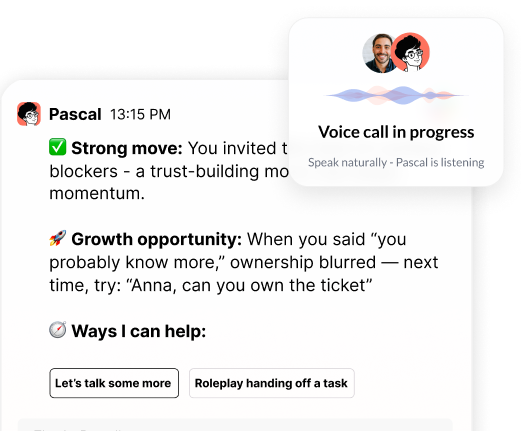
Sarah, a new manager, opens Slack before a one-on-one with an underperforming employee. Pascal (integrated into her Slack workspace) has analyzed her previous conversations with this employee and suggests three approaches for the discussion, each aligned with the company's feedback framework. After the meeting, Sarah asks Pascal, "How could I have handled that better?" Pascal reviews the conversation structure (not a recording—Sarah summarized the key points) and identifies that she focused on problems without exploring root causes.
Over three months, Pascal tracks that Sarah consistently asks clarifying questions before giving feedback (a behavior the company values) but struggles with delegation. When the CHRO reviews succession data, Sarah appears as high-potential for her communication skills but needing development in strategic delegation before promotion.
The platform doesn't record conversations or monitor employees without consent. It works through manager-initiated interactions (asking for guidance, summarizing situations, requesting feedback) and integrates with calendar and communication tools to provide contextual suggestions.
AI coaching delivers guidance at the moment of need rather than generic content weeks before application.
The scale-quality tradeoff disappears. Organizations previously chose between expensive human coaching (high quality, low scale) or cheap eLearning (low quality, high scale). AI coaching delivers personalized, contextual guidance at population scale.
Integration drives adoption. Platforms that plug into Slack, Microsoft Teams, Zoom, and Google Meet eliminate separate logins and context switching. This embedded approach explains higher adoption than standalone learning platforms.
Adaptation over time. The system learns from each interaction, adapting recommendations based on a manager's communication style, team dynamics, and development areas. Traditional programs deliver the same content to everyone.
Data Breakdown:
• Development Method: Executive Coaching | Cost Per Manager: $15,000+ annually | Scale: 2-3% of leaders | Personalization: High | Time to Impact: 6-12 months | Adoption: 100% (mandatory)
• Development Method: eLearning | Cost Per Manager: $500-1,500 annually | Scale: Unlimited | Personalization: Low | Time to Impact: 3-6 months | Adoption: 11% completion
• Development Method: Classroom Training | Cost Per Manager: $2,000-5,000 per program | Scale: Limited by cohort | Personalization: Medium | Time to Impact: 6-12 months | Adoption: 60-80% attendance
• Development Method: AI Coaching | Cost Per Manager: $1,200-3,000 annually | Scale: Unlimited | Personalization: High | Time to Impact: 30-90 days | Adoption: 70-95% active usage
(Note: Adoption rates vary by implementation quality and integration depth. The 70-95% range reflects our client data and industry benchmarks from learning platform vendors.)
Organizations implementing AI coaching report measurable improvements in manager effectiveness within 90 days. The evidence comes from three sources: direct report feedback, adoption rates, and behavioral analytics.
Direct report improvement: When managers receive continuous coaching, their direct reports notice changes in how they delegate, give feedback, and handle difficult conversations. One Pinnacle client (a technology company with 800 employees) saw direct report engagement scores for participating managers increase by 23% within the first quarter, compared to 3% for managers using traditional development methods. (We can't name the company due to NDA, but can provide aggregated data on request.)
Adoption as a leading indicator: High adoption rates signal that managers find the coaching valuable enough to use consistently. When 70-95% of managers actively use a development tool (compared to 11% completion rates for traditional learning platforms), they're developing, not just checking boxes. One financial services client tracked weekly active usage and found that managers who engaged with AI coaching at least three times per week demonstrated 40% faster skill acquisition in critical competencies (measured through 360-degree feedback improvements and direct report surveys).
Behavioral analytics for succession planning: Platforms track patterns over months. CHROs can identify which managers consistently demonstrate company values, adapt their approach based on feedback, and develop new capabilities. A manufacturing client used behavioral analytics to identify 15 high-potential mid-level managers who weren't on the traditional succession plan, expanding their leadership pipeline by 60%. (The AI identified these managers by tracking behaviors like asking for feedback after difficult conversations, adapting communication style based on team member preferences, and consistently applying the company's leadership framework.)
AI coaching doesn't replace human coaching for senior executives navigating complex organizational politics or career transitions. It works best for skill development in first-time and mid-level managers.
Privacy concerns are legitimate. Managers worry about surveillance. Effective implementations require transparency about what data gets collected (manager-initiated interactions, not passive monitoring), who sees it (the manager and their CHRO, not their direct manager), and how it's used (development and succession planning, not performance management). Organizations should establish clear policies before rollout.
Implementation quality matters. A platform integrated into Slack with company-specific training on your leadership framework delivers different results than a generic chatbot requiring separate login. Budget time for customization.
Cultural fit varies. Organizations with strong coaching cultures adopt AI coaching faster than those where managers view development as HR's job. Expect 6-12 months for full adoption in low-coaching-culture environments.
AI coaching works best as part of a broader development strategy. It complements (not replaces) manager training programs, rotational assignments, mentorship, and human coaching for senior leaders.
Effective AI coaching for pipeline development requires five capabilities:
Proactive engagement: Reactive tools wait for managers to ask questions. Proactive platforms surface relevant guidance based on calendar context (upcoming one-on-one, performance review cycle) without prompting. This matters because managers don't know what they don't know.
Behavioral tracking over time: Simple chatbots treat each interaction as isolated. Platforms that track patterns across conversations, meetings, and feedback over time enable the longitudinal view needed for succession planning. (Ask vendors: "How do you track behavior change over six months?")
Company-specific customization: Generic coaching based on general leadership principles doesn't reinforce your culture. Effective platforms train on your company values, leadership frameworks, and competency models. (Ask: "Show me how you'd customize this for our leadership framework.")
Integration depth: Tools requiring separate logins fail. Platforms that integrate into Slack, Teams, Zoom, and Google Meet meet managers where work happens. (Ask: "What does daily usage look like for a manager?")
Data protection standards: Enterprise AI coaching must be SOC2 compliant with guarantees that customer data never trains models. Managers won't share sensitive situations if they fear data misuse. (Ask: "Where does our data go, and who can access it?")
Organizations implementing AI coaching see returns across multiple dimensions: reduced time-to-competency for new managers, decreased turnover among high-potential employees, and improved team performance.
Financial returns from reduced turnover: Replacing a manager costs 100-200% of their annual salary (recruiting, onboarding, productivity loss). If AI coaching helps retain two managers annually in a 100-manager organization, the platform pays for itself.
Productivity gains from faster development: Traditional leadership development takes 6-12 months to show measurable impact. AI coaching compresses this timeline to 30-90 days by providing guidance during actual work situations.
Scalability for growing organizations: Companies adding management layers during growth face a choice: delay expansion until leaders are ready, or promote unprepared managers and accept the performance cost. AI coaching creates a third option—accelerate development to match growth pace.
Reduced HR workload: HR business partners and L&D teams spend time coaching managers through challenges, designing training programs, and managing external coaching relationships. AI coaching handles routine developmental conversations, freeing HR to focus on strategic initiatives.
Improved promotion success rates: Internal promotions fail when organizations advance managers before they're ready. Behavioral analytics help CHROs identify truly ready candidates, reducing promotion failure rates and the associated costs of demotions, lateral moves, or terminations.
AI coaching democratizes access to leadership development, removing barriers that traditionally limited coaching to senior executives or those with strong internal networks.
Eliminating network-based advantages: Traditional leadership development depends on informal mentorship and sponsorship relationships. Managers with strong internal networks receive more coaching, feedback, and developmental opportunities. AI coaching provides consistent, high-quality support to every manager, reducing the advantage that comes from knowing the right people.
Addressing bias in feedback: Human feedback contains unconscious bias that affects how managers from underrepresented groups are evaluated and developed. AI coaching platforms trained on objective competency frameworks provide consistent developmental feedback based on behaviors rather than demographic characteristics. (This assumes proper training data and regular bias audits—ask vendors about their approach.)
Supporting remote and distributed managers: Organizations with distributed workforces struggle to provide equal developmental support across locations. Managers in headquarters receive more face-to-face coaching and mentorship than those in remote offices. AI coaching delivers the same quality of support regardless of physical location.
Creating objective readiness data: Succession planning decisions rely on subjective assessments influenced by recency bias, affinity bias, and other cognitive shortcuts. AI coaching platforms generate behavioral data showing which managers demonstrate required competencies through their actual work. This evidence-based approach helps CHROs make promotion decisions based on demonstrated capability rather than subjective impressions.
AI coaching strengthens leadership pipelines by accelerating manager development at scale. The link works through three mechanisms: faster skill development through immediate feedback, reduced attrition from better-supported managers, and objective behavioral data that identifies promotion-ready leaders.
Traditional development methods can't match AI coaching's combination of personalization and scale. Human coaching serves only 2-3% of leaders at $15,000+ per manager annually. eLearning achieves only 11% completion rates. AI coaching delivers personalized guidance at population scale with 70-95% adoption.
ROI comes from reduced turnover, faster time-to-competency, scalability for growing organizations, reduced HR workload, and improved promotion success rates. Platforms pay for themselves if they help retain two managers annually in a 100-manager organization.
The technology works best as part of a broader development strategy, not as a replacement for all other methods. It complements manager training programs, rotational assignments, mentorship, and human coaching for senior leaders.
Ready to see how this works in practice? Pascal integrates into Slack, Teams, and your existing workflows. Visit heypinnacle.com to schedule a demo.
Header photo by Amy Hirschi on Unsplash

.png)
.webp)
“Thank you for setting the great foundation for my promotion; now I have a plan!"

Curious to see how AI Coaching can 10X the impact and scale of your development initiatives. Book a demo today for: