

Organizations that extend coaching beyond executives to all managers see 30–40% faster time-to-competency for new managers, higher team engagement, and improved retention of high performers. The ROI comes from scaling personalized leadership guidance to the hundreds or thousands of managers who directly shape daily employee experience.
Traditional one-on-one coaching costs $15,000–$50,000 per executive annually. Scaling to 200 managers would require $3M–$10M—impossible for most organizations.
According to Gallup, 70% of team engagement variance comes from the manager. Yet most organizations invest coaching dollars in the 2–5% of leaders furthest from frontline employees. Executive coaching ranges from $300–$1,000 per hour. The supply constraint compounds the problem: there aren't enough qualified coaches to serve every manager in mid-sized organizations.
Companies spend millions on learning platforms with 10–15% engagement while managers struggle with real-time challenges that determine whether employees stay or leave.
A mid-level manager at a Series B SaaS company faces a situation she's never handled: one of her senior engineers just told her he's interviewing elsewhere because he doesn't see a path forward. It's 10 PM. Her HRBP won't be available until tomorrow. The engineer wants an answer by Friday.
She opens Slack and messages her AI coach: "My best engineer says he's leaving because there's no growth path. I don't know what I can promise him. How do I handle this conversation?"
The AI asks: "What has he told you about what growth means to him? Is he looking for management opportunities, deeper technical work, or something else?" She realizes she doesn't know. The AI walks her through preparing questions, understanding his motivations, and identifying options within her authority (project ownership, technical leadership, mentorship opportunities) versus what requires executive approval (title changes, compensation).
By the time she meets with him the next day, she's prepared. She asks better questions, understands his actual goals (technical depth, not management), and proposes a path he hadn't considered. He stays.
This is democratized coaching: personalized leadership guidance available to every manager, not as a scheduled event, but embedded in daily workflows. The access shift is dramatic—from 20–50 executives to 200–2,000 managers and emerging leaders. The delivery model changes from scheduled sessions to support inside Slack, Teams, and meeting prep.
AI coaching platforms deliver this at $250–$750 per manager annually while maintaining quality. These aren't generic chatbots. They're trained on professional coaching frameworks and customized with your company's values, competencies, and leadership principles. The AI asks open-ended questions, helps managers think through challenges, and provides guidance aligned with how your organization approaches leadership.
Traditional executive coaching provides access to 20–50 senior leaders at $15,000–$50,000 per person annually, with sessions one to two times monthly. AI coaching extends access to 200–2,000+ managers at $250–$750 annually, with 24/7 support available in-the-flow. Traditional coaching is limited by coach supply. AI coaching scales without constraint.
The ROI comes from four sources: reduced HR capacity strain, improved manager effectiveness, faster skill development, and reduced attrition costs.
A $3M–$10M traditional coaching budget shrinks to $50K–$150K with an AI platform serving the same population. AI coaching handles routine guidance (preparing for one-on-ones, processing feedback, navigating team conflicts), allowing HR teams to increase span of control from 1:80 to 1:120+. This frees HRBPs for strategic work: culture transformation, leadership development, organizational design.
At a 400-person technology company, the three-person HRBP team tracked time spent on manager coaching requests for 90 days before deploying AI coaching. They logged 180 hours answering questions like "How do I structure a performance improvement plan?" and "What should I say in a one-on-one with someone who seems disengaged?" After deployment, those requests dropped 65%. The team redirected that capacity to building a leadership development program they'd delayed for two years.
Companies replace underutilized LMS subscriptions ($50–$150 per employee annually) with higher-engagement AI coaching that people use because it meets them where work happens.
Managers deliver more frequent, specific, and actionable feedback when coached in real-time. Fewer costly mistakes emerge from under-supported managers: legal exposure, bad hires, team conflicts that escalate unnecessarily.
A 250-person professional services firm tracked one-on-one meeting quality before and after AI coaching deployment. They measured quality through quarterly pulse surveys asking direct reports: "My manager provides helpful, timely feedback" and "My manager helps me grow in my role." Managers using AI coaching saw scores improve from 3.2 to 4.1 (on a 5-point scale) over six months. Teams led by these managers showed 18% higher billable utilization.
Better-coached managers conduct more effective one-on-ones, navigate difficult conversations with greater confidence, and make better hiring decisions by preparing more thoroughly for interviews.
A 180-person marketing agency tracked regrettable attrition (departure of high performers they wanted to keep) for 12 months after deploying AI coaching to all people managers. Teams whose managers actively used the platform (defined as three or more coaching conversations monthly) saw 28% lower regrettable attrition compared to teams whose managers used it sporadically or not at all.
The retention impact operates through multiple mechanisms. Better-coached managers create better employee experiences, reducing voluntary turnover among high performers. The managers themselves stay longer because they feel supported and see a clear development path. The organization builds a stronger internal talent pipeline, reducing dependence on expensive external hires for leadership positions.
Team engagement scores improve when managers have access to just-in-time guidance. The succession pipeline strengthens. Faster development of internal leadership bench reduces external hiring costs and preserves institutional knowledge.
Aggregated coaching data reveals organizational skill gaps. If 40% of managers request guidance on delivering critical feedback, that signals a training need. You can target interventions instead of deploying generic programs.
A financial services company analyzed six months of aggregated coaching data and discovered that 52% of new manager conversations involved delegation and workload management. They built a targeted two-hour workshop on delegation frameworks, delivered it to all managers hired in the past 18 months, and saw coaching requests on that topic drop 35% while team productivity metrics improved 12%.
This strategic intelligence transforms how organizations approach leadership development. Instead of guessing which skills need reinforcement or relying on annual survey data that's outdated by the time it's analyzed, HR leaders see real-time patterns in what managers struggle with. This enables rapid response to emerging challenges, targeted development programs that address actual needs, and more efficient allocation of training budgets.
Start with problems your CFO already recognizes: manager turnover costs, HR capacity constraints, and underutilized learning investments. Frame it as infrastructure investment, not a learning perk.
Calculate current manager turnover costs. If you lose 10 managers annually at $150K average salary, replacement costs hit $1.5M–$2.25M (SHRM estimates replacing a mid-level employee costs 100–150% of salary). A 20% reduction in manager turnover saves $300K–$450K annually—three to six times the cost of an AI coaching platform.
Quantify HRBP capacity gains. If AI coaching saves 150 hours per quarter across a three-person HRBP team, that's 600 hours annually—equivalent to adding a $120K+ headcount without hiring.
Most companies spend $50–$150 per employee on learning platforms with 10–15% engagement. AI coaching platforms see 60–80% active usage because they meet managers where work happens. You're not adding another tool—you're replacing underutilized ones with something people use.
Propose a 90-day pilot with 30–50 first-time managers or a high-turnover department. Measure manager NPS, direct report feedback quality, and HRBP time savings. Let the data make the case for broader rollout.
When presenting to the executive team, use concrete scenarios that resonate with their experience. Describe the last time a manager made a costly hiring mistake because they didn't know how to conduct effective interviews, or when a valued employee left because their manager couldn't navigate a straightforward career development conversation. CFOs respond to clear financial models showing payback periods of six to 12 months through reduced turnover and improved HR efficiency. CEOs respond to competitive advantage arguments: organizations that develop managers faster execute strategy more effectively and adapt more quickly to market changes.
The biggest risk isn't technology failure—it's deploying a generic chatbot that managers don't trust and won't use. Organizations see adoption below 20% when AI coaching lacks company-specific context, fails to integrate with daily workflows, or provides surface-level advice that doesn't account for organizational culture.
Managers won't share real challenges if they fear their conversations will be monitored or used against them. Enterprise-grade platforms maintain SOC2 compliance and never train models on customer data. The platform analyzes patterns across all conversations (for example, "35% of managers in Sales are asking about performance improvement plans") but individual conversations remain private. No manager's name appears in reports. No individual conversation is shared with HR or leadership.
The tension is real: you want aggregated insights while protecting individual privacy. Address this honestly. In small teams (five people or fewer), pattern analysis can identify individuals even without names. Some organizations exclude small teams from aggregated reporting or require minimum thresholds (at least 10 managers asking about a topic) before surfacing insights.
Establish clear privacy policies from the outset. Managers need explicit assurance that their coaching conversations are confidential and won't be used in performance evaluations or disciplinary actions. The most successful implementations include clear communication about what data is collected, how it's used, and who has access.
Managers accustomed to traditional training resist new tools unless the value is immediately obvious. Successful rollouts pair AI coaching with clear use cases: preparing for difficult conversations, processing feedback, navigating team conflicts. Show managers how it saves time and improves outcomes.
Effective change management includes executive sponsorship, where senior leaders share their own experiences using AI coaching and model the behavior they want to see. It includes manager champions who become early adopters and share success stories with peers. It includes integration with existing manager rhythms, such as using AI coaching to prepare for quarterly performance reviews or weekly one-on-ones. The most successful implementations don't position AI coaching as a new initiative requiring additional time, but as a tool that makes existing responsibilities easier.
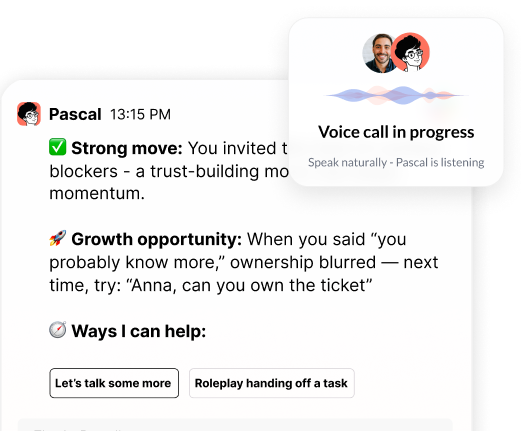
AI coaching that requires managers to leave their workflow and log into another platform fails. The most effective solutions embed directly in Slack, Teams, and meeting tools where managers already work. The AI can join video meetings (with permission), transcribe conversations, and provide feedback afterward—or managers can message it directly before a difficult conversation to think through their approach.
Generic chatbots trained on public internet data give advice that contradicts your company's values and leadership principles. Purpose-built platforms trained by professional coaches and customized with your competency models deliver guidance that aligns with how your organization approaches leadership.
A retail company piloted a generic AI chatbot before switching to a purpose-built coaching platform. The chatbot suggested a manager "document everything and build a case for termination" when asked about an underperforming employee. The company's culture emphasized coaching and development first, with termination as a last resort after documented improvement attempts. The generic advice contradicted company values and could have created legal exposure. The purpose-built platform, trained on the company's performance management framework, suggested a structured improvement plan with clear milestones and support resources.
Quality control means ongoing monitoring and refinement. Organizations should establish feedback mechanisms where managers can flag unhelpful or inappropriate coaching responses. They should regularly review aggregated coaching conversations to ensure the AI provides guidance consistent with company values. They should update the AI's training as company policies, leadership frameworks, or strategic priorities evolve.
Measuring AI coaching success requires looking beyond login rates to behavioral change, manager effectiveness improvements, and team-level outcomes. The most meaningful metrics track whether managers are having better conversations, making better decisions, and creating better employee experiences.
Track manager effectiveness through direct report feedback. Pulse surveys (short, frequent check-ins sent monthly or quarterly) asking "My manager provides helpful, timely feedback" and "My manager helps me grow in my role" reveal whether coaching translates to better management behavior.
Monitor HRBP escalation rates. If AI coaching handles routine guidance, HRBPs should see fewer low-complexity manager questions and more time for strategic work. A 30–40% reduction in routine escalations within 90 days indicates the system is working.
Measure retention of high performers (employees you'd fight to keep—top performers in critical roles whose departure would hurt the business). Compare regrettable attrition rates before and after AI coaching deployment, controlling for other variables.
Analyze aggregated coaching data for skill gaps. If 45% of managers request guidance on delivering critical feedback, build a targeted workshop on feedback frameworks. If 30% ask about delegation, create resources on workload management. Use coaching data to inform targeted development programs, not generic leadership training.
Additional success metrics include manager confidence scores, measured through periodic surveys asking managers to rate their confidence in handling various leadership situations. Track time-to-competency for new managers, measuring how quickly they reach performance milestones compared to historical baselines. Monitor the quality of performance reviews and development plans, using rubrics to assess whether they're more specific, actionable, and aligned with company standards.
Track leading indicators that predict longer-term outcomes. An increase in coaching conversations about career development often precedes improvements in retention. An increase in coaching requests about delegation and prioritization often precedes improvements in team productivity. By monitoring these patterns, HR leaders can identify early signals of success and adjust their implementation strategy.
Coaching has been limited to executives due to cost ($15K–$50K per person annually) and supply constraints, creating misalignment between where coaching dollars go and where impact lives.
Democratizing coaching through AI platforms extends access to 200–2,000+ managers at $250–$750 per person annually while maintaining quality through professional coaching frameworks and company-specific customization.
Organizations see measurable ROI through four channels: direct cost savings (reduced HR capacity strain), improved manager effectiveness, faster skill development, and reduced attrition.
Building the business case requires leading with cost avoidance (manager turnover, HRBP capacity), showing utilization gaps in existing learning tools, and piloting with high-impact populations to let data drive broader rollout decisions.
Implementation success depends on deploying purpose-built platforms that integrate with daily workflows (Slack, Teams, meetings), maintain enterprise-grade security, and provide company-specific guidance—not generic chatbot advice.
The case for democratizing coaching isn't about replacing human coaches or eliminating learning programs. It's about scaling personalized, contextual guidance to the people who need it most: the managers who shape daily employee experience.
Ready to explore how AI coaching can scale leadership development at your organization? Pinnacle helps companies build manager capability at scale through AI coaching platforms customized to your leadership frameworks and values. Contact us to discuss your specific needs.

.png)
.webp)
“Thank you for setting the great foundation for my promotion; now I have a plan!"

Curious to see how AI Coaching can 10X the impact and scale of your development initiatives. Book a demo today for: