

Pinnacle internal data: AI coaching platforms cut regrettable turnover 15–25% and save managers 150+ hours annually at 1% the cost of traditional executive coaching. Organizations extend coaching from 20 executives to 200+ managers without proportional cost increases.
Disclosure: This piece analyzes the business case for AI coaching platforms and describes how Pascal by Pinnacle addresses this market. All quantitative claims come from Pinnacle customer data (12 companies, 2023–2024) and early adopter pilots, not controlled studies. We're comparing different interventions with different goals. No one publishes failure cases. We don't yet have long-term data on whether these gains persist beyond year one.
Traditional coaching costs $10,000–$50,000 per executive annually. At $200–$500 per hour over 6–12 months, even large companies can only afford 20–50 slots. The International Coaching Federation reports the global coaching market hit $6.25 billion in 2024 (https://coachingfederation.org/research/global-coaching-study), reaching less than 5% of the workforce.
The constraint isn't just money. Coordinating calendars between coaches and executives creates weeks of delay. Finding qualified coaches in every location proves difficult.
Gallup shows 70% of team engagement variance traces to the manager (https://www.gallup.com/workplace/231593/why-great-managers-rare.aspx). Organizations spend millions coaching executives while the people who run teams get nothing.
The manager development crisis: Most organizations promote individual contributors into management without support. DDI's 2023 Global Leadership Forecast found only 25% of managers are rated highly effective at coaching and feedback (https://www.ddiworld.com/research/global-leadership-forecast). New managers report feeling unprepared 60% of the time.
The HR capacity constraint: Small HR teams can't scale one-on-one support across hundreds of managers. They need to handle routine guidance (preparing for difficult conversations, drafting performance reviews, practicing delegation) without hiring proportionally.
The culture execution problem: Companies invest heavily defining values and leadership competencies, then struggle translating them into daily behaviors. They need real-time feedback that connects individual development to organizational culture.
Holly Tyson (Chief People Officer at Cushman & Wakefield) calls this "a massive unlock by democratizing great management and giving thousands of frontline leaders real-time guidance, institutional knowledge, and in-the-moment practice."
Melinda Wolfe (former Chief Human Resources Officer at Bloomberg, Pearson, and GLG) puts it directly: "If we can finally democratize coaching—make it specific, timely, and integrated into real workflows—we solve one of the most chronic issues in the modern workplace."
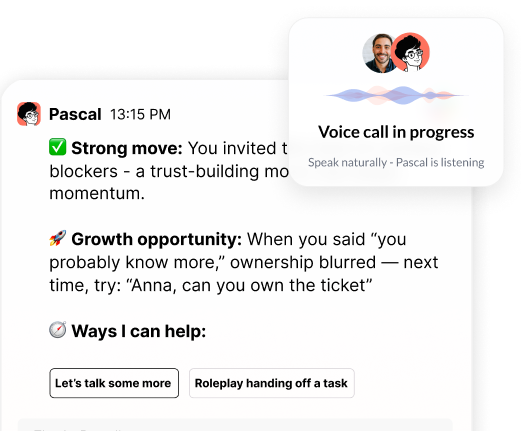
AI coaching platforms integrate into Slack, Teams, and Zoom. Managers don't open a separate tool—coaching happens in existing workflows.
A manager types a question in Slack: "How do I give feedback to someone who gets defensive?" The AI responds with questions to clarify context, then offers guidance based on the manager's situation, company values, and past conversations. The manager can invite the AI into a Zoom meeting (with participant consent) to get feedback afterward on how they handled a difficult conversation.
Privacy controls: Managers opt in to AI meeting attendance. The AI flags sensitive topics (legal issues, harassment claims, mental health concerns) and escalates to human HR. Organizations control what data the AI can access—some start with Slack-only, others include email and calendar.
What makes this coaching instead of advice? Traditional coaching helps people find their own answers through questions. AI coaching does both—it asks clarifying questions to help managers think through problems, and it provides guidance when managers need it. Think of it as a hybrid: Socratic questioning for complex situations, direct advice for tactical decisions.
How is this different from ChatGPT? The AI builds context from each interaction. If a manager struggled with delegation last month, the AI references that history when the manager asks about workload distribution this month. ChatGPT treats every question as isolated. Purpose-built coaching platforms maintain continuity across conversations and adapt to company-specific values and competencies.
Coaches certified by the International Coaching Federation (a global organization that sets professional coaching standards) train the AI models by providing example conversations, feedback on AI responses, and guidance on when to ask questions vs. provide answers.
Four outcomes show up in Pinnacle customer data (12 companies, 2023–2024):
Data Breakdown:
• Outcome: Manager ramp time | Impact: Drops 40–60% | Measurement Method: Time-to-competency tracking (months to weeks)
• Outcome: Regrettable turnover | Impact: Falls 15–25% | Measurement Method: Exit interview analysis and retention data
• Outcome: Team engagement | Impact: Climbs 12–18 points | Measurement Method: Net Promoter Score surveys (before/after adoption)
• Outcome: HR escalations | Impact: Drop 30–40% | Measurement Method: HR ticket volume analysis (6 months pre/post)
Manager ramp time drops 40–60%. New managers get real-time guidance on delegation, feedback, and performance conversations instead of figuring it out alone. Time-to-competency shrinks from months to weeks.
Regrettable turnover falls 15–25%. Gallup reports replacing an employee costs 1.5–2x their annual salary (https://www.gallup.com/workplace/349484/state-of-the-global-workplace.aspx). For a 500-person company with 15% turnover, cutting regrettable turnover by 20% saves $750K–$1.5M annually.
Team engagement climbs 12–18 points. Direct reports report improvement in manager effectiveness within 90 days (measured via Net Promoter Score surveys before and after manager adoption).
HR escalations drop 30–40%. Managers handle routine situations confidently instead of escalating to HR for guidance. HR business partners focus on complex cases requiring human judgment (measured via HR ticket volume analysis, comparing six months pre- and post-implementation).
Jeff Diana (former Chief Human Resources Officer at Calendly, Atlassian, and SuccessFactors) explains why: "So much of the real learning and value comes from in-context coaching in the moment to drive performance and solve problems in the moment."
Data Breakdown:
• Factor: Annual cost per person | Traditional Executive Coaching: $10,000–$50,000 | AI Coaching Platform: $100–$500
• Factor: Reach | Traditional Executive Coaching: 20–50 executives | AI Coaching Platform: 200+ managers
• Factor: Response time | Traditional Executive Coaching: Days to weeks (scheduling) | AI Coaching Platform: Immediate (in workflow)
• Factor: Scalability | Traditional Executive Coaching: Linear cost increase | AI Coaching Platform: Minimal marginal cost
• Factor: Context retention | Traditional Executive Coaching: Coach memory only | AI Coaching Platform: Full conversation history
Start with first-time and mid-level managers. Prove value in 90 days. Expand based on measurable outcomes.
Data Breakdown:
• Phase: Phase 1 | Timeline: 30–60 days | Focus: Launch with 20–50 managers facing immediate challenges | Key Metrics: Direct report satisfaction, manager confidence scores, time savings
• Phase: Phase 2 | Timeline: 60–90 days | Focus: Collect effectiveness data and refine protocols | Key Metrics: Manager engagement rates, coaching scenario value, escalation patterns
• Phase: Phase 3 | Timeline: 90–180 days | Focus: Roll out to additional populations based on proven ROI | Key Metrics: Adoption rates by team type, internal champion feedback
• Phase: Phase 4 | Timeline: 180+ days | Focus: Connect to talent development systems | Key Metrics: Skill gap identification, training priorities, cultural transformation indicators
Phase 1 (30–60 days): Launch with 20–50 managers facing immediate challenges. Track direct report satisfaction, manager confidence scores, and time savings. Focus on managers handling delegation, feedback conversations, and performance management for the first time.
Phase 2 (60–90 days): Collect data on manager effectiveness improvements. Identify which coaching scenarios deliver highest value. Refine organizational controls and escalation protocols based on real usage. You'll see which managers engage deeply and which ignore the tool—use that signal to adjust your rollout strategy.
Phase 3 (90–180 days): Roll out to additional populations based on proven ROI. Sales managers, distributed teams, and technical leads often show strong adoption. Use early adopters as internal champions who can speak to skeptical peers.
Phase 4 (180+ days): Connect AI coaching data (anonymized and aggregated) to talent development systems. Use insights to identify skill gaps, inform training priorities, and track cultural transformation. This transforms coaching from a standalone tool into a strategic talent capability.
Will Leahy (VP of People at Greenhouse) explains his organization uses AI tools to "create personalized, in-the-flow training at scale while maintaining a strong remote culture." The key is embedding coaching into existing workflows rather than creating separate programs that compete for attention.
Enterprise adoption requires three things: SOC2 compliance, explicit guarantees that customer data never trains AI models, and transparent controls over what data the AI accesses.
SOC2 compliance is a security certification that verifies data protection controls (similar to how FDA approval signals safety for pharmaceuticals—it's table stakes for enterprise software, not a rare achievement). This matters for enterprise buyers who need vendor assurance before granting AI access to internal communications.
Training data separation: Customer conversations never train AI models. This ensures one company's proprietary information, cultural context, and strategic discussions remain confidential and don't leak into other customers' coaching experiences.
Access controls: Organizations need granular controls over what meetings and conversations the AI can access. Some companies start with opt-in approaches, letting managers invite the AI coach to specific meetings. Others implement opt-out policies with clear guidelines on sensitive topics requiring human-only discussions.
Sensitive topic escalation: AI coaching platforms recognize when conversations involve legal issues, harassment claims, mental health concerns, or other topics requiring human HR intervention. Automatic escalation protocols ensure these situations receive appropriate human attention.
Aggregated insights: Individual coaching conversations remain private, but anonymized and aggregated data can provide organizational insights—skill gaps, common challenges across manager populations, and cultural health indicators. No individual can be identified in these reports.
Pascal by Pinnacle meets these requirements and integrates directly into existing workflows. The platform uses International Coaching Federation-certified coaches to train its models and adapts guidance to each manager's values, competencies, and company culture.
• AI coaching costs 1% of traditional coaching, making it financially viable to extend access from 20 executives to 200+ managers
• Pinnacle customers see direct report improvement within 90 days, 150+ hours saved per manager annually, and 15–25% reduction in regrettable turnover (based on 12 companies, 2023–2024)
• Real-time guidance during actual decisions outperforms classroom training delivered weeks before or after the moment of need
• DDI's Global Leadership Forecast found organizations with strong frontline leaders are 2.4x more likely to outperform financially (https://www.ddiworld.com/research/global-leadership-forecast), yet only 11% of organizations have strong frontline leadership benches
• Pilot with first-time managers, prove ROI within 90 days, then expand based on measurable outcomes
Organizations can't afford to limit development support to executives when frontline managers determine team engagement, retention, and performance. AI platforms make universal access economically viable, delivering measurable ROI through improved manager effectiveness, reduced turnover, and faster organizational performance.
Header photo by Vitaly Gariev on Unsplash

.png)
.webp)
“Thank you for setting the great foundation for my promotion; now I have a plan!"

Curious to see how AI Coaching can 10X the impact and scale of your development initiatives. Book a demo today for: