

Democratizing coaching beyond the C-suite isn't just equitable—it's a business imperative that delivers 3–5× ROI within 18 months by improving manager effectiveness, reducing turnover, and accelerating skill development at a fraction of traditional coaching costs. When every manager has access to personalized, contextual guidance, organizations accelerate leadership capability at scale while reaching populations who would never access traditional coaching.
Quick Takeaway: Democratizing coaching means extending personalized development support beyond senior leaders to every manager and employee through scalable formats like AI coaching, group programs, and hybrid models that reduce cost-per-person from $3,000–$15,000 annually to $30–$150. This shift transforms coaching from a C-suite perk into an organizational capability that reaches everyone, delivering measurable ROI through faster manager ramp time, improved feedback quality, and sustained behavior change.
The coaching industry has fundamentally shifted. 38% of organizations now offer coaching to mid-level managers and 32% to frontline leaders, with nearly 70% planning to expand access further over the next two years. This expansion reflects a critical insight: manager quality directly determines team performance and retention, yet most organizations reserve development support for the top 5% while leaving first-time managers to figure it out alone.
Democratized coaching means extending personalized development support beyond senior leaders to every manager and employee through scalable formats like AI coaching, group programs, and hybrid models that reduce cost-per-person from $3,000–$15,000 annually to $30–$150. This shift transforms coaching from an exclusive executive benefit into an organizational capability that reaches everyone.
Traditional executive coaching has long been the gold standard, yet only reaches 5–10% of manager populations due to cost constraints. Virtual coaching adoption jumped to 72% in 2023 from 40% in 2020, eliminating geographic barriers and making distributed coaching viable. 70% of clients prefer flexible payment structures and group coaching, lowering entry barriers for broader populations. The economics shift dramatically when you move from one-on-one to group and hybrid models. Group coaching yields $20,000 from 20 clients at $1,000 each for equivalent coach time, enabling coaches to extend impact while reducing per-person costs.
Manager quality directly determines team performance and retention, yet most organizations reserve development support for the top 5% while leaving first-time managers to figure it out alone. Democratizing coaching closes this gap by ensuring every manager receives consistent guidance at the moment they need it.
70% of employee engagement variance is determined by the manager, according to Fortune's analysis of Gallup research. 57% of people quit jobs because of bad managers, according to Gallup. Organizations with strong manager development see up to 114% higher sales and 70% lower turnover among high-potentials. 87% of high-performing organizations actively support new leaders during transition, compared to just 38% of lower performers according to MindTools research.
This gap explains why regrettable turnover concentrates around poor manager relationships. When you examine where coaching happens today, the inequity becomes stark. Melinda Wolfe, former CHRO at Bloomberg and Pearson, calls it the "permafrost layer"—mid-level management where momentum stalls. Organizations invest heavily in executive coaching for senior leaders while first-time managers, who need support most urgently, receive minimal guidance.
Organizations democratizing coaching see faster manager ramp time (30–40% reduction), higher quality feedback conversations, improved performance review consistency, and measurable behavior change—outcomes that directly address CHRO KPIs and connect to business performance.
83% of direct reports see measurable improvement in their manager when coaching is accessible and proactive. 20% average lift in Manager Net Promoter Score appears among highly engaged coaching users. New managers reach baseline effectiveness 30–40% faster with consistent, contextual guidance. Performance review quality improves when every manager has access to coaching on feedback delivery and goal-setting. Organizations can identify emerging team health issues through aggregated coaching patterns before they escalate into formal complaints.
The retention impact alone justifies investment. When managers receive consistent coaching support, their direct reports experience better leadership, which correlates with higher engagement and lower voluntary turnover. For organizations struggling with talent retention, democratized coaching becomes a strategic retention lever that addresses the root cause of departures.
Purpose-built AI coaching reduces per-person cost to 1–2% of human coaching while delivering comparable outcomes for foundational skill development, proactive engagement, and behavioral habit formation. This economics shift makes organization-wide coaching affordable for the first time.
The coaching industry reached $6.25 billion in 2024 with 109,200 credentialed practitioners, signaling professionalization that supports broader access. AI can provide up to 90% of day-to-day coaching functions, with human coaches reserved for complex situations. AI coaching delivers at 1/20th to 1/100th the cost of human coaching, making universal access viable for the first time.
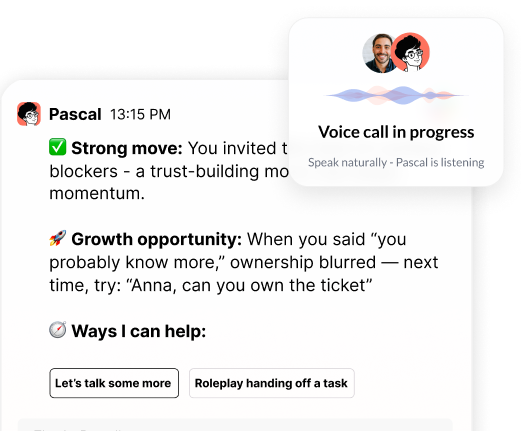
Purpose-built AI coaching platforms deliver coaching at scale while delivering comparable outcomes for foundational skill development. Pascal combines purpose-built coaching expertise, contextual awareness of your people and culture, proactive engagement in daily workflows, and appropriate guardrails for sensitive topics—enabling coaching at scale while protecting organizational integrity.
Start by quantifying current state gaps (manager effectiveness variance, turnover costs tied to poor leadership), then compare scenarios: cost of status quo versus cost of democratized coaching. Most organizations find ROI obvious within 18 months.
Calculate fully loaded replacement cost per manager departure; multiply by voluntary turnover rate to establish baseline cost of inaction. Survey managers on coaching access; most organizations find 90%+ of non-executive managers receive zero formal development. Melinda Wolfe emphasizes making the business case through survey data, internal feedback, and performance trends. Everyone knows it's a problem. Your job is proving it's also a priority.
Pilot with a willing cohort; measure leading indicators (adoption, engagement) alongside outcome metrics (manager effectiveness scores, team engagement). Involve HR and IT early; align on governance, data privacy, and escalation protocols for sensitive topics. Three veteran CHROs recently joined Pinnacle as strategic advisors, bringing decades of experience scaling people programs. Their consistent insight: organizations that build clear business cases, pilot with intention, and measure rigorously see adoption and impact exceeding expectations.
| Metric | Traditional Coaching | Democratized AI Coaching |
|---|---|---|
| Cost per manager annually | $3,000–$15,000 | $30–$150 |
| Managers reached per $1M budget | 67–333 | 6,667–33,333 |
| Availability | Scheduled sessions only | 24/7, in the moment |
| Contextual awareness | Limited to what's shared | Integrates performance data, goals, team dynamics |
"If we can finally democratize coaching, make it specific, timely, and integrated into real workflows, we solve one of the most chronic issues in the modern workplace."
Pascal combines purpose-built coaching expertise, contextual awareness of your people and culture, proactive engagement in daily workflows, and appropriate guardrails for sensitive topics—enabling coaching at scale while protecting organizational integrity.
Pascal integrates with HRIS, performance data, and communication tools to deliver personalized guidance informed by actual work context. Lives inside Slack, Teams, and Zoom where managers already work, eliminating adoption friction. Draws from 50+ proven leadership frameworks and ICF-certified coaching principles. Includes moderation systems and escalation protocols that recognize sensitive topics and route to HR appropriately.
The organizational insights that emerge from scaled coaching represent an underutilized opportunity. When you have visibility into what challenges managers face across your organization, you can make strategic decisions about where to focus development resources, which team dynamics need intervention, and where systemic issues exist before they become crises. This shifts HR from reactive problem-solving to proactive pattern recognition.
"We haven't had the people power to provide this level of guidance. Now we finally do and it's scalable."
Organizations like HubSpot and Zapier are demonstrating what becomes possible when AI coaching is designed specifically for manager development. At HubSpot, 98% of employees used AI tools on the job after implementing proactive systems, with 84% feeling comfortable doing so. The hybrid model combining AI coaching for daily skill development with quarterly human coach interventions for complex situations delivers measurable team engagement improvements.
Key Insight: The organizations winning today aren't waiting for perfect clarity. They're piloting purpose-built AI coaching platforms that combine contextual awareness, proactive engagement, and appropriate guardrails—then measuring impact in real time.
Book a demo to explore how Pascal democratizes coaching access across your organization and delivers the measurable outcomes your business needs. Discover how purpose-built AI coaching helps new managers develop faster, improves feedback quality across your leadership population, and proves ROI through adoption, behavior change, and team outcomes.

.png)
.webp)
“Thank you for setting the great foundation for my promotion; now I have a plan!"

Curious to see how AI Coaching can 10X the impact and scale of your development initiatives. Book a demo today for: