

Manager enablement delivers real-time coaching to managers through the tools they already use. Instead of quarterly workshops, managers get guidance at the moment they need it (before a difficult conversation, during a performance review, when handling team conflict).
Remote work broke traditional manager development. The hallway conversation with your boss disappeared. New managers can't watch senior leaders handle difficult moments. The informal learning system that developed management skills for decades stopped working in 2020.
At the same time, managers became player-coaches: delivering individual results while developing teams and navigating constant change. Gallup research shows managers account for 70% of the variance in employee engagement scores, yet only 35% of managers report being engaged themselves. When managers fail at critical moments, the costs multiply: broken trust, poor decisions, legal exposure, disengaged teams.
AI made scalable, personalized coaching possible. What used to require an executive coach (expensive, limited to senior leaders) now works through Slack or Teams. Every manager can access expert guidance, not just the top 5%.
Manager enablement provides contextual coaching in the flow of work. A manager opens Slack 10 minutes before a performance review. They type: "How do I tell my top performer their promotion is delayed?" They get a structured framework, specific language to use, and follow-up questions to anticipate. The conversation happens in 90 seconds, not a 60-minute coaching session scheduled three weeks out.
This differs from training in five ways:
Data Breakdown:
• Dimension: Timing | Traditional Training: Quarterly workshops | Manager Enablement: Real-time support
• Dimension: Content | Traditional Training: Generic frameworks | Manager Enablement: Situation-specific guidance
• Dimension: Accessibility | Traditional Training: Senior leaders only | Manager Enablement: All managers
• Dimension: Reinforcement | Traditional Training: Minimal follow-up | Manager Enablement: Continuous practice
• Dimension: Measurement | Traditional Training: Completion rates | Manager Enablement: Behavioral change
Training teaches concepts in a classroom. Enablement delivers answers at the moment of need.
Employee engagement programs measure sentiment. Manager enablement creates the conditions that drive sentiment. You can't improve engagement scores without improving manager capability.
15Five research confirms managers account for 70% of variance in engagement. Engagement surveys tell you what needs improvement. Enablement gives managers the how.
A manager learns their team's engagement scores dropped. Without enablement, they schedule 1:1s and ask vague questions ("How are you feeling about work?"). With enablement, they get specific conversation frameworks: questions to diagnose root causes, language to address concerns, follow-up actions to rebuild trust. The engagement initiative succeeds because managers know what to do with the data.
Effective manager enablement combines five elements:
Real-time access. Managers get guidance before critical moments, not after. A Slack message delivers coaching in 60 seconds. Scheduling a meeting with HR takes three days.
Workflow integration. The tool lives inside Slack, Teams, or Zoom. Managers won't context-switch to a separate application. Adoption dies when you add friction.
Organizational customization. Generic advice fails. Coaching must reflect your company's values, culture, and specific challenges. A startup's approach to performance reviews differs from a 10,000-person enterprise.
Behavioral data. The platform shows what managers struggle with (difficult conversations, delegation, feedback delivery). You build training based on real challenges, not assumptions about what managers need.
Continuous reinforcement. Behavior change requires repeated practice. One workshop doesn't create new habits. Daily micro-coaching does.
Start with a 30-60 day pilot targeting 20-50 managers during performance review season. Choose managers whose success or failure has visible impact. Measure three things:
Leading indicators (predict future success):
• Platform usage frequency
• Manager confidence scores before difficult conversations
• Time from challenge to resolution
• Repeat usage rates
Lagging indicators (prove ROI):
• Manager Net Promoter Scores from direct reports
• Team engagement survey results
• Retention rates for high-adoption managers
• HR business partner hours freed up
Qualitative feedback:
• What moments did the platform help with?
• Where did it fall short?
• What would make managers use it more?
After 60 days, calculate ROI. Compare HR business partner hours spent coaching managers before and after. Measure engagement score changes for pilot teams versus control groups. Track manager confidence improvements through surveys.
Expand based on results. Add manager cohorts quarterly. Integrate enablement into existing processes: onboarding, performance reviews, quarterly check-ins.
Manager skepticism. Don't launch with company-wide announcements. Start with managers facing immediate challenges and let results spread organically. Skepticism dissolves when managers experience value in real moments.
Inconsistent adoption. Managers won't use a separate application. Choose platforms that work inside tools they already open 50 times per day.
Treating this as a technology deployment. Technology enables enablement, but success requires leadership modeling. If executives don't use the platform, managers won't either.
Measuring the wrong things. Completion rates and satisfaction scores don't matter. Behavioral change and team outcomes do. Track 1:1 frequency, feedback quality, and direct report engagement scores.
Traditional leadership development reaches 5-10% of managers through cohort programs and executive coaching. Enablement platforms support 100% of your management population while providing visibility into who develops fastest.
First-time managers represent your future senior leadership. Enablement platforms show who applies coaching quickly, improves team outcomes, and handles complexity well. You identify high-potential leaders through behavioral data, not performance reviews written by managers with inconsistent standards.
At Pinnacle, we've seen this pattern: managers who engage deeply with enablement in their first 90 days outperform peers on engagement scores 18 months later. Early adoption predicts long-term effectiveness.
• Remote work broke informal manager development; AI made scalable coaching possible
• Manager enablement delivers real-time guidance through existing tools (Slack, Teams) at the moment of need
• Start with 30-60 day pilots during high-stakes moments (performance reviews, restructuring) and measure behavioral change, not completion rates
• Effective enablement combines real-time access, workflow integration, organizational customization, behavioral data, and continuous reinforcement
• Success requires leadership modeling and integration into existing people processes, not just technology deployment
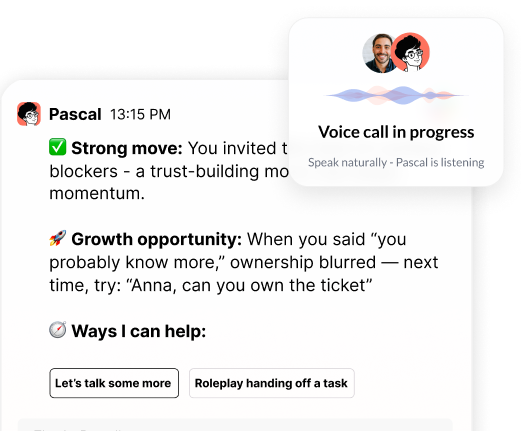
Ready to see how this works in practice? Pascal delivers real-time coaching inside Slack at the moments managers need it most.
Header photo by Vitaly Gariev on Unsplash

.png)
.webp)
“Thank you for setting the great foundation for my promotion; now I have a plan!"

Curious to see how AI Coaching can 10X the impact and scale of your development initiatives. Book a demo today for: