

In-the-flow-of-work coaching delivers guidance when managers need it—during meetings, Slack conversations, and daily decisions—rather than pulling them into scheduled training. It embeds learning into existing workflows instead of adding separate tasks.
What you'll learn:
• How in-the-flow coaching works inside tools managers already use
• Why it drives higher engagement than traditional courses
• What problems it solves that training can't
• How to implement it without disrupting workflows
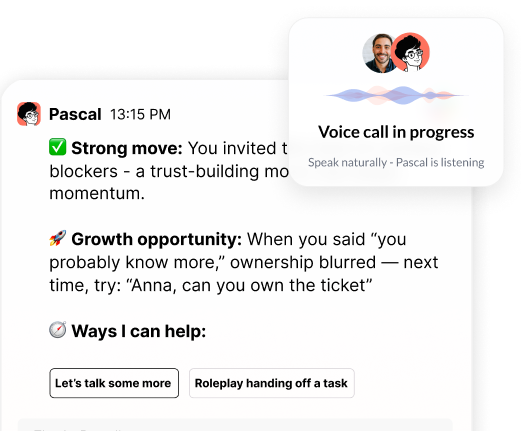
In-the-flow-of-work coaching happens inside the tools managers already use—Slack, Zoom, email—rather than requiring them to log into a separate platform. An AI coach observes interactions (with manager permission), provides feedback afterward, and surfaces guidance before high-stakes moments.
Traditional learning platforms see 5-15% engagement within six months. Pascal by Pinnacle maintains 94% monthly retention with 2.3 sessions per week because it meets managers where they spend 40+ hours weekly.
The shift moves from "stop working to learn" to "learn while working." A manager receives feedback on a difficult 1-on-1 within minutes of the meeting ending, not weeks later in a quarterly review. Pascal plugs directly into Slack, Microsoft Teams, Zoom, and Google Meet.
Managers don't have bandwidth for another login. They need support embedded where they already spend time.
Data Breakdown:
• Dimension: Timing | Traditional Courses: Scheduled, calendar-based | In-the-Flow Coaching: Moment of need
• Dimension: Personalization | Traditional Courses: Generic content for groups | In-the-Flow Coaching: Contextual, individual guidance
• Dimension: Cost per employee | Traditional Courses: $50-150 annually (LMS) + $200-500/hour (coaching) | In-the-Flow Coaching: Fraction of traditional costs
• Dimension: Engagement rate | Traditional Courses: 5-15% within 6 months | In-the-Flow Coaching: 94% monthly retention
• Dimension: Application | Traditional Courses: 10-20% apply skills | In-the-Flow Coaching: Immediate application
• Dimension: Scalability | Traditional Courses: Limited to executives | In-the-Flow Coaching: All managers, all levels
Courses deliver generic information at scheduled times. In-the-flow coaching delivers personalized guidance when a manager faces a real challenge.
A course on "difficult conversations" teaches theory in a conference room. In-the-flow coaching helps you navigate the actual difficult conversation you're having tomorrow with your underperforming team member.
Traditional training has a 10-20% application rate. Contextual coaching drives immediate behavior change because it's attached to real work. Human coaching costs $200-500 per hour and reaches fewer than 5% of employees. AI coaching reaches everyone—from first-time managers to senior directors.
"So much of the real learning and value comes from in-context coaching in the moment to drive performance and to solve problems in the moment." — Jeff Diana, Former CHRO at Calendly, Atlassian, and SuccessFactors
Courses rely on one-time knowledge transfer. In-the-flow coaching uses spaced repetition across weeks and months, creating muscle memory through repeated practice.
In-the-flow coaching solves the "knowing-doing gap"—the disconnect between understanding a concept and applying it under pressure. When guidance arrives at the moment of need, managers apply it immediately, creating muscle memory through repeated practice rather than relying on recall from a workshop they attended months ago.
Pascal users report 83% of direct reports see manager improvement (based on direct report surveys conducted 90 days after implementation). Managers save 150+ hours annually on development activities.
The practice advantage compounds over time. Managers get 2-3 coaching moments per week (a "moment" is a specific piece of feedback tied to a real interaction—a meeting, a Slack thread, an email) compared to 2-3 training sessions per year. Continuous micro-improvements build into capability gains over 3-6 months.
Immediate feedback loops create faster skill acquisition than delayed assessment. When a manager receives guidance within minutes of a challenging conversation, they can reflect while the details are fresh and adjust their approach for the next interaction.
Small wins accumulate. A manager who gets real-time feedback on delegation, communication clarity, and accountability conversations develops competence through consistent reinforcement, not through remembering slides from a workshop.
In-the-flow coaching addresses three chronic failures of traditional training: low engagement (managers don't complete courses), poor transfer (they don't apply what they learn), and inability to scale (you can't coach everyone). By embedding guidance into existing workflows, it eliminates the activation energy required to seek help and provides support when managers are most receptive to learning.
Even personalized learning content suffers from low engagement when it's not attached to actual work context. Managers attend workshops, nod along, then revert to old habits under pressure.
The scale barrier is economic. Traditional coaching reaches only executives because of cost constraints. In-the-flow AI coaching democratizes access to all 200-4,000 employees.
Courses can't track whether managers apply skills. Pascal observes actual behavior in meetings and provides data on application rates. HR leaders see whether development investments change behavior or just check compliance boxes.
Managers don't need to remember to seek help—the coach surfaces guidance proactively. When a manager enters a performance review meeting, the AI coach can surface relevant frameworks before the conversation starts, not after the damage is done.
Learning and development budgets shift from underutilized LMS subscriptions ($50-150 per employee annually) to high-engagement coaching. The ROI calculation becomes straightforward: measure engagement rates, behavior change, and manager effectiveness scores.
Start with first-time and mid-level managers—the population with highest need and fastest ROI—then expand based on measured adoption and satisfaction thresholds. Integration should be opt-in initially, with the AI coach joining meetings only when invited, building trust through value delivery before scaling organization-wide.
Phased rollout:
• Pilot with 20-50 managers for 60-90 days
• Measure engagement rates, satisfaction scores, and behavior change indicators
• Expand to 200-500 managers once you hit 70%+ weekly active usage (managers who interact with the coach at least once per week) and 4.0+ satisfaction scores
Pascal plugs into existing tools—Slack, Teams, Zoom, Meet—without requiring new logins or workflow changes. The integration happens where work already happens, not in a separate platform managers need to remember.
Privacy framework: SOC2 compliance, anonymous aggregated insights (individual manager data is visible only to that manager, not to HR or leadership), and a commitment to never train on customer data. This matters for regulated industries like financial services and healthcare. Pascal's enterprise-grade security means customer data stays protected while managers get personalized guidance.
Change management requires clarity on what the AI coach does and doesn't do. It's not surveillance—it's support. Managers control when Pascal joins meetings. The coach provides feedback to help them improve, not to evaluate them for HR.
Success metrics to track:
• Weekly active usage rates (target: 70%+)
• Manager satisfaction scores (target: 4.0+ out of 5)
• Direct report feedback on manager effectiveness (target: 15%+ improvement)
• Time saved on manager development (target: 100+ hours annually)
• Behavior change indicators (delegation frequency, feedback quality, 1-on-1 consistency)
The implementation timeline spans 3-6 months from pilot to full rollout. Month 1: pilot launch with early adopters. Month 2: gather feedback and refine. Month 3: expand to broader manager population. Months 4-6: measure sustained behavior change and prepare for organization-wide scaling.
• In-the-flow-of-work coaching embeds guidance into existing tools like Slack, Teams, and Zoom, eliminating the friction that kills traditional training adoption and driving 94% monthly retention compared to 5-15% for learning platforms.
• Immediate feedback at the moment of need drives higher application rates than courses because managers apply skills to real work immediately, creating muscle memory through repeated practice.
• The knowing-doing gap narrows when coaching happens during actual work rather than in scheduled sessions—managers don't need to recall workshop content from months ago.
• Start with first-time and mid-level managers to prove ROI quickly, then expand based on measured adoption thresholds of 70%+ weekly active usage and 4.0+ satisfaction scores.
• Enterprise-grade privacy and SOC2 compliance are non-negotiable for regulated industries—Pascal never trains on customer data while delivering personalized guidance to every manager.
Ready to see how in-the-flow coaching works in practice? Explore how Pascal delivers AI coaching inside Slack, Teams, and your meetings to scale manager development across your organization.

.png)
.webp)
“Thank you for setting the great foundation for my promotion; now I have a plan!"

Curious to see how AI Coaching can 10X the impact and scale of your development initiatives. Book a demo today for: