
AI coaching integrates organizational context, behavioral data, and coaching frameworks to deliver personalized leadership guidance in the flow of work. Chatbots respond to queries with generic advice. AI coaches understand your people, culture, and the moments when guidance matters most.
Confusing AI coaching with chatbots leads to failed implementations and wasted budgets. AI coaching is designed for leadership development with coaching methodologies, organizational context, and behavioral change frameworks built into its architecture. Chatbots are conversational interfaces built for information retrieval and task completion.
Coaching methodology separates the two. AI coaches apply ICF-certified coaching frameworks that guide managers through structured development. Chatbots provide conversational responses without coaching philosophy or behavioral science foundation.
Contextual awareness determines effectiveness. AI coaches maintain records of team dynamics, goals, and interaction history. They understand who reports to whom, what challenges each manager faces, and how communication patterns evolve. Chatbots lack this persistent memory of organizational relationships.
Proactive engagement changes outcomes. AI coaches surface guidance after a difficult meeting, before a performance review, when patterns emerge. Chatbots wait for user queries, requiring managers to remember to seek help.
Integration depth drives adoption. AI coaches embed in workflow tools like Slack, Teams, and Zoom, meeting managers where work happens. Chatbots exist as standalone applications that require context-switching.
Data Breakdown:
• Capability: Coaching methodology | AI Coaching: ICF-certified frameworks, behavioral science | Chatbots: Conversational AI, information retrieval
• Capability: Organizational context | AI Coaching: Deep integration with culture, competencies, values | Chatbots: Generic or minimal customization
• Capability: Memory & continuity | AI Coaching: Persistent records of relationships, goals, history | Chatbots: Session-based or no memory
• Capability: Engagement model | AI Coaching: Proactive, surfaces guidance at critical moments | Chatbots: Reactive, requires user to initiate
• Capability: Workflow integration | AI Coaching: Embedded in Slack, Teams, Zoom, email | Chatbots: Standalone app or basic integrations
• Capability: Development tracking | AI Coaching: Longitudinal behavior change measurement | Chatbots: Transaction-based interactions
You need AI coaching when your goal is sustained manager behavior change, not information access. If managers need to develop skills like giving feedback, delegating, or navigating difficult conversations, a chatbot won't deliver results. It lacks the coaching structure, contextual awareness, and proactive engagement required for behavioral development.
Choose AI coaching when:
• Engagement surveys reveal weak management as a top issue
• You're spending on executive coaching but can't scale to all managers
• Learning platforms show under 20% utilization rates
• New managers receive minimal support during their first 90 days
• You need real-time insights into management quality across the organization
• Your HR business partners spend excessive time on routine manager guidance
Choose chatbots when:
• Your primary need is answering policy questions or HR information retrieval
• You want to automate FAQ responses for benefits, time-off, or procedures
• Your use case is transactional (scheduling, form completion, status checks)
• You don't need behavioral development or skill-building outcomes
Red flags that indicate you're being sold a chatbot disguised as AI coaching:
• No mention of coaching frameworks or behavioral science foundations
• Vendor can't explain how the system maintains context across interactions
• No proactive engagement features—everything is user-initiated
• Generic "AI assistant" positioning without leadership development specificity
• Lack of integration with meeting platforms or communication tools
• No measurement of manager behavior change or direct report outcomes
AI coaching combines five factors: coaching expertise grounded in people science, contextual awareness of your people and organization, proactive engagement that surfaces guidance before crises occur, integration into daily workflows, and guardrails for sensitive topics.
Coaching expertise ensures quality. ICF-certified coaches train the AI models, embedding proven coaching methodologies into every interaction. Behavioral science frameworks like growth mindset, psychological safety, and structured feedback models guide responses. The AI recognizes coaching moments versus situations requiring HR escalation.
Here's what this looks like in practice:
Generic chatbot interaction:
Manager: "My direct report missed another deadline."
Chatbot: "Here are some tips for managing deadlines: 1) Set clear expectations, 2) Check in regularly, 3) Address issues early."
AI coaching interaction:
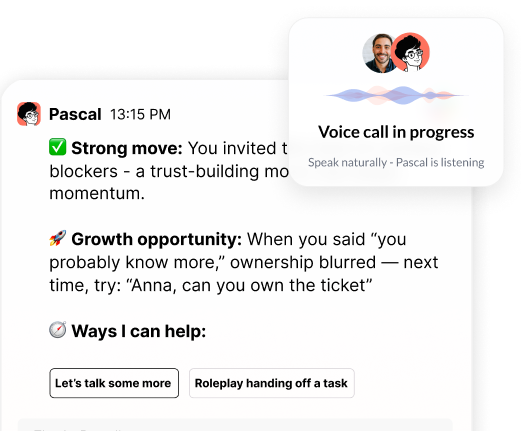
AI Coach: "I noticed this is the third deadline Sarah has missed this quarter. In our last conversation, you mentioned she seemed overwhelmed. Before we discuss the deadline, let's explore what might be driving this pattern. What have you observed about her workload and priorities?"
The AI coach remembers previous conversations, asks questions instead of providing answers, and guides the manager toward their own insights (the GROW model in action).
Contextual awareness personalizes guidance. The system maps team relationships, interaction patterns, and communication styles. Integration with performance data, 360 feedback, and personality assessments creates a complete picture. It understands organizational culture, values, and leadership competencies. Longitudinal memory tracks manager goals, challenges, and development areas over time.
Proactive engagement drives behavior change. The AI surfaces guidance after difficult meetings without requiring managers to remember to ask. It identifies patterns (like consistently interrupting direct reports) and initiates coaching conversations. Managers receive preparation before high-stakes conversations with relevant frameworks. Timely reminders about follow-through on commitments prevent dropped balls.
Integration reduces friction. The AI lives in Slack, Teams, and meeting platforms where work happens. No context-switching or separate app to access. Real-time guidance during meetings when stakes are highest. Adoption barriers drop to near-zero.
Guardrails protect everyone. Moderation systems flag sensitive topics like harassment, discrimination, and legal issues. Escalation protocols route situations beyond coaching scope to HR. SOC2 compliance and data protection standards ensure security. Organization-specific controls define what the AI can and cannot address.
McKinsey reports that 82% of executives plan to adopt AI agents by 2027, but success depends on these architectural choices. Generic implementations fail because they lack the coaching-specific design required for behavioral change.
AI coaching works when managers apply new behaviors consistently, direct reports see improvement, and organizational outcomes shift. Vanity metrics like login rates and session counts don't predict success. Focus on behavior change, team impact, and business results.
Behavior change metrics show adoption:
• Frequency of coaching conversations (2-3 times per week indicates engagement)
• Application of specific frameworks (delegation, feedback, conflict resolution)
• Time between challenge and seeking guidance (shorter equals more trust)
• Follow-through on action items from coaching sessions
Team impact metrics demonstrate effectiveness:
• Direct report engagement scores (should increase within 90 days)
• Manager effectiveness ratings from 360 feedback
• Team performance indicators (velocity, quality, retention)
• Reduction in HR escalations and conflict resolution needs
Business results validate investment:
• Manager retention rates (coaching reduces burnout)
• Time-to-productivity for new managers (should decrease significantly)
• HR business partner capacity (should handle broader scope)
• Replacement cost for underutilized learning platforms
Leading indicators predict long-term success:
• Managers proactively asking for guidance before difficult conversations
• Voluntary sharing of coaching insights with peers
• HR leaders using aggregated data for strategic workforce planning
• Expansion requests from departments not initially included
ADP's 2026 HR trends report emphasizes that AI's impact on work will be defined by how well organizations integrate these tools into daily workflows. The difference between success and failure comes down to measurement discipline and willingness to iterate based on data.
Evaluate vendors on five dimensions: coaching methodology foundation, contextual intelligence capabilities, integration architecture, data protection standards, and evidence of outcomes. Demos reveal surface features. These criteria predict long-term success.
Coaching methodology foundation:
• Are ICF-certified coaches involved in training the AI models?
• Can the vendor articulate specific coaching frameworks used (GROW, psychological safety, feedback models)?
• Does the system recognize when to coach versus when to escalate?
• How does the AI handle ambiguous or emotionally charged situations?
Contextual intelligence capabilities:
• What data sources does the system integrate (HRIS, performance reviews, 360 feedback)?
• How does it maintain memory across interactions?
• Can it understand team dynamics and organizational relationships?
• Does it adapt to your specific culture, values, and competencies?
Integration architecture:
• Where does the AI live (Slack, Teams, meetings, standalone app)?
• How much friction exists between needing help and receiving it?
• Can it provide real-time guidance during meetings?
• Does it require managers to context-switch or remember to use it?
Data protection standards:
• Is the vendor SOC2 compliant?
• Do they train AI models on your customer data?
• What controls exist for sensitive information?
• How do they handle escalation to HR for serious issues?
Evidence of outcomes:
• Can the vendor provide customer references with specific metrics?
• What behavior change data do they track?
• How do they measure manager effectiveness improvement?
• What's their typical time-to-value?
The International Coaching Federation released AI Coaching Standards in 2025, providing a framework for evaluating whether AI coaching tools meet professional coaching criteria. Reference these standards during vendor evaluation.
• AI coaching is built for leadership development with coaching frameworks, organizational context, and behavioral change architecture; chatbots are conversational interfaces for information retrieval
• AI coaching requires five elements: coaching expertise, contextual awareness, proactive engagement, workflow integration, and guardrails
• The distinction between AI coaching and chatbots is technical: AI coaching systems use specialized training data (from ICF-certified coaches), maintain persistent context (knowledge graphs of team relationships), and integrate deeply into workflow tools (Slack, Teams, Zoom) to enable proactive engagement
• Evaluate vendors on coaching methodology, contextual intelligence, integration architecture, data protection, and outcomes—not demo polish
• Measure success through behavior change (frequency of coaching conversations, application of frameworks), team impact (direct report engagement, manager effectiveness ratings), and business results (manager retention, time-to-productivity)
Ready to see how AI coaching works in practice? Explore how we deliver proactive, personalized coaching inside Slack, Teams, and meetings to transform manager effectiveness across your organization.
Header photo by Jonathan Kemper on Unsplash

.png)
.webp)
“Thank you for setting the great foundation for my promotion; now I have a plan!"

Curious to see how AI Coaching can 10X the impact and scale of your development initiatives. Book a demo today for: