

AI coaching is a system that uses structured frameworks, organizational context, and behavioral data to guide managers through leadership challenges in the flow of work. Unlike chatbots that provide generic responses when asked, AI coaches understand your people, culture, and the moments when guidance matters most.
This distinction matters because most workplace AI tools fail to change behavior. They answer questions but don't observe how you actually lead, don't reach out when you need help, and don't track whether you're improving over time. AI coaching platforms close this gap by embedding development into daily work.
Not all AI coaching platforms deliver the same value. The market spans five distinct levels, from basic chatbots to purpose-built coaching systems. Understanding these differences is critical if you're evaluating solutions.
Data Breakdown:
• Level: 1 | Type: Generic AI | Context Depth: None | Engagement Model: Reactive | Behavioral Impact: Minimal | Example Use Case: "How do I give feedback?"
• Level: 2 | Type: Customized Chatbot | Context Depth: Basic FAQs | Engagement Model: Reactive | Behavioral Impact: Low | Example Use Case: Company policy questions
• Level: 3 | Type: Context-Aware Platform | Context Depth: Some org data | Engagement Model: Mostly reactive | Behavioral Impact: Moderate | Example Use Case: Career path guidance
• Level: 4 | Type: Integrated Coach | Context Depth: Rich context | Engagement Model: Proactive + reactive | Behavioral Impact: Significant | Example Use Case: Pre-meeting preparation
• Level: 5 | Type: Purpose-Built System | Context Depth: Full context + behavioral data | Engagement Model: Proactive, embedded | Behavioral Impact: Transformative | Example Use Case: Real-time meeting feedback
Level 1 consists of generic AI assistants like ChatGPT and Claude. These tools lack organizational context and coaching methodology. A manager at your company gets the same guidance as someone at a different company facing different challenges.
Level 2 includes chatbots with basic customization but no proactive engagement. Companies upload handbooks and policies, but the system can't observe behavior or provide timely intervention. The advice remains generic despite surface-level personalization.
Level 3 platforms add organizational data but remain reactive. They might know career paths and competency frameworks, but they wait for users to ask questions. Managers must remember to seek help.
Level 4 solutions integrate deeper context and begin proactive outreach. They might join meetings or monitor communication patterns, providing relevant guidance and reaching out at appropriate moments.
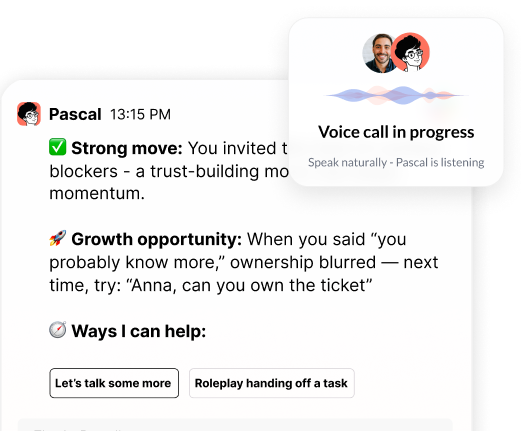
Level 5 represents purpose-built coaching systems that combine coaching expertise, contextual awareness, proactive engagement, workflow integration, and privacy guardrails. These platforms join meetings, observe team dynamics, track development over time, and reach out when coaching moments arise. Pascal operates at this level.
The most polished conversational interface means nothing if the AI doesn't understand who you're managing, what your team is working on, or what your organization values. Context transforms generic advice into actionable guidance.
An AI coach that knows a manager received critical 360 feedback about listening skills, observes them interrupting in meetings, and understands their team's current project pressures can provide specific, timely coaching: "I noticed you cut off Sarah twice in today's standup when she was explaining the API delay. Given your goal to improve active listening, try letting her finish next time before jumping to solutions."
Compare this to a chatbot response to "How do I improve my listening skills?" The chatbot provides five generic tips about maintaining eye contact and asking clarifying questions. The manager reads it, nods, and continues interrupting their team because the advice isn't connected to their actual behavior.
Context comes from multiple sources that purpose-built AI coaching platforms integrate: performance reviews reveal development priorities, 360 feedback highlights blind spots, meeting observations show behavior patterns, personality assessments inform communication preferences, and company competencies define what good looks like in your organization.
Pascal builds understanding of relationships and communication patterns over time. It learns that Alex prefers direct feedback while Jordan needs more context before criticism, that the engineering team responds well to data-driven arguments, and that the manager tends to micromanage during product launches. This accumulated context makes every coaching interaction more relevant.
Privacy considerations around context are significant. Enterprise-grade AI coaching platforms maintain SOC2 compliance and never use customer data to train models. Pascal provides anonymous, aggregated insights to organizations while protecting individual privacy. Companies can see trends across teams without accessing specific conversations.
AI coaching operates as a continuous development system that observes, learns, and guides managers through real situations. Chatbots wait passively for questions and deliver generic advice disconnected from your organization's reality. The distinction lies in three core capabilities.
Contextual awareness: AI coaches know your team dynamics, performance data, and company frameworks. When a manager struggles with delegation, a chatbot might offer a generic article about delegation best practices. An AI coach like Pascal observes the manager's team meetings, notices they're micromanaging project details, provides specific feedback on moments they could have delegated, and follows up with practice scenarios tailored to their team's dynamics.
Proactive intervention: Rather than waiting for managers to remember to seek help, AI coaches join meetings, observe interactions, and provide feedback when it matters most. This embedded approach drives higher weekly engagement compared to tools managers must remember to access.
Behavioral reinforcement: AI coaches track patterns over time and adapt guidance to drive change. They notice when managers slip into old habits and offer reminders aligned with their development goals.
The structured methodology behind AI coaching platforms comes from proven coaching frameworks. Many are trained by ICF-certified coaches. This isn't conversational AI repurposed for workplace guidance—it's coaching expertise translated into intelligent systems that understand how adults develop new skills through practice and iteration.
AI coaching platforms address the gap between knowing what to do and doing it in high-pressure moments. Managers attend workshops, watch videos, and complete modules, but when faced with real conflict or delegation decisions, they revert to old patterns. AI coaching provides just-in-time support when managers face actual decisions, not weeks after a training session when the information has faded.
This "knowing-doing gap" (identified by Pfeffer & Sutton in their 2000 research) explains why traditional training underperforms. Information without application doesn't change behavior.
Scale limitations of human coaching prevent most organizations from providing personalized development beyond senior executives. Traditional coaching costs prohibit scaling. AI coaching delivers personalized guidance to every manager at a fraction of traditional costs.
Low utilization plagues most learning platforms. Companies invest in LMS systems and content libraries that see single-digit engagement rates. AI coaches embedded in daily tools like Slack, Teams, and Zoom achieve higher adoption because they meet people where work happens, not in a separate platform they must remember to visit.
Delayed feedback loops undermine development effectiveness. Annual reviews and quarterly check-ins come too late to shape behavior in the moment. AI coaches provide real-time feedback that influences decisions as they happen, creating immediate learning loops that accelerate skill development.
Pascal demonstrates this difference through measurable outcomes: 83% of managers' direct reports report improvement in their manager's effectiveness (based on internal customer surveys), and managers save time through just-in-time guidance rather than searching for resources or waiting for scheduled coaching sessions.
AI coaching combines three elements that traditional training and generic chatbots miss: immediate feedback loops, deliberate practice opportunities, and continuous reinforcement over time. Adults learn through iteration and application, not passive information consumption.
Immediate feedback loops create learning moments when they matter most. When a manager handles a difficult conversation poorly, waiting two weeks for their next coaching session means the opportunity to learn from that specific situation has passed. AI coaches provide feedback within minutes of the interaction, while the details are fresh and the emotional stakes are present.
Deliberate practice opportunities let managers rehearse difficult scenarios before facing them in real situations. Pascal offers AI role-play with simulated versions of colleagues, allowing managers to practice giving tough feedback or navigating conflict in a safe environment. This practice-based learning builds muscle memory and confidence that transfers to real interactions.
Continuous reinforcement addresses the forgetting curve that undermines traditional training. A single workshop or course creates temporary awareness, but without ongoing support, managers revert to old habits within weeks. AI coaches provide persistent guidance, noticing when managers slip into old patterns and offering reminders aligned with their development goals.
Organizations measure AI coaching effectiveness through three categories: engagement indicators, behavioral outcomes, and business impact. AI coaching platforms provide data on actual behavior change and organizational results, not just completion rates and satisfaction scores.
Engagement indicators reveal whether managers use the coaching platform. Weekly active users, session frequency, and feature adoption rates show if the tool has become part of daily workflow or sits unused. Pascal achieves higher weekly engagement compared to traditional learning platforms because it's embedded in Slack, Teams, and meetings where managers already work.
Behavioral outcomes measure whether managers develop new skills and change how they lead. Direct report feedback shows whether team members notice improvement in their manager's effectiveness. Pascal customers report that 83% of direct reports see positive changes (based on internal customer surveys). 360 feedback scores, performance review ratings, and specific competency assessments track skill development over time.
Business impact connects coaching to organizational results. Manager retention rates, team productivity metrics, employee engagement scores, and promotion readiness all reflect whether leadership development translates to business outcomes.
The key difference from traditional training metrics is the focus on behavior change rather than content consumption. Completing a course doesn't mean a manager improved their delegation skills. An AI coach that observes meetings and tracks delegation patterns over months provides evidence of skill development.
• AI coaching differs from chatbots because it combines coaching expertise, organizational context, and proactive engagement to drive measurable behavior change
• The five levels of AI coaching sophistication range from generic chatbots (Level 1) to purpose-built systems (Level 5) that integrate deep context, observe behavior, and guide managers through real situations
• Context matters more than conversational polish. AI coaches that understand your people, culture, and team dynamics deliver specific, actionable guidance rather than generic advice
• AI coaching solves the knowing-doing gap through immediate feedback loops, deliberate practice opportunities, and continuous reinforcement that traditional training can't provide
• Organizations should measure AI coaching effectiveness through behavioral outcomes and business impact, not just engagement metrics or completion rates
Ready to see how AI coaching works in practice? Discover how Pascal delivers proactive, personalized coaching inside Slack, Teams, and meetings to help every manager develop leadership skills in the flow of work.
Header photo by Vitaly Gariev on Unsplash

.png)
.webp)
“Thank you for setting the great foundation for my promotion; now I have a plan!"

Curious to see how AI Coaching can 10X the impact and scale of your development initiatives. Book a demo today for: