

AI coaching adoption refers to how widely and consistently managers use AI-powered coaching tools integrated into their workflows. It matters for leadership pipelines because pipeline strength depends entirely on manager quality, and manager quality improves measurably when coaching is accessible, personalized, and continuous rather than episodic.
Quick Takeaway: Organizations that adopt purpose-built AI coaching platforms report 83% of direct reports seeing measurable manager improvement, 94% monthly engagement, and faster time to manager readiness. This directly strengthens leadership benches by making personalized development accessible to every manager, not just executives, while accelerating the timeline from 12-18 months to 8-10 months for new manager competency.
The leadership pipeline crisis is real. Only 15% of organizations rate their leadership bench as strong, yet companies with robust leadership development see up to 114% higher sales and 70% lower turnover among high-potentials. The gap between investment and outcomes persists because traditional development happens episodically, disconnected from where managers actually work. AI coaching closes this gap by delivering guidance in context, at scale, and continuously.
AI coaching adoption refers to how widely and consistently managers use AI-powered coaching tools integrated into their workflows. It matters for pipelines because pipeline strength depends on manager quality, and manager quality improves measurably when coaching is accessible, personalized, and continuous rather than episodic.
The connection between manager effectiveness and pipeline strength is direct. 70% of employee engagement is linked to manager quality, and 57% of people have quit a job because of a bad boss. When organizations improve manager effectiveness through AI coaching, they simultaneously improve retention, engagement, and the quality of emerging leaders those managers develop. This creates the bench depth that characterizes strong leadership pipelines.
AI coaching transforms leadership development by making personalized guidance accessible to all employees, not just executives. New managers need 12–18 months to reach baseline competency through traditional support; AI coaching accelerates this timeline by 30–40%. This acceleration matters enormously for pipeline strength because organizations can move capable leaders into higher-impact roles faster, creating more opportunities for emerging talent.
Proactive AI coaching meets managers in their workflow without requiring them to remember to seek help, achieving 75%+ regular usage versus 51% for on-demand tools. This consistency creates the habit loops that drive sustained behavior change and pipeline-building competencies.
Proactive systems achieve 40% higher client retention and 60% faster goal achievement compared to reactive models. Pascal maintains 94% monthly retention with 2.3 coaching sessions per week, demonstrating that integrated coaching becomes automatic rather than requiring discipline.
Behavioral friction kills adoption: on-demand tools require managers to remember they exist, navigate to them, and articulate their situation. 89% of employees in structured AI programs report positive workflow impacts versus less than half in ad hoc implementations. Pipeline strength depends on consistent development across many managers, not sporadic coaching for the motivated few. Proactive models scale adoption to the 70-80% of managers who need support but won't seek it independently, transforming pipelines from narrow benches of high-potential individuals to broader populations of capable leaders ready for advancement.
Purpose-built AI coaching integrates performance data, team dynamics, organizational values, and real-time work context to deliver personalized guidance. Generic tools like ChatGPT offer lowest-common-denominator advice disconnected from your specific culture and people.
83% of colleagues see measurable manager improvement when using contextual AI coaching, with 20% average lift in Manager Net Promoter Score among highly engaged users. Organizations using contextual AI coaching report 57% higher course completion rates and 60% faster time to competency than generic platforms.
Contextual depth eliminates friction: managers don't need to repeatedly explain situations because the AI already knows their team's communication styles, recent feedback, and career goals. Purpose-built platforms draw from 50+ leadership frameworks trained by ICF-certified coaches. When coaching reflects actual team dynamics and company culture, managers trust it enough to apply it; generic advice requires managers to translate it themselves, which they rarely do.
Traditional programs struggle with adoption and transfer to daily work. AI coaching delivers consistent practice at the moment of need, creating sustained behavior change that builds stronger benches faster and more equitably across the organization.
77% of coaching clients report improved leadership skills, but traditional coaching reaches only senior leaders due to cost. The executive coaching market is projected to reach $161.10 billion by 2030, with AI adoption driving growth and enabling broader access. AI-assisted coaching analytics now correlate coaching inputs with revenue, innovation, and retention KPIs, proving pipeline impact.
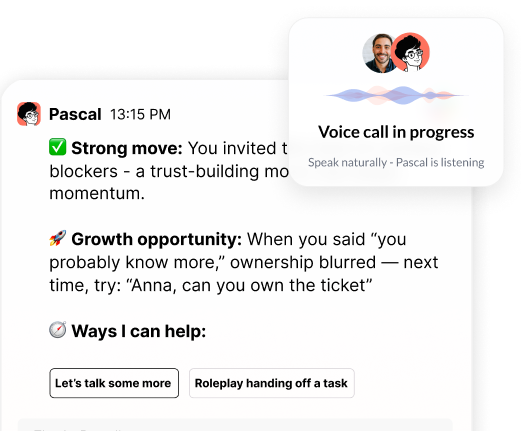
The transfer problem that kills traditional training becomes solvable with AI coaching. Managers attend workshops then revert to old habits; AI coaching reinforces skills through consistent practice in real situations. After a team meeting, Pascal offers specific feedback on the manager's facilitation; before a one-on-one, it provides talking points tailored to that employee. This continuous reinforcement at the moment of application drives the behavior change that shows up in pipeline strength.
Purpose-built platforms include escalation protocols for sensitive topics, moderation for toxic behavior, and organization-specific controls, de-risking adoption while ensuring human expertise engages when it matters most.
Pascal includes guardrails recognizing sensitive employee topics and escalating to HR rather than providing AI-generated guidance. Hybrid models combining AI for routine skill-building with human coaches for complex situations outperform either approach alone. Organizations that prioritize proper guardrails see faster adoption because employees trust the system won't create legal or ethical risk. When managers know sensitive topics like terminations or harassment concerns route to HR, they engage more openly with the coaching system.
Track adoption metrics (weekly active users, session frequency, monthly retention), leading indicators (manager effectiveness scores, feedback conversation quality), and lagging indicators (retention of high-potentials, time to manager readiness, promotion velocity) to reveal whether AI coaching is actually strengthening your bench.
Measure monthly retention target: 75%+; sessions per week target: 2+; manager NPS lift target: 15%+. 83% of direct reports reporting improvement indicates pipeline strengthening. Link coaching engagement to succession readiness and promotion velocity to prove ROI to leadership. Measure both hard efficiency metrics (time saved, faster ramp) and soft outcome metrics (improved manager NPS, better feedback quality).
| Metric Category | What to Measure | Pipeline Impact |
|---|---|---|
| Adoption | Weekly active users, session frequency, monthly retention | Higher adoption equals broader pipeline development |
| Leading Indicators | Manager effectiveness scores, feedback quality, one-on-one frequency | Improved behaviors predict pipeline strength |
| Lagging Indicators | Time to manager readiness, promotion velocity, retention of high-potentials | Direct measures of pipeline strength |
"If we can finally democratize coaching, make it specific, timely, and integrated into real workflows, we solve one of the most chronic issues in the modern workplace."
Pascal delivers the contextual, proactive guidance that turns every manager into a developer of talent. When coaching lives where work happens, integrated into Slack, Teams, and Zoom, managers receive guidance at the moment it matters most, accelerating their development and building the bench strength your organization needs for sustainable growth. Book a demo to see how Pascal helps you scale manager effectiveness, improve feedback quality, and build succession-ready benches across your organization.

.png)
.webp)
“Thank you for setting the great foundation for my promotion; now I have a plan!"

Curious to see how AI Coaching can 10X the impact and scale of your development initiatives. Book a demo today for: