

AI coaching integrations determine whether your investment becomes a daily habit or expensive shelfware. Prioritize workflow tools (Slack, Teams, Zoom) where managers spend their day, HRIS systems that provide performance context, and calendar platforms that enable proactive engagement. The right integrations transform generic advice into coaching managers actually use because it understands their people, their challenges, and their context.
Integration means connecting your AI coach to the systems where work happens and where employee data lives. Instead of requiring managers to visit another portal, integrated AI coaching meets them in Slack conversations, Teams channels, and Zoom meetings while pulling performance data from your HRIS to deliver personalized guidance.
Workflow integration embeds coaching into tools like Slack, Teams, and email where managers spend their day. Data integration connects to HRIS, performance management, and talent systems to understand individual context. Behavioral integration observes work patterns through calendar, meeting transcripts, and communication data. Proactive engagement triggers coaching at relevant moments, not just when managers remember to ask.
AI coaching integrations are bidirectional and behavioral, not just transactional data pulls. Traditional HR software integrations involve one-way data syncs—pulling employee records from your HRIS into a learning platform. AI coaching integrations observe ongoing behavior (meetings, communications, decisions), then provide real-time guidance based on that context and feed insights back into your talent systems.
Observational vs. transactional: AI coaches analyze communication patterns and meeting dynamics, not just static employee records. Real-time vs. batch: Coaching happens during a difficult conversation, not days later after data syncs. Contextual vs. generic: Integrations enable coaching that references specific people, projects, and organizational priorities. Feedback loops: Insights from coaching interactions inform performance reviews, development plans, and talent decisions.
Brandon Sammut, CHRO at Zapier, describes this shift: "We're embedding AI expectations into existing behaviors, not creating new frameworks." The most effective implementations don't ask managers to change how they work—they enhance existing workflows with intelligent guidance.
Four integration categories determine whether your AI coach delivers measurable impact: communication platforms where coaching happens, calendar and meeting tools for proactive engagement, HRIS and performance systems for personalization, and knowledge repositories for organizational context.
Data Breakdown:
• Integration Category: Communication Platforms | Purpose: Deliver coaching where work happens | Impact on Adoption: Critical | Examples: Slack, Teams, email
• Integration Category: Meeting & Calendar | Purpose: Enable proactive, contextual coaching | Impact on Adoption: High | Examples: Zoom, Meet, Outlook, Google Calendar
• Integration Category: HRIS & Performance | Purpose: Personalize coaching to individual context | Impact on Adoption: High | Examples: Workday, Lattice, Culture Amp
• Integration Category: Knowledge Systems | Purpose: Ground coaching in company policies | Impact on Adoption: Medium | Examples: Notion, Confluence, Google Drive
Native integrations with Slack and Microsoft Teams deliver coaching directly in the tools managers use hundreds of times daily. This placement eliminates the friction of context-switching. Managers can ask questions, receive feedback, and practice difficult conversations without leaving their primary workspace.
The platform can also connect to messaging APIs to understand communication patterns and identify moments when coaching would be valuable—before a difficult conversation, after a tense meeting, or when delegation patterns suggest burnout risk.
Calendar integration enables proactive coaching by identifying upcoming meetings where managers might need preparation support. Connections to Outlook and Google Calendar surface relevant guidance before 1:1s, performance reviews, or conflict resolution conversations. This transforms coaching from reactive (managers must remember to ask) to proactive (coaching anticipates needs).
Meeting integrations with Zoom and Google Meet allow the AI to join meetings, observe dynamics, and provide real-time feedback afterward. This observational capability differentiates purpose-built AI coaching from generic chatbots. The system builds a knowledge graph (a structured map of workplace relationships and communication patterns), enabling coaching that references specific interactions: "I noticed tension in your meeting with Sarah yesterday—here's how you might address that in your 1:1 tomorrow."
Some organizations use AI coaching effectively without meeting recording enabled due to regulatory constraints. However, organizations that enable meeting observation report higher coaching relevance and manager trust.
Connecting your AI coach to systems like Workday, Lattice, Culture Amp, or Dayforce enables personalization based on actual performance data, not generic advice. The system pulls performance reviews, 360 feedback, goal progress, and competency frameworks to ground coaching in your organization's specific expectations and each manager's development priorities.
This integration category addresses a critical gap in traditional learning platforms: context. When a manager asks for help with a difficult performance conversation, the AI can reference that employee's actual performance history, the manager's previous feedback patterns, and company-specific performance improvement frameworks. Generic AI tools cannot provide this level of personalization.
Integrating with knowledge repositories like Notion, Confluence, and Google Drive allows your AI coach to ground guidance in company-specific policies, values, and frameworks. When a manager asks about your performance review process, the AI references your actual documentation rather than generic best practices. When coaching on difficult conversations, it reinforces your organization's specific values and communication norms.
This integration prevents the "hallucination" problem where generic AI tools invent policies or procedures. The system can link directly to relevant documentation, ensuring managers receive accurate, compliant guidance that reflects your organization's actual standards.
Embedding your AI coach directly into daily workflow tools drives higher adoption compared to standalone portals that require managers to remember to visit. The integration strategy that works: meet managers where they already work, make coaching invisible until it's needed, and eliminate every friction point between needing help and receiving it.
Organizations that require managers to open a separate app, log in, and navigate to a coaching interface see adoption collapse within three months. Organizations that embed coaching in Slack, Teams, and meetings see sustained adoption because the tool becomes part of existing habits rather than creating new ones.
The adoption hierarchy: Native integrations (Slack, Teams) drive highest adoption. Calendar-triggered proactive coaching drives second-highest. Email-based coaching works for specific use cases but shows lower engagement. Standalone portals show lowest adoption regardless of coaching quality.
Proactive coaching requires integrations that observe work patterns and trigger guidance at relevant moments, not just respond when managers ask questions. Calendar integrations identify upcoming 1:1s and performance reviews. Meeting integrations observe communication dynamics and flag moments requiring follow-up. HRIS integrations surface performance trends that suggest coaching opportunities.
Without these integrations, AI coaching remains reactive—managers must recognize they need help and remember to ask. With deep integrations, coaching becomes proactive—the system identifies moments when guidance would be valuable and reaches out. This shift from pull to push increases coaching impact because it catches problems early and reinforces positive behaviors in real-time.
The most common integration gap is treating AI coaching as a standalone tool rather than a connected system. Organizations that implement AI coaching without HRIS integration get generic advice that managers don't trust. Organizations that skip communication platform integration see adoption collapse within weeks. Organizations that avoid meeting integration miss the behavioral context that makes coaching relevant.
Missing HRIS integration means coaching lacks personalization and organizational context. Missing communication platform integration creates adoption friction that kills usage. Missing calendar integration prevents proactive engagement at critical moments. Missing knowledge system integration risks compliance issues and inaccurate guidance.
The second-biggest risk is implementing too many integrations without clear purpose. Every integration should answer: "What specific coaching outcome does this enable?" Integrations for integration's sake create complexity without value.
Evaluate integration depth, not just integration breadth. A vendor claiming 50 integrations through Zapier is less valuable than a vendor with native, purpose-built integrations for your core systems. Ask vendors to demonstrate how their integrations enable specific coaching scenarios: "Show me how your HRIS integration personalizes feedback coaching for a struggling manager."
Critical evaluation questions: Does the integration observe behavior or just pull static data? Can the AI coach reference specific meetings, conversations, and interactions? Does the integration enable proactive coaching or just reactive responses? How does the vendor handle data security and compliance across integrations? What happens when an integration breaks—does coaching continue or fail completely?
Purpose-built integrations that observe behavior deliver more value than broad integration catalogs that only pull static data.
AI coaching integrations access sensitive performance data, communication patterns, and behavioral information that require enterprise-grade security. Prioritize vendors with SOC2 compliance, clear data handling policies, and explicit commitments never to train models on customer data.
Security evaluation checklist: How is data encrypted in transit and at rest? Where are integration credentials stored? Can you control which data sources the AI accesses? How does the vendor handle sensitive topics that should escalate to HR? What audit trails exist for integration access? How quickly can integrations be disabled if security concerns arise?
The integration strategy should include clear governance: who approves new integrations, how are access permissions managed, and what monitoring exists to detect unusual data access patterns. These controls become critical as AI coaching scales across your organization.
The integrations you choose for your AI coach determine whether it becomes a transformative tool or another underutilized platform. Success requires embedding coaching into daily workflow tools, connecting to performance systems for personalization, and enabling proactive engagement through calendar and meeting integrations.
Key Takeaways:
• Communication platform integrations (Slack, Teams) drive higher adoption than standalone portals by eliminating context-switching friction
• HRIS and performance system integrations enable personalized coaching grounded in actual organizational context rather than generic advice
• Calendar and meeting integrations transform coaching from reactive to proactive by identifying moments when guidance matters most
• Purpose-built integrations that observe behavior deliver more value than broad integration catalogs that only pull static data
• Enterprise-grade security, SOC2 compliance, and clear data handling policies are non-negotiable for AI coaching integrations
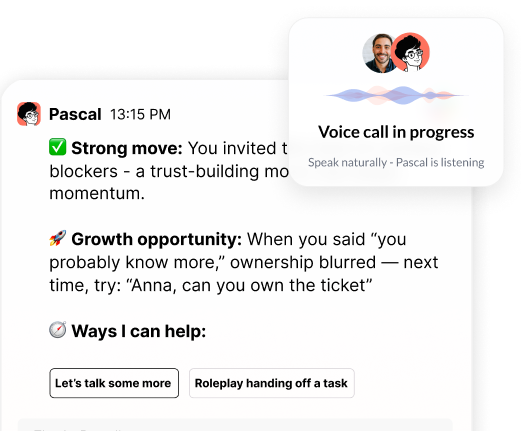
See how Pascal works inside Slack, Teams, and your existing workflow to deliver proactive, personalized coaching that managers actually use.
Header photo by Christina @ wocintechchat.com M on Unsplash

.png)
.webp)
“Thank you for setting the great foundation for my promotion; now I have a plan!"

Curious to see how AI Coaching can 10X the impact and scale of your development initiatives. Book a demo today for: