
Your AI coach needs to live where your managers already work. A chatbot in a separate portal gets forgotten within weeks. A coach embedded in Slack, connected to your HRIS, and present in meetings becomes a daily habit.
The integration question breaks into three parts: where does coaching happen (Slack, Teams, Zoom), what context does the AI need (HRIS, performance systems, career frameworks), and how does it learn (calendars, meeting transcripts, communication patterns).
Generic AI chatbots fail because managers must leave their workflow to use them. They open a separate portal, describe their situation from scratch, and receive advice disconnected from their actual calendar, team structure, or company values.
Effective AI coaching requires four capabilities:
Contextual awareness: The AI knows your team structure, upcoming meetings, and company-specific leadership expectations. Instead of generic advice about difficult conversations, it references your organization's feedback framework and the specific 1:1 on your calendar tomorrow.
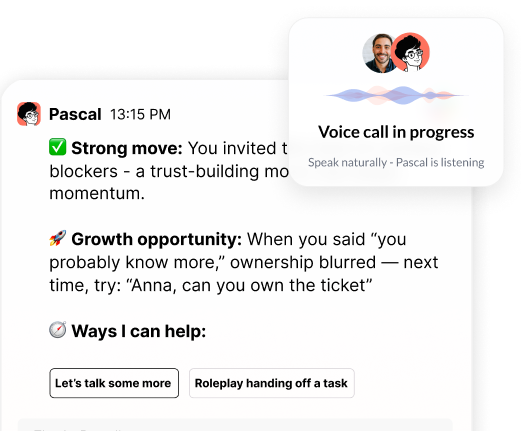
Reduced friction: Managers ask questions in Slack, receive coaching before meetings through calendar integration, and get feedback after observed interactions. No context-switching to a separate tool.
Proactive engagement: The AI surfaces guidance before important meetings, not just when asked. Calendar integration identifies upcoming performance conversations and delivers preparation support automatically.
Measurable outcomes: Integration with performance systems connects coaching activity to business metrics. You can track whether managers who receive coaching on feedback delivery actually improve their review quality.
Workflow Platforms: Where Coaching Happens
Communication platforms (Slack, Microsoft Teams) and meeting tools (Zoom, Google Meet) form the foundation. Coaching that lives here becomes a daily habit. Coaching that requires visiting a separate portal gets forgotten.
Workflow integration enables proactive check-ins before important meetings, real-time feedback after observed interactions, on-demand coaching through conversational interface, and team health insights surfaced in relevant channels.
Organizational Systems: What the AI Knows
HRIS platforms (Human Resources Information Systems like Workday, BambooHR, ADP), performance management tools (Lattice, Culture Amp, 15Five), and learning systems (Cornerstone, LinkedIn Learning) provide the context that separates useful coaching from generic advice.
Without organizational context, AI coaching delivers guidance that may contradict company values or ignore performance history. A manager at a company that values radical candor needs different guidance than one at a company emphasizing servant leadership.
These integrations provide organizational structure (team composition, reporting relationships), role context (job title, level, function, tenure), competency frameworks (company-specific leadership expectations—the skills and behaviors your organization defines as effective management), performance data (review ratings, goal achievement, 360 feedback), and current goals (active objectives, quarterly priorities, development plans).
Data Sources: How the AI Learns
Calendar systems (Google Calendar, Outlook), meeting platforms, and knowledge management tools (Confluence, Notion, Google Drive) enable AI coaches to observe actual behavior patterns and reference company-specific processes.
Calendar integration identifies upcoming 1:1s, performance conversations, and difficult discussions, then delivers preparation support automatically. Meeting observation (through transcript access, not video recording) enables specific behavioral feedback based on what actually happened. Knowledge management integration allows the AI to reference your specific career frameworks, compensation guidelines, and cultural documents.
Not every organization needs every integration. Your priorities depend on organization size, existing tool stack, and primary coaching goals.
For smaller organizations (under 200 employees): Start with communication platform integration (Slack or Teams) and calendar integration. These two create the daily habit and proactive engagement that drive adoption. Add HRIS integration when you have structured performance processes.
For mid-size organizations (200-1,000 employees): Add performance management integration to communication and calendar foundations. At this scale you have formal review cycles, competency frameworks, and development plans that provide valuable coaching context.
For larger organizations (over 1,000 employees): Consider full integration across communication platforms, HRIS, performance management, meeting tools, and knowledge management systems. Large organizations have the structured processes and distributed management population where comprehensive integration delivers measurable ROI.
Tool stack considerations: If your organization uses Google Workspace, prioritize Google Calendar, Google Meet, and Google Drive integrations. If you use Microsoft 365, prioritize Outlook, Teams, and SharePoint. Match integrations to where your managers actually work.
Primary coaching goals: If you're focused on feedback quality, prioritize performance management and meeting platform integrations. If you're addressing 1:1 effectiveness, prioritize calendar and communication platform integrations. If you're scaling manager onboarding, prioritize knowledge management and HRIS integrations.
Enterprise organizations need three security guarantees: data residency, training separation, and granular controls.
Data residency means all coaching data remains within your organization's security perimeter. Look for SOC2 compliance (a security audit standard that verifies data handling practices) as a baseline. For regulated industries (pharma, banking, healthcare), verify that the platform meets your specific compliance requirements.
Training separation means the vendor never trains AI models on your data. Your conversations, performance reviews, and meeting transcripts should never improve the vendor's product for other customers. This should be contractually guaranteed, not just claimed in marketing materials.
Granular controls mean you decide which channels the AI can observe, which meetings it can join, and what data it can access. Individual managers should be able to opt out of specific integrations. You should be able to exclude sensitive channels, confidential meetings, and protected employee data.
Integration strategy determines whether you can prove value. Without deep integration into your HRIS, performance management systems, and communication platforms, AI coaching remains a black box with unclear business impact.
Three measurement approaches require different integrations:
Behavior change measurement requires performance management integration. Track whether managers who receive coaching on feedback delivery actually improve their feedback quality in performance reviews. Measure whether coaching on 1:1 effectiveness correlates with improved team engagement scores. This requires connecting coaching activity to performance system data.
Efficiency gains require communication platform and HRIS integration. Measure how many routine manager questions get answered by the AI coach instead of escalating to HR business partners. Track time saved on manager onboarding when new managers get instant answers instead of waiting for training sessions. This requires observing actual usage patterns in communication platforms.
Program replacement requires comparing AI coaching costs to traditional alternatives. Executive coaching costs $300-500 per hour. Manager training programs cost $50,000-200,000 annually. Engagement survey platforms cost $20,000-100,000 per year. AI coaching that replaces or reduces these expenses delivers clear ROI, but only if integration quality makes the AI coach a genuine alternative.
• AI coaching embedded in communication platforms drives higher sustained engagement than separate portal tools
• Three integration layers matter: workflow platforms (where coaching happens), organizational systems (what the AI knows), and data sources (how the AI learns)
• Integration priorities depend on organization size, existing tool stack, and primary coaching goals—not every organization needs every integration
• Security requirements include data residency, training separation, and granular controls over what the AI can observe
• Measuring ROI requires integration with performance management systems to connect coaching activity to business outcomes
Ready to see how integrated AI coaching works inside your existing workflow? Explore Pascal and discover how embedded coaching transforms manager effectiveness.

.png)
.webp)
“Thank you for setting the great foundation for my promotion; now I have a plan!"

Curious to see how AI Coaching can 10X the impact and scale of your development initiatives. Book a demo today for: