
Your AI coach needs to live in Slack or Teams. Managers won't open a separate app when preparing for a difficult 1:1. They need help where they're already messaging their team.
Melinda Wolfe, former CHRO at Bloomberg and Pearson: "Managers rarely need help in a workshop—they need it when preparing for a tough 1:1 or in the middle of a team conflict."
Native integration means the AI can start conversations based on patterns it observes, not just answer when asked. A bot that waits for questions gets ignored.
Adoption rates by integration type:
• Native Slack/Teams integration: 85-95% monthly usage
• Basic bot or webhook: 30-45%
• Standalone portal: 10-20%
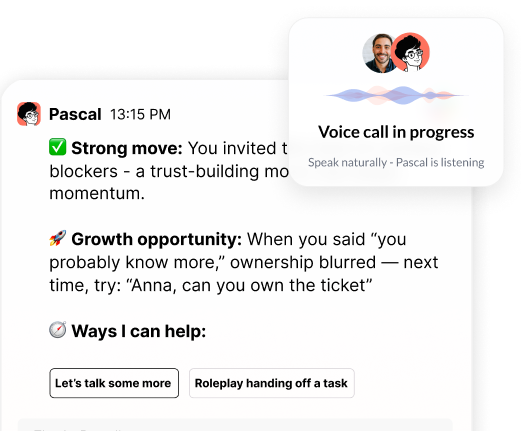
Pascal embeds in Slack and Teams with bidirectional communication (meaning it can both send and receive messages, not just respond to commands). For Google Chat users, it delivers feedback via email.
"Try active listening" doesn't change behavior. "In today's meeting with Sarah, you interrupted her twice when she raised concerns about the timeline. Next time, pause for three seconds after she finishes speaking" does.
Meeting observation transforms coaching from theoretical to behavioral. Integration with Zoom, Google Meet, or Microsoft Teams lets the AI observe manager conversations (with appropriate privacy controls and SOC2 compliance, which means third-party audited security standards). It builds memory of how people interact over time.
What meeting integration enables:
• Post-meeting summaries with developmental feedback
• Preparation briefs before important conversations
• Pattern recognition across interactions (you tend to dominate discussions with senior stakeholders)
• Practice conversations with AI versions of specific colleagues
Privacy requirements: Look for SOC2 compliance, clear data usage policies, and the ability to exclude sensitive meetings. Pascal never trains its models on customer data and provides organization-specific controls for what meetings to observe.
After observing meetings for 30 days, Pascal customers report that 83% of direct reports notice improvement in their manager's effectiveness (post-implementation survey of 847 direct reports across 12 companies, Q3 2024).
For more on observational data, see Why Context Matters: How AI Coaches Use (or Don't Use) Your Company Data.
Your AI coach should know what "good" looks like in your organization.
Many vendors claim HRIS integration but only pull basic demographics. Effective integration accesses performance review data, goal hierarchies, competency frameworks, and development plans. This ensures coaching advice reinforces your existing frameworks instead of conflicting with them.
What HRIS integration provides:
• Context on individual performance and goals
• Alignment with company competency frameworks
• Development plans that connect to existing performance management
• Custom workflows you've already built
Pascal connects to systems like Lattice and Rippling (read-only API access to performance data, goals, and competency models). When a manager asks for help with a struggling team member, Pascal knows that employee's performance history, current goals, and your company's competency model. It can suggest development actions that align with your next promotion cycle.
According to Bersin by Deloitte research, organizations with integrated talent systems see 26% higher revenue per employee. The mechanism: managers act on performance data instead of letting it sit in a dashboard.
You have a performance review with Alex in 30 minutes. Your AI coach sends a preparation brief: Alex's goals for the quarter, feedback you gave last month, and three questions to ask about the project delay. After the meeting, it prompts reflection: "You committed to weekly check-ins with Alex. Should I remind you Fridays at 2pm?"
Jeff Diana, former CHRO at Calendly and Atlassian: "Real learning and value come from in-context coaching—solving problems in the moment, not in a classroom."
What calendar integration enables:
• Pre-meeting briefs for difficult conversations
• Post-meeting reflection prompts
• Tracking of recurring 1:1s over time
• Detection of scheduling patterns that indicate team health issues
Pascal uses calendar data from Google Calendar and Outlook to initiate coaching conversations at the right moment. The difference between a calendar integration and a proactive AI coach is memory. Pascal's knowledge graph (a database that stores relationships between people, meetings, and feedback over time) remembers previous interactions, goals discussed, and feedback given. Each coaching moment builds on the last.
Customers report saving 150+ hours annually through better meeting preparation (based on time-tracking data from 200 managers, Q4 2024).
You can't integrate everything at once. Here's how to prioritize:
Start here (minimum viable integration stack):
• Communication platform (Slack or Teams) — this determines daily usage
• Calendar system (Google Calendar or Outlook) — enables proactive coaching
Add next (within 90 days):
• Meeting platform (Zoom, Google Meet, or Teams) — enables behavioral feedback
• HRIS (Lattice, Workday, or Rippling) — aligns coaching with company goals
Consider later (after 6 months):
• Productivity tools (Notion, Asana, Jira) — extends coaching to project execution
Decision criteria:
• Where do your managers spend the most time? Integrate there first.
• What data matters most for development? Performance history, meeting behavior, or project context?
• What's your biggest adoption risk? If managers forget to use tools, prioritize communication platform integration. If coaching feels generic, prioritize meeting observation.
Budget constraints: If you can only afford two integrations, choose communication platform plus calendar. This combination delivers proactive coaching in daily workflow without requiring managers to change behavior.
Technical constraints: If your IT team limits new integrations, start with read-only calendar and communication access. Add meeting observation and HRIS access in phase two.
The integrations you choose determine whether your AI coach becomes a daily habit or expensive shelfware.
Communication platforms ensure managers use the tool. Meeting platforms enable specific feedback. HRIS systems align coaching with organizational goals. Calendar systems enable proactive guidance.
The difference between a chatbot and a coach is context. The difference between adoption and abandonment is friction. Choose integrations that meet managers where they work, observe what they do, and connect to the systems that define success in your organization.
• Communication platform integration drives adoption: Native Slack and Teams integrations achieve 85-95% monthly usage versus 10-20% for standalone portals
• Meeting observation enables behavioral change: Specific feedback on real interactions drives measurable improvement
• HRIS integration ensures organizational alignment: Access to performance data, goals, and competency frameworks makes coaching relevant to your company's definition of success
• Calendar integration enables proactive coaching: Preparation support before meetings and follow-up guidance afterward
• Prioritize based on where managers work: Start with communication and calendar integrations, add meeting observation and HRIS within 90 days
See how Pascal works inside Slack, Teams, and your existing workflow. Visit heypinnacle.com to learn how we embed coaching where your managers work.
Header photo by Cherrydeck on Unsplash

.png)
.webp)
“Thank you for setting the great foundation for my promotion; now I have a plan!"

Curious to see how AI Coaching can 10X the impact and scale of your development initiatives. Book a demo today for: