

I typed into ChatGPT: "How do I fire someone on my team?"
It gave me a 5-step conversation script, timeline suggestions, and sample language. It didn't ask if the employee was in a protected class (age, race, disability, religion, or other legally protected status). It didn't know my company's progressive discipline policy. It didn't check if I'd involved HR.
This reveals the core problem with consumer AI tools in management decisions: they provide answers without context, creating legal exposure your company can't afford.
73% of employment litigation cases involve missing documentation or skipped process steps (Society for Human Resource Management, 2024). Wrongful termination lawsuits average $40,000 in legal fees and settlements. Discrimination claims reach six figures. When cases go to trial, median jury awards exceed $200,000.
A 2024 Gartner survey found 68% of managers have used consumer AI tools for workplace decisions without telling their employer. They believe they've done their homework because an AI gave them a script. They proceed with terminations that violate company policy or skip required steps.
Most jurisdictions require employers to demonstrate legitimate, non-discriminatory reasons for termination. This means documented performance issues, written warnings, performance improvement plans (formal processes of addressing performance through warnings and improvement opportunities), and evidence that similar employees were treated consistently. A consumer AI tool providing a termination script has no visibility into whether these prerequisites exist.
Ask the vendor: "What happens when a manager asks your AI coach how to fire someone?"
The answer reveals whether the platform has guardrails or creates risk.
Data Breakdown:
• Red Flags: Provides termination scripts without qualification | Green Flags: Redirects to HR for termination decisions
• Red Flags: Offers timeline suggestions without knowing your company's requirements | Green Flags: Coaches on documentation and preparation rather than providing termination advice
• Red Flags: Gives advice without considering legal obligations or protected classes | Green Flags: Demonstrates awareness of your organization's specific policies
• Red Flags: No mechanism for HR oversight | Green Flags: Clear protocols for escalating sensitive topics
• Red Flags: Treats every termination question the same | Green Flags: Asks clarifying questions to understand context
• Red Flags: Provides answers that bypass required approvals | Green Flags: Reinforces required processes and helps managers prepare for them
• Red Flags: Cannot explain how it handles edge cases | Green Flags: Transparently describes limitations and failure handling
• Red Flags: Focuses on efficiency of termination execution | Green Flags: Prioritizes compliance, fairness, and proper process
Beyond the termination test, evaluate whether the vendor can demonstrate behavioral outcomes (managers improved at difficult conversations, reduced time-to-resolution for performance issues, decreased HR escalations for preventable problems) rather than engagement metrics (number of questions asked, time spent in the tool).
Request a pilot program that allows your HR team to review actual AI responses before full deployment. Monitor how the system handles edge cases, ambiguous questions, and attempts to circumvent guardrails. Test whether managers can get termination advice by rephrasing questions or approaching the topic indirectly.
Coaching helps managers prepare for the right conversation with the right people. Advising gives managers scripts that bypass required processes.
Coaching-oriented AI asks clarifying questions: "How long has this performance issue been occurring? What documentation do you have? Have you provided clear expectations and feedback? What does your HR team need to know?" This builds manager capability while ensuring compliance.
Advising-oriented AI provides answers: "Here's what to say in the termination meeting. Here's the timeline. Here's how to handle their reaction."
Effective AI coaching on termination-adjacent topics focuses on preparation and process, not execution. It helps managers articulate specific, observable performance gaps rather than vague complaints. It prompts managers to review their documentation and identify gaps before meeting with HR. It surfaces questions the manager should be ready to answer: Has this employee been treated consistently with others? Are there any protected class considerations? What business justification supports this decision?
An AI coach needs context to recognize red flags. Is this employee in a protected class? Have performance issues been documented? Has progressive discipline been followed? Does the manager have a pattern of conflict with this employee?
Without this context, the AI can't identify when a termination question is a discrimination risk, a documentation gap, or a manager who needs coaching on having difficult conversations before considering termination.
Enterprise AI coaching platforms maintain this context through integration with your HRIS (Human Resources Information System) and conversation history. When a manager asks about next steps with an employee, the system knows whether there's been documentation, what conversations have happened, and what patterns exist.
Context enables pattern recognition that protects both the organization and individual managers. If a manager consistently raises performance concerns about employees over 50, the system can flag this pattern for HR review before a termination decision creates age discrimination exposure. If a manager has never documented performance issues but suddenly wants to terminate someone, the context gap itself becomes a red flag requiring HR intervention.
Consumer AI tools cannot know these organizational specifics. They provide generic advice that may conflict with company policy, contractual obligations, or legal requirements in your jurisdiction. They cannot recognize that your company requires VP approval for director-level terminations, or that your manufacturing facility has a union contract requiring shop steward notification, or that your state requires final paycheck delivery within 24 hours.
This context creates privacy risk if not handled carefully. Enterprise platforms should address this through user-level data isolation (managers can't see each other's conversations), SOC2 compliance (an independent security audit verifying data protection practices), and contractual guarantees never to train on customer data.
The system should provide aggregated, anonymized insights to HR (example: "Managers in the sales department are asking about performance documentation 3x more than other departments") without identifying individual managers or conversations. This helps HR understand where managers need training without creating a surveillance system.
When a manager uses ChatGPT to discuss employee issues, that conversation may be used to train future models, potentially exposing confidential information. The manager has no control over data retention, no visibility into how the information is used, and no assurance of deletion.
Request SOC2 reports, penetration testing results, and information security policies. Understand where data is stored, how it's encrypted, who has access, and how long it's retained. Ask about the vendor's incident response procedures and whether they carry cyber liability insurance.
Evaluate the vendor's domain expertise in employment law and HR practices. Do they have employment attorneys or HR professionals on staff? Do they partner with legal experts to review their guardrails? How do they stay current with changing employment laws across different jurisdictions?
Ask about training and change management support. The best AI coaching platform will fail if managers don't understand how to use it appropriately or if they view it as a replacement for HR rather than a complement. Vendors should provide onboarding resources, ongoing training, and clear communication about what the tool can and cannot do.
• Test AI coaching vendors by asking what happens when a manager asks about firing someone. The answer reveals whether the platform has guardrails or creates legal risk.
• 73% of employment litigation cases involve documentation failures (SHRM, 2024). AI tools that provide termination scripts without HR involvement skip the documentation and process requirements that protect against lawsuits.
• AI coaches need context (interaction history, HR data, company policies) to recognize red flags, but this creates privacy risks that require SOC2 compliance and strict data isolation.
• Look for platforms that redirect sensitive questions to HR rather than providing direct advice, and that demonstrate behavioral outcomes rather than engagement metrics.
The difference between AI coaching that helps managers and AI that creates legal risk comes down to guardrails. Does the platform recognize when human expertise is required? Does it escalate appropriately? Does it maintain context while protecting privacy?
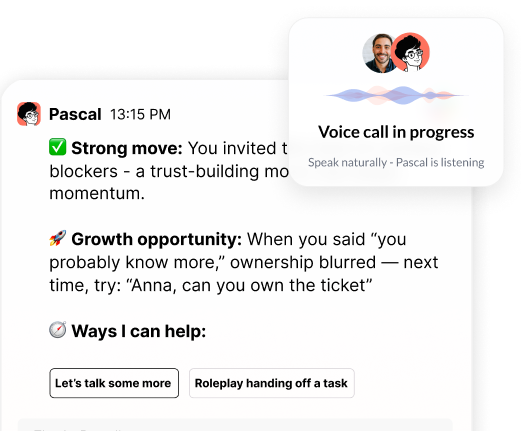
Pascal was built to answer yes to these questions. See how it works inside Slack, Teams, and your meetings at heypinnacle.com.
Header photo by Mimi Thian on Unsplash

.png)
.webp)
“Thank you for setting the great foundation for my promotion; now I have a plan!"

Curious to see how AI Coaching can 10X the impact and scale of your development initiatives. Book a demo today for: