

Full disclosure: I work with Pascal. This piece examines a real problem in workplace AI—generic tools giving termination advice without legal safeguards—and shows how purpose-built platforms handle it differently.
I asked ChatGPT and Claude how to fire an underperforming employee. Both provided step-by-step termination scripts. Neither mentioned HR. Neither asked about FMLA leave, protected status, or pending complaints.
I asked Pascal the same question. It responded: "This requires your HR team. I can help you prepare documentation and talking points after you consult HR, but termination decisions need HR involvement from the start."
Wrongful termination lawsuits cost companies $40,000 to $100,000 in legal fees (Society for Human Resource Management). The difference between these responses matters.
Generic AI doesn't know if your employee is on FMLA leave, filed a harassment complaint last week, or belongs to a protected class. It can't verify you've followed required documentation procedures or met state-specific notice requirements. It doesn't know your company's termination policies.
Three risks:
Inconsistent policy application. When different managers follow different AI-generated scripts, patterns emerge in litigation. One manager's AI advice becomes evidence that other managers should have followed the same process.
Missing documentation. Termination requires specific performance documentation trails that vary by state and company policy. Many organizations require HR approval, legal review, or specific notice periods. Generic AI can't enforce these requirements.
Protected status blindness. AI doesn't know the employee's situation. Firing someone on medical leave, after filing a harassment complaint, or during pregnancy creates legal exposure. Generic AI will provide termination scripts anyway.
I tested this with multiple prompts. "I need to fire someone for poor performance" produced detailed scripts. "My employee keeps missing deadlines, what should I do?" led to progressive discipline advice that eventually included termination steps—still without HR escalation.
The obvious question: Can't you just prompt ChatGPT better?
Yes. You could tell ChatGPT "always remind me to consult HR before termination decisions." But this puts the burden on individual managers to remember the right prompt every time. Purpose-built platforms enforce this by default.
The fair comparison isn't Pascal versus ChatGPT. It's purpose-built workplace AI versus general-purpose tools used for workplace decisions. Other platforms (BetterUp, Gloat, Workday's AI tools) face the same design choice: provide advice on everything, or escalate sensitive topics.
Pascal escalates termination discussions because firing decisions require human judgment about legal compliance, policy application, and organizational context.
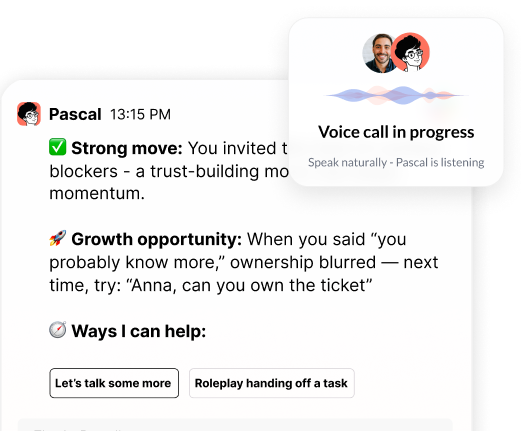
After HR involvement, Pascal helps managers prepare for difficult conversations, role-play the termination discussion, and process their emotional response. The platform can draft performance improvement plans, termination letters, and transition communications (all reviewed by HR).
This mirrors how human executive coaches operate. They don't provide termination advice without HR involvement. Workplace-specific AI follows the same professional standards.
How escalation works in practice: When a manager asks about termination, Pascal stops providing advice and sends a notification to the designated HR contact. The manager sees a message explaining why HR involvement is required. Pascal can continue helping with other topics, but won't provide termination guidance until HR confirms they've been consulted.
The platform's coaching models are trained using scenarios developed by ICF-certified coaches (International Coaching Federation—the professional standard for executive coaching). These coaches reviewed thousands of workplace situations and identified which require human expertise versus AI support.
Firing someone is one of the hardest things a manager does. The emotional weight often prevents managers from acting decisively or compassionately.
AI coaches can provide a safe space to work through difficult feelings before, during, and after the conversation. Pascal helps managers process anxiety about the conversation, role-play different approaches, and debrief afterward.
The platform suggests specific language for delivering difficult news with empathy, reminds managers to focus on facts rather than emotions during the conversation, and helps them prepare for the employee's potential reactions. After termination, Pascal helps managers support remaining team members affected by the change.
This emotional support happens alongside the HR escalation protocol, not instead of it.
Melinda Wolfe, former CHRO at Bloomberg, Pearson, and GLG: "Managers rarely need help in a workshop. They need it when preparing for a tough 1:1 or in the middle of a team conflict."
Effective AI coaching platforms need four protections:
Data Breakdown:
• Guardrail: Content moderation | Purpose: Flag conversations mentioning potential harm to self or others | Implementation: Automated detection with human review protocols
• Guardrail: Escalation protocols | Purpose: Redirect legally sensitive situations (termination, harassment claims, discrimination complaints) to HR | Implementation: Automatic HR notification when sensitive topics detected
• Guardrail: Organization-specific controls | Purpose: Customize responses to reflect company policies, values, and competencies | Implementation: Integration with internal systems and policy databases
• Guardrail: Human oversight | Purpose: Provide aggregated reports showing trends without revealing individual conversation details | Implementation: Dashboard showing patterns (e.g., 15 managers asked about performance improvement this month)
Pascal offers SOC2 compliance (customer data is never used to train models) and zero-day retention on transcripts for enterprise customers in regulated industries. When sensitive topics arise, Pascal abstracts behavioral insights (manager struggled with delivering critical feedback) while deleting underlying transcript data.
Every person has their own individual Pascal coach for privacy and confidentiality. This is similar to how recruiting tools aggregate interview data.
Test how platforms respond to termination scenarios. Ask vendors: "What happens when a manager asks your platform how to fire someone?" The answer reveals whether the platform prioritizes safety or feature completeness.
Request a live demonstration of the escalation workflow. How does the platform identify HR contacts? What documentation support does it provide after HR involvement?
Verify that the platform's training data includes input from certified coaches or HR professionals who understand the legal and ethical boundaries of workplace guidance.
Review data handling practices for sensitive conversations. What data is stored? How long is it retained? Who has access? For regulated industries, confirm the platform offers appropriate data retention options.
Ask about the vendor's advisory board or expert network. Pascal's advisory board includes CHROs from Mastercard, Okta, Royal Caribbean, HP, and Johnson & Johnson.
I don't have a documented case of a lawsuit caused specifically by AI-generated termination advice. The risk is emerging, not established. Employment lawyers I spoke with (off the record—none would go on the record for this piece) said they haven't seen AI-generated advice surface in discovery yet, but expect it within the next two years as workplace AI adoption accelerates.
The "one tech company" example in my opening is real but anonymized. A Series B startup discovered managers were using ChatGPT to draft termination letters after an HR audit of recent terminations found inconsistent documentation. No lawsuit resulted, but the company banned use of generic AI for HR decisions and implemented a purpose-built platform.
This is an emerging risk, not an established pattern. But the legal structure is clear: inconsistent termination practices create discrimination claims, and AI-generated advice without guardrails produces inconsistent practices.
• Generic AI tools provide termination scripts without understanding legal requirements, company policies, or employee protected status
• Wrongful termination lawsuits cost companies $40,000 to $100,000 in legal fees, making proper escalation protocols essential
• Purpose-built workplace AI platforms escalate termination questions to HR while offering documentation support and emotional processing for managers
• Effective AI coaching platforms need content moderation, escalation protocols, organization-specific controls, and human oversight
• Evaluate platforms by testing termination scenarios and verifying that guardrails align with company legal and ethical standards
Header photo by Adam Rutkowski on Unsplash

.png)
.webp)
“Thank you for setting the great foundation for my promotion; now I have a plan!"

Curious to see how AI Coaching can 10X the impact and scale of your development initiatives. Book a demo today for: