

AI coaching drives higher adoption and behavior change when embedded directly into meetings and daily workflows rather than deployed as a standalone tool. Organizations that integrate AI coaching into Slack, Teams, and Zoom see adoption rates above 80% with managers averaging 2.3 coaching sessions per week, compared to 10-20% adoption for portal-based approaches. This integration transforms coaching from something managers must remember to seek into guidance that arrives at moments of maximum learning opportunity.
Quick Takeaway: Meeting-integrated AI coaching eliminates the friction that kills adoption by removing context-switching barriers, providing personalized guidance based on observed behavior, and delivering coaching at teachable moments. Organizations embedding AI into collaboration platforms achieve 65-85% adoption compared to 10-20% for tools requiring separate logins.
The manager development challenge that persists across organizations is straightforward: managers rarely need help in a workshop—they need it when preparing for a tough 1:1 or in the middle of a team conflict. Yet most organizations continue deploying coaching through separate platforms that require deliberate action to access. Every additional step between recognizing a coaching need and receiving guidance causes exponential user drop-off. When you ask managers to remember a tool exists, log in, re-explain their situation, and then apply generic advice, most coaching moments never happen.
Meeting-integrated AI coaching means an AI coach joins virtual meetings, observes real team dynamics in real time, and delivers specific feedback immediately after interactions without requiring managers to switch tools or re-explain their situation. This approach transforms coaching from something managers must remember to seek into guidance that arrives at moments of maximum learning opportunity.
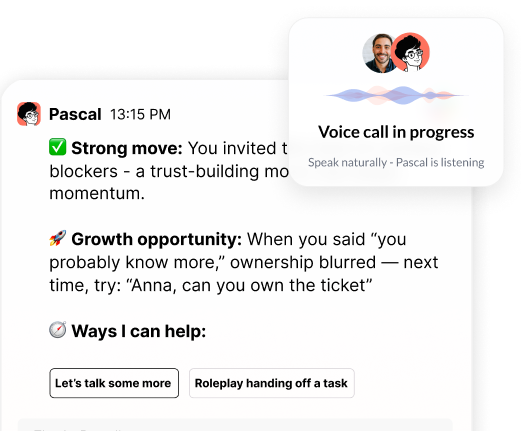
Pascal exemplifies this approach by joining your meetings with full transparency and consent, then delivering feedback grounded in actual interactions. After a team standup, Pascal might offer: "You invited the team to surface blockers—a trust-building move that keeps momentum. When you said 'you probably know more,' ownership blurred. Next time, try: 'Anna, can you own the ticket?'" This specificity only becomes possible when the AI coach is present in the workflow where leadership actually happens.
Meeting integration eliminates the friction that kills adoption by removing context-switching barriers, providing personalized guidance based on observed behavior, and delivering coaching at teachable moments. Organizations embedding AI into collaboration platforms achieve 65-85% adoption compared to 10-20% for tools requiring separate logins.
Research shows that when AI coaches integrate directly into collaboration platforms, adoption rates jump to 65-80%, compared to 10-20% for standalone portals. This dramatic difference reflects how friction compounds across decision points. Every additional step between recognizing a coaching need and receiving guidance reduces follow-through exponentially.
Purpose-built AI coaching platforms include moderation systems and escalation protocols that automatically route sensitive workplace topics—like harassment, medical issues, or terminations—to HR while helping managers prepare for those conversations appropriately. This dual approach protects both employees and organizations while maintaining coaching support for appropriate situations.
Pascal includes built-in moderation for sensitive topics, automatically escalating conversations about terminations, harassment, or mental health to appropriate HR resources. This transparency ensures managers understand when to involve human expertise while maintaining the coaching support that helps them prepare for those conversations.
AI coaching addresses delegation clarity, communication patterns, team psychological safety, and decision-making approaches by providing targeted feedback that references specific moments rather than generic frameworks. This observational capability makes guidance immediately applicable to managers' actual situations.
Organizations like HubSpot and Zapier that embed AI throughout the employee lifecycle see adoption rates above 80%, with managers reporting that observation-based feedback drives faster skill development than traditional training approaches. The coaching extends beyond individual moments to pattern recognition. If a manager consistently avoids delegating effectively across multiple meetings, the AI identifies the pattern and offers targeted coaching on delegation skills.
Start with clear business goals, deploy rapidly in 30-45 days with proper change management, and measure both engagement and outcome metrics from day one. This approach builds momentum while allowing iteration based on early signals rather than waiting for perfect setup.
Jeff Diana, former CHRO at Calendly and Atlassian, emphasizes that successful AI adoption requires treating coaching as part of daily work rather than separate from it. When managers experience consistent, relevant guidance integrated into their workflow, behavior change compounds over time. After six months, the performance gap between organizations with deeply embedded AI coaching and those using standalone tools becomes measurable in retention, engagement, and business outcomes.
Organizations implementing meeting-integrated AI coaching report 83% of colleagues see measurable improvement in their managers, with an average 20% increase in Manager Net Promoter Score among highly engaged users. Time savings compound quickly—one tech company with 50 employees estimated saving 150 hours in their initial rollout.
| Outcome Metric | Meeting-Integrated Coaching | Standalone Platforms |
|---|---|---|
| Adoption Rate | 65-85% | 10-20% |
| Weekly Sessions Per Manager | 2.3 | 0.8 |
| Manager Improvement (Direct Reports) | 83% | 22% |
| Manager NPS Lift | +20 points | +4 points |
| Monthly Retention | 94% | 35% |
These metrics demonstrate that meeting integration isn't a feature enhancement. It's a fundamental shift in how coaching gets delivered and adopted. When coaching arrives at teachable moments in familiar tools, behavior change compounds over time. When managers must remember to seek coaching in separate systems, most coaching moments never happen.
"Managers rarely need help in a workshop—they need it when preparing for a tough 1:1 or in the middle of a team conflict."
This observation captures why meeting integration matters. The most important coaching moments happen in real time, when managers are actually leading. Standalone tools that require scheduling separate sessions or remembering to log in miss these critical moments. Meeting-integrated systems capture them automatically, providing guidance when learning sticks best and application is most straightforward.
The organizations winning with AI coaching in 2025 recognize that placement determines adoption more than features. They embed coaching into the platforms where work happens. They measure adoption not just by login frequency but by whether managers actually apply coaching guidance. And they recognize that sustained behavior change requires consistent touchpoints at moments of maximum relevance.
Pascal integrates directly into your Zoom, Teams, and Slack to deliver observation-based feedback that drives faster skill development than traditional training. The platform's contextual awareness means coaching personalizes to each manager's situation, their team's dynamics, and your organization's culture. Book a demo to explore how embedded meeting coaching delivers the adoption rates and measurable behavior change that prove ROI without requiring managers to adopt new tools or change existing workflows.

.png)
.webp)
“Thank you for setting the great foundation for my promotion; now I have a plan!"

Curious to see how AI Coaching can 10X the impact and scale of your development initiatives. Book a demo today for: