

The difference between an AI coaching tool that managers use 2.3 times per week and one they abandon within weeks comes down to one thing: whether it knows your people, your culture, and how work actually happens in your organization. Purpose-built AI coaches integrate performance data, team dynamics, company values, and real-time work patterns to eliminate friction and drive sustained engagement; generic tools that lack this context see adoption collapse because managers quickly recognize when advice doesn't fit their situation.
Quick Takeaway: The most effective AI coaching systems connect to HRIS platforms, performance management tools, communication systems, and company documentation to build contextual awareness that generic AI tools cannot match. This integration eliminates friction because managers receive guidance immediately applicable to their actual situations rather than generic templates. Organizations using contextual AI coaching report 57% higher course completion rates, 60% shorter completion times, and 83% of direct reports see measurable improvement in their managers.
In our work building Pascal and implementing AI coaching across organizations ranging from 100 to 5,000 employees, we've observed a consistent pattern. Platforms that integrate deeply with company data drive measurable behavior change and sustained adoption. Those that operate in isolation from your organization's reality become expensive experiments that managers try once and abandon. The question for CHROs isn't whether AI coaching can work. It's whether your chosen platform has the contextual awareness to make guidance relevant enough that managers apply it immediately.
Effective AI coaching systems connect to HRIS platforms, performance management tools, communication systems, and company documentation to build contextual awareness that generic AI tools cannot match. This integration eliminates the friction that kills adoption because managers receive guidance immediately applicable to their actual situations rather than generic templates.
Performance reviews, 360 feedback, and career goals reveal individual development needs. Company values, competency frameworks, and culture documentation ensure coaching reinforces organizational expectations, not conflicting approaches. Meeting transcripts and communication patterns from Slack, Teams, or Zoom show how leadership actually happens in practice. Organization structure and team composition data enable team-specific guidance tailored to real relationships. Organizations using AI-powered training with company-specific data report 57% higher course completion rates, 60% shorter completion times, and 68% higher satisfaction scores.
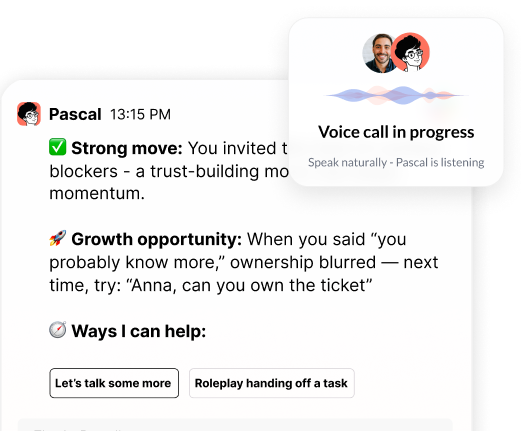
Pascal integrates with your existing systems to understand each employee's context without requiring managers to repeatedly explain their situation. Rather than asking a manager to describe their team dynamics before offering guidance, Pascal already knows the reporting structure, recent performance data, company values, and communication patterns. When a manager asks for delegation coaching, Pascal knows whether they tend to over-explain tasks, which team members are ready for stretch assignments, and current project pressures creating bottlenecks. The guidance becomes immediately actionable because it's grounded in observable behavior and real team dynamics.
ChatGPT and similar platforms provide one-size-fits-all advice because they cannot access your organizational context, team dynamics, or performance history, forcing managers to repeatedly explain situations before receiving generic guidance that often conflicts with company culture.
Generic tools require managers to explain background information every conversation, creating friction that kills adoption. 57% of professional coaches believe AI cannot deliver "real coaching" when divorced from organizational context. Only 29% of coaches report using company data directly in AI-driven sessions; 71% rely on self-reported information or generic benchmarks, stripping away the organizational nuance that makes coaching relevant. Managers engage with contextual AI coaches 2.3 times per week on average with 94% monthly retention, compared to single-digit engagement with generic tools. Without context, coaching cannot address the specific nuance that determines success: this manager's communication style with this employee on this project in your culture.
The most impactful data sources fall into four categories that directly correlate with behavior change and sustained engagement: performance and goal data, behavioral patterns from real interactions, organizational context, and team dynamics.
Performance and goal data including past reviews, current OKRs, career development plans, and 360 feedback create the foundation for understanding where someone is in their development journey. Behavioral data from meeting transcripts, communication patterns in Slack or Teams, calendar activity, and project collaboration patterns show how someone actually leads day to day. Organizational context including company values, competency frameworks, culture documentation, and leadership training materials ensures coaching aligns with how your organization defines success. Team dynamics from reporting structures, team composition changes, project workload, and interpersonal patterns help the AI understand relationship complexity. Organizations using contextual AI coaching report 83% of colleagues see measurable improvement in their managers, with 20% average lift in Manager Net Promoter Score among highly engaged users.
| Data Layer | What It Includes | Impact on Coaching Quality |
|---|---|---|
| Individual employee information | Role, goals, performance history, career aspirations | Personalizes guidance to specific development needs |
| Organizational knowledge | Values, competencies, culture documentation | Ensures coaching reinforces organizational priorities |
| Real-time work patterns | Meeting dynamics, communication style, team interactions | Enables proactive feedback on observable behavior |
| Temporal context | Performance cycles, goal-setting seasons, current projects | Surfaces coaching at moments of maximum relevance |
Purpose-built platforms practice data minimization, store information at the user level to prevent cross-account leakage, never train AI models on customer data, and include configurable guardrails for sensitive topics.
Data stored at individual user level makes information leakage technically impossible. Enterprise-grade encryption and SOC2 compliance should be standard, not premium features. By 2027, at least one global company is predicted to face an AI deployment ban due to data protection non-compliance, underscoring why robust privacy architecture cannot be an afterthought. Users should have transparent visibility and control over what the AI knows about them. Clear escalation protocols ensure HR involvement for sensitive topics like harassment, medical issues, or terminations. Custom data retention policies including zero-day retention should be available for conversations and transcripts.
Key Insight: Data isolation at the user level makes cross-account leakage architecturally impossible. Your manager's conversations with Pascal remain completely separate from their direct reports' interactions, even when Pascal is coaching both parties. This technical safeguard removes a significant adoption barrier by building trust that personalization doesn't create surveillance concerns.
Sophisticated AI coaches recognize when situations require human judgment—terminations, harassment concerns, mental health crises, discrimination claims—and create smooth escalation pathways rather than attempting to provide guidance on matters requiring legal awareness and organizational context.
Moderation filters detect toxic behavior, mental health concerns, or harmful content and flag for HR review. Sensitive topic detection identifies employee grievances, medical issues, and legal risks requiring human involvement. Clear escalation protocols ensure appropriate expertise engages when stakes are high.
"So much of the real learning and value comes from in-context coaching in the moment to drive performance and solve problems in the moment."
The most sophisticated AI coaches include guardrails that recognize boundaries and escalate appropriately, building manager confidence while maintaining appropriate oversight. When conversations touch on mental health concerns, harassment, discrimination, or other topics requiring human expertise, the AI escalates to HR rather than attempting to provide guidance on matters requiring legal awareness and organizational context. This protective layer de-risks AI adoption by ensuring appropriate human expertise is involved when it matters most.
Pascal integrates with your HRIS, performance systems, and communication tools to understand your people and culture, then delivers personalized guidance in Slack, Teams, or Zoom without requiring managers to repeatedly explain their situations. With customizable guardrails, user-level data isolation, and proper escalation for sensitive topics, you get the context advantage without the compliance risk. Book a demo to see how Pascal's contextual awareness delivers the business outcomes that matter to CHROs—faster manager ramp time, higher quality feedback conversations, and sustained behavior change that proves training ROI.

.png)
.webp)
“Thank you for setting the great foundation for my promotion; now I have a plan!"

Curious to see how AI Coaching can 10X the impact and scale of your development initiatives. Book a demo today for: