

When evaluating AI coaching platforms, prioritize coaching expertise, organizational customization, proactive engagement, workflow integration, and privacy guardrails. Red flags include generic chatbot responses, lack of SOC2 compliance, inability to customize for your culture, reactive-only tools, and vendors unwilling to demonstrate real coaching scenarios during demos.
You're evaluating vendors because your managers need help with performance conversations, delegation, and team conflicts. The question isn't whether AI can help—it's whether a specific platform delivers coaching or just repackaged advice.
The difference shows when you test with real scenarios. A coaching platform asks questions that surface your assumptions. A chatbot tells you what to do.
Five capabilities that separate coaching platforms from chatbots:
Coaching expertise: Platforms trained on coaching conversations (not just leadership books) understand how to guide reflection. When you describe a delegation problem, they ask what's stopping you from trusting your team—not just how to delegate. Look for vendors who can name their coaching methodology (GROW model, ICF competencies, cognitive-behavioral frameworks) and who trained their models. Many platforms are language models with no coaching foundation.
Contextual awareness: Effective platforms reference your organization's values, competencies, and leadership frameworks. When you ask about giving feedback, they cite your culture deck—not generic leadership principles. This requires customization: uploading your frameworks, configuring the platform to recognize your terminology, and testing that it actually uses this context. During demos, reference a specific value from your organization and watch whether the response feels generic or specific.
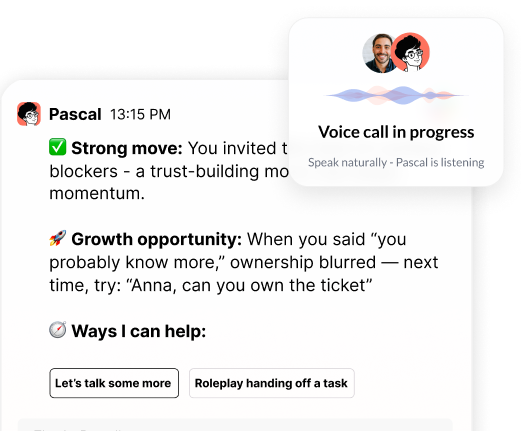
Proactive engagement: The platform joins your meetings, offers real-time feedback, and reaches out when it notices patterns (three difficult conversations in one week, repeated questions about the same team member). You don't log into a separate tool. In a 2023 study of enterprise software adoption, Forrester found that tools requiring separate logins see 60% drop in usage within 90 days. Proactive systems operate in your workflow—Slack, Teams, Zoom, email.
Workflow integration: Coaching happens where you work. You ask questions in Slack during a meeting without switching contexts. This is technical: API integrations, bot permissions, data sync between platforms. Ask vendors to show you the integration in your actual tools, not a demo environment.
Appropriate guardrails: The platform recognizes when topics require HR escalation (harassment, discrimination, mental health crises) and routes them to humans. It maintains SOC2 Type II compliance (an audit of security controls over a 6-12 month period, more rigorous than Type I). For regulated industries (healthcare, financial services, life sciences), this is non-negotiable. Ask: "What happens when someone describes potential harassment?" The answer should be immediate escalation, not coaching.
Test this during demos: Bring three real scenarios—a difficult performance conversation, a delegation challenge, and a sensitive HR situation. Watch how the platform responds. Generic tools give advice that could apply anywhere. Purpose-built platforms reference your values and escalate appropriately.
Red flags reveal themselves when you test platforms with real scenarios and ask about data handling. The most dangerous red flag is a vendor who delivers polished demos but refuses to let you test the platform with your actual challenges.
Use this scorecard during every demo:
Data Breakdown:
• Essential Capabilities: Coaching expertise with named methodology (GROW, ICF, CBT) | Critical Red Flags: Generic responses to your specific scenarios
• Essential Capabilities: Organizational customization (uploads your frameworks, references them in responses) | Critical Red Flags: Won't explain if they train models on your data
• Essential Capabilities: Proactive engagement (joins meetings, real-time feedback, pattern recognition) | Critical Red Flags: No escalation pathways for harassment or mental health
• Essential Capabilities: Workflow integration (Slack, Teams, Zoom, email—show it working) | Critical Red Flags: Requires separate login (engagement drops 60% in 90 days per Forrester)
• Essential Capabilities: SOC2 Type II compliance (ask for report) | Critical Red Flags: Vague or hidden pricing
• Essential Capabilities: No training on customer data (get this in writing) | Critical Red Flags: Can't name who trained coaching models
• Essential Capabilities: Clear data retention policies (30 days? 1 year? Forever?) | Critical Red Flags: Won't demonstrate with your real scenarios
• Essential Capabilities: Anonymous aggregated insights (no individual identifiable in reports) | Critical Red Flags: Missing security certifications (SOC2, GDPR, HIPAA if applicable)
• Essential Capabilities: Escalation protocols for HR issues (show the workflow) | Critical Red Flags: Evasive answers about data handling
Scoring: Rate each vendor on capabilities (present/absent) and red flags (triggered/not triggered). Eliminate any platform with 3+ red flags.
Ten scenarios to test during every demo:
• Difficult performance conversation: "I need to tell a long-tenured employee their work quality has declined. They're defensive and have strong relationships with senior leadership." Watch whether the platform explores your hesitation or just lists feedback steps.
• Delegation challenge: "I'm overwhelmed and need to delegate, but I don't trust my team to handle this work." Effective platforms ask why you don't trust them (skill gaps? control issues? past failures?). Generic platforms list delegation steps.
• Sensitive HR escalation: "An employee just told me they're experiencing harassment from another team member." The platform should immediately recognize this requires HR involvement—not coaching advice. Ask the vendor: "What just happened behind the scenes? Where did this conversation go?"
• Culture-specific scenario: Reference a specific value from your organization ("We value 'radical candor'—how do I apply that here?"). Generic platforms give textbook answers. Purpose-built platforms reference your definition of radical candor.
• Cross-functional conflict: "Two departments are blaming each other for a project failure, and I'm caught in the middle." This reveals whether the platform understands organizational dynamics or just individual-level advice.
• Career development conversation: "A high-performer wants a promotion, but they're not ready. How do I have this conversation?" Watch for coaching that balances honesty with development planning—not just "be honest" or "create a development plan."
• Remote team challenge: "My distributed team feels disconnected, and I'm not sure how to build culture virtually." This tests whether the platform offers practical guidance (specific rituals, meeting structures, async communication norms) or generic advice ("schedule more video calls").
• First-time manager scenario: "I just became a manager and need to give critical feedback for the first time." Effective platforms recognize the developmental stage and adjust their coaching (more structure, more reassurance, more specific steps).
• Burnout prevention: "I'm working 60-hour weeks and my team is stretched thin." Watch whether the platform addresses systemic issues (workload, prioritization, saying no) or just individual coping strategies (meditation, time management).
• Organizational change: "We're going through a major restructuring and my team is anxious." This reveals whether the platform can coach through ambiguity (acknowledging what you can't control, focusing on what you can, addressing team fears).
During each scenario, evaluate three things: Does the response feel specific to your organization? Does it demonstrate coaching methodology (questions, reflection, exploration)? Does it recognize when to escalate?
Data privacy is non-negotiable because managers discuss sensitive performance issues, employee concerns, and confidential business information. A single data breach can create legal liability and destroy trust.
The privacy requirements that matter:
SOC2 Type II compliance: This is an audit of security controls over 6-12 months (Type I is a point-in-time audit, less rigorous). For enterprises, this is the baseline. Ask to see the report.
No training on customer data: Your coaching conversations should never train the AI model. Your leadership challenges and organizational dynamics are proprietary information. Ask: "Will our data be used to train your models?" The answer must be no. Get this in writing.
Data retention policies: How long does the platform store coaching conversations? Some retain everything indefinitely. Others provide configurable retention (30 days, 90 days, 1 year) aligned with your HR policies. Ask: "Can we configure retention periods? What happens to data after that?"
Anonymous aggregated insights: When platforms provide organizational insights (common challenges, skill gaps, cultural trends), this data should be anonymized and aggregated. No individual should be identifiable in company-level reporting. Ask to see a sample report.
Escalation protocols for sensitive topics: When coaching conversations reveal potential harassment, discrimination, mental health crises, or legal concerns, these require human intervention. Ask: "Show me what happens when someone describes harassment. Where does that conversation go? Who sees it? How quickly?"
In 2023, a mid-size tech company experienced a data breach involving employee coaching conversations. The breach exposed performance issues, mental health discussions, and confidential business information. The company faced lawsuits from employees and lost two major customers who cited the breach as evidence of poor data governance. The reputational damage cost more than the platform ever saved.
For regulated industries (healthcare, financial services, life sciences), add HIPAA compliance (healthcare), GDPR compliance (EU employees), and industry-specific requirements.
The cost of getting this wrong outweighs any benefits the platform provides.
• Test with real scenarios: Bring actual workplace challenges to vendor demos—difficult performance conversations, delegation issues, HR escalation situations. Generic platforms give textbook answers. Purpose-built platforms reference your culture and escalate appropriately.
• Demand data privacy transparency: SOC2 Type II compliance is the baseline for enterprises. Your coaching conversations should never train the vendor's AI models. Ask directly about data handling, retention policies, and whether customer data is used for model training. Get it in writing.
• Prioritize proactive engagement: Platforms requiring separate logins see 60% drop in usage within 90 days (Forrester, 2023). Effective platforms join meetings, offer real-time feedback, and operate in your workflow—Slack, Teams, Zoom, email.
• Verify coaching expertise: Ask who trained the coaching models and what methodology they follow (GROW model, ICF competencies, cognitive-behavioral frameworks). Many platforms are language models with no coaching foundation.
• Use the scorecard: Rate each vendor on capabilities and red flags. Eliminate any platform with 3+ red flags, regardless of how polished their marketing appears.
Ready to see how purpose-built AI coaching works in practice? See how Pascal delivers real-time coaching inside Slack, Teams, and meetings with SOC2 compliance, organizational customization, and coaching trained by certified professionals.
Header photo by Christina @ wocintechchat.com M on Unsplash

.png)
.webp)
“Thank you for setting the great foundation for my promotion; now I have a plan!"

Curious to see how AI Coaching can 10X the impact and scale of your development initiatives. Book a demo today for: