

The most critical capabilities in AI coaching platforms are purpose-built coaching expertise, deep contextual awareness of your organization, proactive engagement in daily workflows, and robust privacy guardrails. Red flags include generic chatbot interfaces, lack of SOC2 compliance, inability to integrate with existing tools, and platforms that train AI models on your sensitive company data.
Three capabilities are non-negotiable: purpose-built coaching expertise, contextual integration with your existing tools, and enterprise-grade privacy controls.
Coaching foundation matters more than the underlying AI model. Generic language models lack the structured frameworks that professional coaches use—the ability to ask powerful questions, create reflection moments, and guide managers through complex interpersonal challenges. Look for platforms trained by ICF-certified coaches (International Coaching Federation, the industry's leading credentialing body). These platforms embed proven methodologies into responses, ensuring every interaction follows coaching best practices rather than providing generic advice.
For example, when a manager asks "How do I give difficult feedback?", a generic chatbot might list five tips. A coaching-trained platform asks "What specific behavior needs to change?" and "What outcome do you want from this conversation?" These questions force reflection and help the manager develop their own solution—the core of effective coaching.
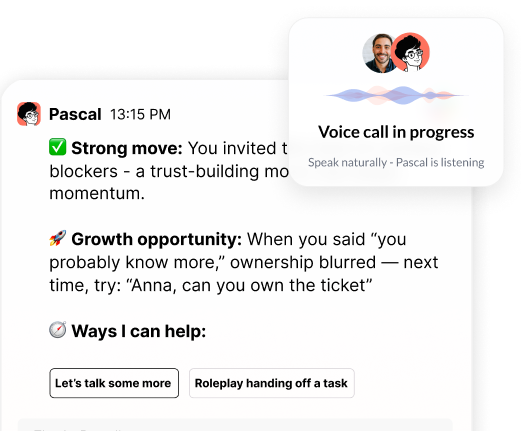
Contextual integration across your tech stack enables the AI to understand manager workflows and relationships. The platform should connect to Slack, Teams, Zoom, calendar systems, and HRIS platforms. Without this integration, managers must manually provide context every time they need coaching—a friction point that kills adoption.
According to MIT research, most AI projects fail due to implementation issues and lack of integration with existing workflows. The same pattern holds for coaching platforms. If managers must leave their workflow, log into a separate system, and re-explain their situation, they won't use it.
Privacy-first architecture protects your organization's sensitive data. Look for SOC2 Type II certification (an independent audit verifying the vendor has implemented and maintained robust controls for data security, availability, processing integrity, confidentiality, and privacy). Equally important: explicit data handling policies stating the vendor will never train their models on your company data. Your performance conversations, strategic discussions, and cultural challenges should never become training data for other customers.
Five red flags indicate fundamental problems: missing SOC2 certification, vague data usage policies, standalone platforms requiring separate login, generic chatbot interfaces, and lack of customer proof points.
No SOC2 Type II certification signals the vendor hasn't invested in enterprise-grade security controls. For regulated industries (healthcare, financial services, life sciences), this is an automatic disqualifier. Even for tech companies, the absence of SOC2 certification indicates the vendor isn't serious about enterprise deployment.
To verify: Ask "Can you provide your SOC2 Type II report?" and "When was your last audit completed?" Legitimate vendors will share these documents under NDA.
Vague or missing data usage policies create unacceptable risk. If the vendor can't clearly state "we never train our models on your company data," walk away. Some AI platforms improve their models by training on customer interactions, which means your performance conversations could inform coaching for competitors.
To verify: Ask "Do you train your AI models on customer data?" and "Can you provide written documentation of your data usage policy?" Demand explicit written commitments.
Standalone platform requiring separate login guarantees low adoption. According to Gartner research, the average enterprise uses 242 SaaS applications. Managers won't adopt tools that require context-switching from their daily workflow. If the demo shows a separate portal where managers must log in, input context, and navigate a new interface, you're looking at future shelfware.
To verify: Ask "Where does the coaching happen?" The answer should be "inside Slack/Teams/meetings," not "in our platform."
Generic chatbot interface without coaching structure reveals the platform is ChatGPT with a coaching label. Effective coaching requires structured frameworks, reflection prompts, and development plans—not just Q&A. If the demo shows a basic chat interface without evidence of coaching methodology, the platform won't drive behavior change.
To verify: Ask the platform "How do I give difficult feedback?" A generic response lists tips. A coaching response asks questions that force reflection: "What specific behavior needs to change?" and "What's your relationship history with this person?"
Lack of customer proof points suggests the vendor hasn't achieved measurable results. Vendors should provide specific metrics—not vague claims about "engagement" or "satisfaction." If the vendor can't share concrete customer outcomes with clear definitions and measurement methodology, they likely don't have any.
To verify: Ask "What specific, measurable outcomes have your customers achieved?" and "How do you measure those outcomes?" Demand definitions (what counts as "improvement"?), methodology (how was it measured?), timeframe (over what period?), and sample size (how many managers?).
Contextual awareness—the platform's ability to understand your organization's culture, individual manager relationships, and real-time work situations—transforms generic advice into actionable coaching. Without context, AI coaching becomes a search engine that managers quickly abandon.
Integration with communication tools provides the raw material for contextual understanding. Platforms that observe (with permission) Slack messages, email patterns, and meeting transcripts can identify communication styles, relationship dynamics, and emerging issues before they escalate. This isn't surveillance—it's pattern recognition that experienced coaches develop by working closely with clients over time, except the AI can do it at scale across hundreds of managers simultaneously.
For example, if the platform notices a manager has canceled three consecutive 1-on-1s with the same direct report, it can proactively flag this pattern and ask "I noticed you've rescheduled with Alex three times. What's making these meetings difficult to prioritize?" This level of awareness requires integration with calendar and communication systems.
HRIS and performance data integration connects coaching to business outcomes. When the platform understands performance ratings, tenure, team composition, and organizational structure, it can provide coaching that aligns with your talent strategy. A platform coaching a high-potential manager on a critical growth trajectory should deliver different guidance than one coaching a solid performer in a stable role.
Cultural and competency alignment ensures coaching reinforces your leadership model. Generic platforms provide advice based on universal leadership principles. Purpose-built platforms can be trained on your specific competency frameworks, values, and cultural norms—ensuring every coaching interaction reinforces what great leadership looks like in your organization.
To verify: Ask "How do you customize coaching to our leadership competencies?" and "Can you show examples of how the platform adapts to different organizational cultures?" Demand specific examples, not vague promises about "customization."
Real-time situational awareness delivers coaching when it matters most. Platforms that join meetings and observe conversations in real-time can provide immediate feedback: "You interrupted Sarah three times in that discussion. Here's how to create more space for her perspective." This in-the-moment coaching drives behavior change far more effectively than post-hoc reflection.
Enterprise-grade privacy guardrails balance the contextual awareness required for effective coaching with the data protection your organization demands. The best platforms implement multiple layers of protection: SOC2 compliance, explicit commitments never to train on customer data, moderation flags for sensitive topics, and anonymous aggregated insights for leadership.
SOC2 Type II compliance establishes the security foundation. This certification requires independent auditors to verify that the vendor has implemented and maintained robust controls for data security, availability, processing integrity, confidentiality, and privacy. It's not just a checkbox—it's evidence that the vendor treats your data with the same rigor you do.
Zero training on customer data prevents your sensitive information from leaking to other customers. Some AI platforms improve their models by training on customer interactions. Platforms with strong privacy commitments explicitly state they will never train their models on customer data—your conversations remain yours.
Moderation flags and escalation protocols create safety nets for sensitive topics. When a manager asks about terminating an employee, handling a discrimination complaint, or dealing with a mental health crisis, the platform should recognize these as topics requiring human judgment. Effective guardrails flag these conversations for HR review rather than providing AI-generated advice on legally sensitive matters.
For example, if a manager asks "How do I fire someone?", the platform should respond "This requires HR guidance. I've flagged this conversation for your HR team to follow up within 24 hours. In the meantime, don't take any action without consulting them." This protects both the manager and the organization.
Anonymous aggregated insights provide organizational value without compromising individual privacy. Leadership teams benefit from understanding communication patterns, common challenges, and skill gaps across the organization. The platform should surface these insights in aggregate form ("30% of managers struggle with delegation") without exposing individual conversations or identifiable data.
Organization-specific controls allow you to define boundaries that match your culture and risk tolerance. Some organizations want the AI to observe all meetings; others prefer opt-in only. Some want full integration with performance data; others want that firewall maintained. The platform should provide granular controls that let you balance contextual awareness with your specific privacy requirements.
• Purpose-built coaching expertise trained by ICF-certified coaches delivers fundamentally different results than generic language models wrapped in a coaching interface.
• Contextual awareness (integration with HRIS, communication tools, and calendar systems) separates platforms that drive behavior change from expensive chatbots.
• SOC2 Type II compliance and explicit commitments never to train on customer data are non-negotiable for enterprise deployment.
• Red flags include standalone platforms requiring separate login, generic chatbot interfaces without coaching structure, vague data usage policies, missing SOC2 certification, and inability to provide specific customer proof points with clear measurement methodology.
• Privacy guardrails (moderation flags, escalation protocols, anonymous aggregated insights, organization-specific controls) balance contextual awareness with data protection.
Ready to evaluate AI coaching platforms for your organization? Explore how Pinnacle approaches purpose-built coaching with enterprise-grade privacy guardrails and ICF-certified coaching expertise.

.png)
.webp)
“Thank you for setting the great foundation for my promotion; now I have a plan!"

Curious to see how AI Coaching can 10X the impact and scale of your development initiatives. Book a demo today for: