

Full disclosure: We build Pinnacle, an AI coaching platform for companies like Zapier and Calendly. This reflects what we've learned, but the framework applies to any vendor.
Before comparing features, demand proof the category works. Request peer-reviewed studies showing managers improve, named customers willing to discuss results, and data on sustained behavior change. Most vendors can't provide this. The evidence is sparse.
Decide: are you comfortable being an early adopter, or should you wait?
If you proceed, five capabilities separate effective platforms from expensive chatbots.
• Contextual personalization requires HRIS integration and your competency framework
• Proactive delivery means the platform reaches managers during work (not a separate app)
• Privacy architecture includes SOC2 Type II certification and escalation protocols for sensitive topics
• Workflow integration embeds coaching in Slack, Teams, Zoom, and email
• Behavior measurement tracks competency development and business outcomes (not just engagement metrics)
AI coaching platforms emerged around 2020, when natural language processing models became sophisticated enough to hold coherent conversations about workplace challenges. Early platforms were essentially chatbots with management advice—impressive demonstrations that failed in practice because managers never remembered to use them.
The category evolved through three generations. First-generation platforms (2020-2021) offered generic advice through standalone apps. Adoption rates rarely exceeded 15%. Second-generation platforms (2022-2023) added integrations and personalization, improving adoption to 30-40%. Third-generation platforms (2024-present) deliver proactive, contextual coaching embedded in workflow, achieving 60-80% sustained adoption.
The shift mirrors earlier enterprise software evolution. Customer relationship management (CRM) systems failed when they required separate data entry but succeeded when they integrated with email and calendar. Learning management systems (LMS) struggled with low completion rates until they embedded learning in workflow. AI coaching follows the same pattern: the technology works, but delivery mechanisms determine success.
Understanding this evolution helps evaluate vendor claims. When a vendor emphasizes their AI sophistication, ask about delivery mechanisms and adoption rates. The most advanced AI fails if managers don't use it.
Without context, you get plausible advice that doesn't fit your reality. Generic tools treat your VP of Engineering the same as a retail manager at a different company.
A contextual platform integrates with your HRIS (Workday, Culture Amp, Dayforce). It ingests your competency framework and leadership principles. When a manager asks how to give difficult feedback, the platform references your company's specific feedback methodology and the employee's recent performance review.
A generic platform suggests "use the SBI model: Situation, Behavior, Impact." A contextual platform knows your company uses Radical Candor, references the employee's recent performance review showing deadline struggles, and notes the manager's development plan identifies "delivering difficult feedback" as a growth area.
This requires sophisticated data integration. The platform must securely connect to your HRIS, parse your competency models, and understand your organizational structure. Some vendors claim "customization" but only let you upload a PDF that the AI references occasionally. True personalization means the platform understands your competency framework as structured data and tracks progress against your definitions of success.
Real-world use case: A technology company with 800 employees implemented a contextual AI coaching platform integrated with their HRIS and custom leadership competency model. When managers asked about delegation, the platform referenced the company's specific delegation framework (which emphasized "delegate outcomes, not tasks") and the manager's current team structure. Within six months, managers asking delegation questions decreased by 40%—not because they stopped delegating, but because they internalized the skill and no longer needed coaching on it. The platform tracked this improvement through conversation analysis and 360 feedback scores.
Jeff Diana, former CHRO at Calendly and Atlassian: "Real learning and value come from in-context coaching—solving problems in the moment, not in a classroom."
Ask vendors: How do you ingest our competency framework? Can you reference our leadership principles during coaching? Can you show us a demo using our actual competency model? If they can't explain the technical integration, they're offering generic advice.
Red flag: Generic advice applicable to any company. No integration capabilities. Claims of "customization" that only involve uploading documents.
A proactive coach joins your meetings, observes interactions, and delivers feedback without prompting. A reactive chatbot waits for you to remember it exists, open a separate app, and type a question.
Consider the manager's day: back-to-back meetings from 9am to 5pm, email and Slack in between, strategic work squeezed into early mornings or evenings. When are they supposed to remember to open a coaching app? After a difficult conversation when they're already late to the next meeting? They won't.
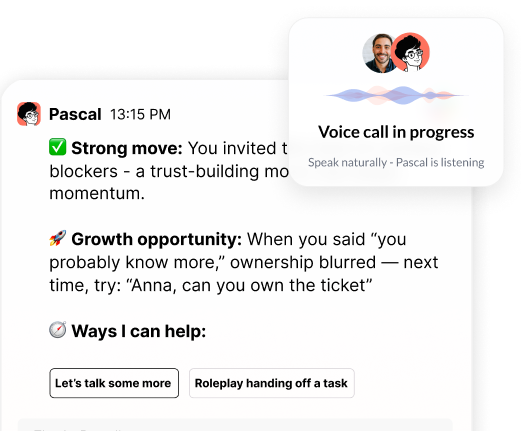
Proactive delivery solves this by meeting managers where they work. A Slack bot messages a manager immediately after a 1:1: "I noticed you committed to three action items. Would you like help prioritizing them?" A meeting companion observes that a manager interrupted their direct report five times and offers feedback on active listening.
Timing matters. Immediate feedback changes behavior more than delayed feedback. When a manager receives coaching within minutes of a challenging conversation, they can reflect while details are fresh and apply lessons to the next similar situation.
Real-world use case: A financial services company deployed proactive AI coaching that integrated with their calendar and video conferencing system. After each 1:1 meeting, the platform automatically sent managers a brief reflection prompt in Slack: "Your 1:1 with Alex just ended. What went well? What would you do differently?" Managers responded to 73% of these prompts (compared to 12% who opened the previous standalone coaching app). The platform then offered targeted coaching based on their reflections. Managers reported the proactive approach felt like having a coach observing their work, not another tool to remember.
Ask vendors: How does your tool reach managers during work? What triggers coaching interventions? Can you show us examples of proactive outreach? If the answer is "they open the app and ask a question," adoption will fail.
Red flag: Requires opening a separate app. Only responds to questions. No calendar or communication tool integration.
The question isn't whether the vendor is SOC2 compliant. It's whether they train their AI models on your company's data, and what happens when a manager discusses harassment with the AI.
Data training: Many AI vendors use customer conversations to improve their models. Your manager's discussion about a struggling employee could become training data that influences how the AI responds to other companies' managers. The best vendors maintain strict data separation. Your conversations train your instance of the AI but never flow into the vendor's general model or other customers' instances.
Sensitive topic detection: Managers will discuss sensitive topics with AI coaches. A manager might ask how to handle an employee who disclosed depression. Another might seek advice on a team member's complaint about discrimination. These conversations require human expertise and legal compliance, not AI responses.
Effective platforms use natural language processing to detect sensitive topics: mental health crises, harassment, discrimination, violence, self-harm. When detected, the platform should immediately escalate to HR, provide crisis resources, and stop offering AI-generated advice.
The escalation protocols matter as much as the detection. Who gets notified? How quickly? What information is shared? A manager discussing harassment needs immediate connection to HR and legal, with full conversation context.
Real-world use case: A retail company with 3,000 managers implemented an AI coaching platform with sensitive topic detection. Within the first month, the system detected and escalated four conversations involving potential harassment or discrimination. In each case, HR received immediate notification with full conversation context, allowing them to intervene within hours rather than weeks. The company's legal team credited the early detection with preventing two situations from escalating into formal complaints. Managers reported feeling safer discussing sensitive situations knowing the platform would escalate appropriately rather than offering potentially harmful AI-generated advice.
Access controls: Who can see what managers discuss with the AI? The right balance: HR sees anonymized, aggregated insights (30% of managers are asking about delegation) but never individual conversations. Individual managers control their own data and can choose to share specific conversations with their own manager or HR.
Some platforms allow HR to access individual conversations "in case of emergency." This destroys trust. Managers won't discuss real challenges if they know HR might read their conversations.
Data residency: If your company operates in Europe, GDPR (General Data Protection Regulation, the EU's privacy law) requires that personal data stays within the EU or in countries with adequate data protection. Ask where data is stored (which specific data centers, in which countries), whether you can specify data residency, and how the vendor handles cross-border data transfers.
Essential criteria:
• SOC2 Type II certification (an independent auditor verified security controls work over time, not just on paper). Not "in progress."
• Data training policy: Do they use your conversations to improve their models?
• Escalation protocols: What happens when the AI detects discussion of harassment, discrimination, or mental health crisis?
• Data residency: Where is your data stored?
• Access controls: Can HR see what employees discuss?
Ask vendors: Do you train AI models on our data? What happens when harassment is discussed? Can you walk us through a specific escalation scenario? Where is our data stored, and can we specify data residency? If they claim "everything is encrypted" without specifying data handling, or can't explain escalation protocols, walk away.
Red flag: Vague encryption claims. "SOC2 in progress." No sensitive topic protocols. Can't specify data residency. HR has access to individual conversations.
The most sophisticated AI coach fails if managers have to leave Slack, close their email, and remember to open a separate platform.
Effective platforms embed in tools managers already use: Slack for quick questions between meetings, Teams for collaboration context, Zoom and Google Meet for meeting feedback, email for follow-up actions.
The principle is simple: coaching should have lower friction than not getting coached. If accessing coaching requires more effort than muddling through on your own, managers will muddle through.
Consider the manager who just finished a difficult performance conversation. They're uncertain whether they struck the right tone. In a high-friction scenario, they would need to remember the coaching platform exists, open a new browser tab or app, log in, navigate to the right section, and type their question. By the time they complete these steps, their next meeting has started.
In a low-friction scenario, they open Slack (already open in another tab) and message their AI coach: "I just told Sarah her work isn't meeting expectations. Did I handle that okay?" The response arrives in seconds, in the same interface they use for all work communication.
Brandon Sammut, CHRO at Zapier: "We're embedding AI expectations into existing behaviors, not creating new frameworks."
Workflow integration extends beyond availability. The best platforms understand context from the tools they integrate with. A Slack integration can see that a manager just messaged their team about a project delay and offer coaching on managing stakeholder communication. A calendar integration knows the manager has five 1:1s scheduled this week and can offer preparation guidance.
Meeting integration provides the richest context. When the AI joins a Zoom call (with appropriate permissions and transparency), it can observe communication patterns, identify coaching opportunities, and deliver feedback based on behavior rather than the manager's self-report.
Real-world use case: A software company with distributed teams implemented AI coaching embedded in Slack and Zoom. Managers could ask questions directly in Slack without leaving their workflow. The platform also joined 1:1 meetings (with employee consent) and provided post-meeting feedback on communication patterns. Adoption reached 78% within three months—compared to 23% adoption of their previous standalone coaching platform. Managers reported that Slack integration made coaching feel like "asking a colleague" rather than "using a tool." The meeting integration revealed patterns managers didn't recognize themselves, such as one manager who consistently interrupted during the first five minutes of meetings but improved after receiving specific feedback.
Ask vendors: Where does coaching happen? How many clicks to access coaching? Can you demonstrate the Slack or Teams integration? What meeting platforms do you integrate with? If the answer is "our platform," expect low adoption.
Red flag: Separate platform requiring context-switching. Requires logging in. No integration with communication tools managers already use daily.
If you can't measure behavior change, you can't justify the investment.
Effective platforms provide three levels of measurement:
Individual progress: Which behaviors are improving over time? A manager struggling with delegation should see progress on delegation competency, not "completed 12 sessions."
Individual measurement requires baseline assessment, ongoing tracking, and clear competency definitions. The platform should establish where a manager starts (through 360 feedback, self-assessment, or initial coaching conversations), track which competencies receive coaching focus, and measure improvement over time.
Self-reported improvement ("I feel better at delegation") is useful but insufficient. Better platforms incorporate multiple signals: frequency of delegation-related coaching conversations decreasing over time (suggesting the manager has internalized the skill), 360 feedback showing improved delegation scores, or direct report engagement scores improving (a proxy for better delegation and empowerment).
Organizational insights: What skill gaps exist across the company? These must be anonymized (no individual data visible) and aggregated (minimum group sizes to prevent identification).
Organizational insights answer questions like: What percentage of managers struggle with giving critical feedback? Do engineering managers face different challenges than sales managers? Are new managers asking different questions than experienced managers?
These insights inform talent development strategy. If 60% of managers are asking about delegation, your leadership development program should emphasize delegation skills. If engineering managers ask about cross-functional collaboration, you might need better processes for engineering-product partnerships.
Aggregated insights must use minimum group sizes (5-10 people) to prevent identification. A report showing "100% of managers in the Boston office ask about work-life balance" is problematic if there's only one manager in Boston.
Business impact: How does coaching engagement connect to retention, performance ratings, and engagement scores? This requires integration with your HRIS to track outcomes.
Business impact measurement answers the CFO's question: "Is this worth the investment?" It requires connecting coaching data to business outcomes.
The methodology involves cohort analysis. Compare managers who use coaching to similar managers who don't. Do their teams show better retention? Higher engagement scores? Better performance ratings? The analysis must control for confounding variables (managers who seek coaching are already more engaged and would have better outcomes regardless).
More sophisticated measurement tracks leading indicators. Does coaching on "effective 1:1s" correlate with managers conducting more frequent 1:1s? Does coaching on feedback correlate with more frequent feedback conversations (measured through engagement surveys or HRIS data on documented feedback)?
The timeline for business impact measurement is longer than for engagement metrics. You might see engagement data (managers are using the platform) within weeks, individual progress data within months, and business impact data within quarters or years.
Real-world use case: A healthcare company with 400 managers implemented AI coaching and tracked behavior change over 12 months. They measured three levels: individual competency improvement (tracked through 360 feedback), organizational skill gaps (aggregated coaching topics), and business impact (team retention and engagement). Results showed managers who actively used coaching (defined as at least two coaching interactions per month) had teams with 18% better retention and 12% higher engagement scores compared to managers who didn't use coaching. The analysis controlled for team size, manager tenure, and department. The company calculated ROI by comparing the cost of the platform ($150 per manager annually) to the cost of replacing employees (estimated at $75,000 per employee). With 400 managers and average team size of 8, the 18% retention improvement prevented approximately 58 departures, saving $4.35 million against a $60,000 platform investment.
Ask vendors: How do you measure behavior change? Can you connect coaching to retention data? Can you show us a sample measurement dashboard? What's the typical timeline to see business impact? If they can't explain measurement beyond engagement metrics, they're guessing.
Red flag: Only engagement metrics. Satisfaction scores. Session counts. No HRIS integration for outcome tracking. Can't explain methodology for connecting coaching to business results.
Data Breakdown:
• Capability: Contextual Personalization | What to Look For: HRIS integration (Workday, Culture Amp, Dayforce); ingests competency frameworks; references leadership principles | Red Flags: Generic advice applicable to any company; no integration capabilities | Questions to Ask: "How do you ingest our competency framework?" "Can you reference our leadership principles during coaching?"
• Capability: Proactive Delivery | What to Look For: Joins meetings; delivers real-time feedback; reaches managers during work | Red Flags: Requires opening separate app; only responds to questions | Questions to Ask: "How does your tool reach managers during work?" "What triggers coaching interventions?"
• Capability: Privacy Architecture | What to Look For: SOC2 Type II certified; never trains on customer data; clear escalation protocols | Red Flags: Vague encryption claims; "SOC2 in progress"; no sensitive topic protocols | Questions to Ask: "Do you train AI models on our data?" "What happens when harassment is discussed?"
• Capability: Workflow Integration | What to Look For: Embeds in Slack, Teams, Zoom, email; no context-switching required | Red Flags: Separate platform; requires logging in | Questions to Ask: "Where does coaching happen?" "How many clicks to access coaching?"
• Capability: Behavior Measurement | What to Look For: Tracks competency development; connects to business outcomes; anonymized organizational insights | Red Flags: Only engagement metrics; satisfaction scores; session counts | Questions to Ask: "How do you measure behavior change?" "Can you connect coaching to retention data?"
When evaluating vendors, the questions they ask reveal as much as the questions they answer. Here's what to listen for:
Vendors who ask about your competency framework and leadership principles understand contextual personalization
Header photo by Christina @ wocintechchat.com M on Unsplash

.png)
.webp)
“Thank you for setting the great foundation for my promotion; now I have a plan!"

Curious to see how AI Coaching can 10X the impact and scale of your development initiatives. Book a demo today for: