

Suggestions or recommendations that feel either generic or wrong break trust with an AI coach fastest. Generic advice reads as an AI telling someone what they should do, and wrong advice shows that the system does not understand their situation. The bar is that every suggestion has to be specific to what the coach knows about the person.
Coaching helps when the person receiving it acts on it. A manager who doubts the advice will skim it, set it aside and stop opening the tool, and the investment quietly fades with each ignored message.
Trust in a coach builds over many accurate, useful suggestions, and a single piece of advice that misreads the situation can undo that progress. For anyone choosing an AI coach, this makes trust a practical measure of quality, because it predicts whether managers will keep using the coach at all.
Generic suggestions are a common way AI coaching loses people. Advice such as "set clear expectations" or "listen actively" applies to almost every manager, so the manager already knows it and the message adds nothing specific to their situation. When a suggestion could apply to anyone, the manager hears it as an AI giving orders and learns to tune it out.
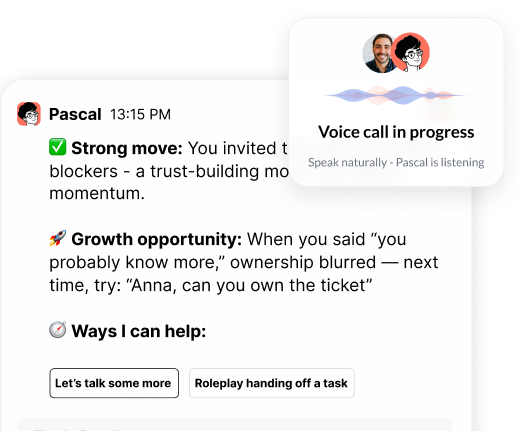
A note that refers to a particular 1:1, names the moment a conversation shifted and suggests a different opening for next time shows the manager that the coach was paying attention to their real work. Managers who see that level of detail are more likely to read the next message as well.
Wrong advice reveals a gap in the coach's understanding of the situation. When a coach recommends pushing harder on a team member who is already overloaded, or praises a meeting the manager knows went badly, the manager concludes that the coach has misread what is going on.
After that moment, every later suggestion carries a question mark. The manager has to check each piece of advice against their own judgment, which removes most of the value a coach is supposed to provide. Accuracy depends on context, because a coach is right about the situations it knows well, and being present for a situation is the clearest way to know it.
Human coaching is question-based for a sound reason. A human coach works from what the client chooses to share, so the coach asks questions that help the client find the answer.
An AI coach that knows the person's context and shares their environment can give a direct answer when one would help. Coaching then becomes much more like a sports coach, who makes a call and tells the player what will work.
Pascal is an AI coach for every manager: a leadership companion who accompanies them in their meetings and work, and coaches from what actually happened. Because Pascal works from real meetings, his suggestions can refer to specific conversations, which is the standard that keeps trust intact. Each person's coaching conversations with Pascal stay private. HR and executives see aggregated, anonymized insights, and only for groups large enough to protect anonymity.
Trust is a useful lens for answering this question when HR teams evaluate AI coaching. Adults learn by practice and iteration, which is why coaching works. Human coaching remains valuable for the people who receive it, and AI coaching extends personalized, continuous feedback and development to every manager in the flow of their work.
For buyers, the deciding factor is whether managers trust the coach enough to use it every week. An AI coach earns that trust in the same way a human coach does, through advice that shows real understanding of the person and their situation. When comparing AI coaches, a short set of checks keeps the focus on trust.



“Thank you for setting the great foundation for my promotion; now I have a plan!"

Curious to see how AI Coaching can 10X the impact and scale of your development initiatives. Book a demo today for: