

Embedded AI tools bolt general-purpose chatbots (ChatGPT, Gemini) into existing platforms (Slack, Teams). Purpose-built AI coaches are standalone systems designed specifically for leadership development, with coaching frameworks, organizational memory, and proactive engagement.
The architectural difference shows up in three layers:
Data layer: Embedded tools see only what happens in their host platform (Slack messages, calendar events). Purpose-built coaches integrate performance reviews, 360 feedback, company competencies, and interaction patterns across multiple systems.
Reasoning layer: Embedded tools apply generic conversation patterns. Purpose-built coaches use validated coaching frameworks (GROW model, SBI feedback structure, developmental questioning sequences).
Engagement layer: Embedded tools wait for you to ask. Purpose-built coaches surface guidance before critical moments (joining meetings, prompting reflection after tense conversations, suggesting preparation before performance reviews).
Data Breakdown:
• Layer: Data | Embedded AI Tools: Single platform, conversation history | Purpose-Built AI Coaches: Multi-source integration, behavioral synthesis
• Layer: Reasoning | Embedded AI Tools: General language models | Purpose-Built AI Coaches: Coaching frameworks (GROW, SBI)
• Layer: Memory | Embedded AI Tools: Session-based logs | Purpose-Built AI Coaches: Knowledge graphs tracking patterns over months
• Layer: Engagement | Embedded AI Tools: Reactive (user-initiated) | Purpose-Built AI Coaches: Proactive (context-triggered)
• Layer: Customization | Embedded AI Tools: Generic best practices | Purpose-Built AI Coaches: Company values, competencies, culture
This matters because the architecture determines whether managers actually use the tool. Reactive systems require managers to remember to access them, provide context every time, and maintain discipline. Proactive systems meet managers where work happens.
Embedded tools living inside Slack see only Slack messages. They can't access performance reviews, 360 feedback, or company competency frameworks. Every interaction is isolated.
Purpose-built coaches connect multiple data sources into unified context. Pascal integrates with Slack, Outlook, Zoom, Teams, Culture Amp, Dayforce, and Darwin Box. The system tracks development over months, incorporates company-specific leadership principles, and synthesizes 360 feedback.
Example: A manager prepares for a difficult performance conversation. An embedded tool suggests generic feedback frameworks. A purpose-built coach knows this manager avoids conflict (from meeting transcripts), understands the company's performance improvement process (from HR documentation), and recognizes the direct report's development goals (from the performance system). The guidance becomes specific: "You tend to soften critical feedback. In this conversation, state the performance gap directly in the first two sentences, then ask what support they need."
The difference compounds. After three months, the embedded tool still treats every conversation as new. The purpose-built coach references previous coaching sessions, notes improvement in direct communication, and adjusts guidance based on developmental trajectory.
Reactive architecture creates a usage problem. Managers must initiate every interaction, remember to access the tool before important moments, and maintain discipline. Engagement drops to 10-20% within months.
Proactive architecture changes the equation. The AI joins meetings and provides real-time feedback. It surfaces guidance before difficult conversations. It prompts reflection on patterns managers don't notice themselves.
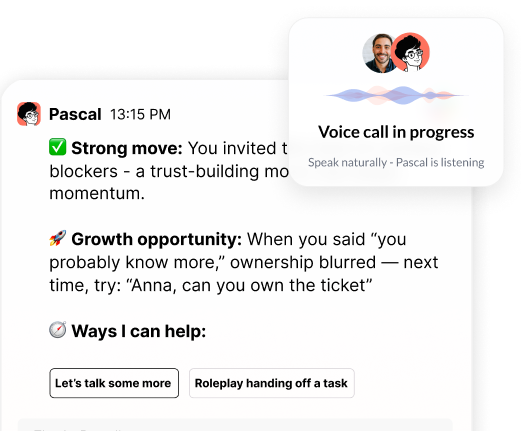
Pascal achieves 94% monthly retention through proactive engagement. Managers don't remember to use it because it meets them where work happens. After a tense meeting, the system sends a message: "I noticed tension when the team pushed back on the deadline. You conceded immediately without exploring their concerns. Want to debrief?"
That single proactive moment creates a coaching opportunity that would otherwise never happen. The manager didn't need to remember to seek coaching, provide context about what happened, or explain the relationship dynamics. The system was there.
Jeff Diana, former CHRO at Calendly and Atlassian, told us: "Real learning comes from in-context coaching—solving problems in the moment, not in a classroom." Proactive engagement architecture makes in-context coaching possible at scale.
Embedded tools retain basic conversation history. No cross-session learning about communication styles. No tracking of developmental progress over weeks. Each interaction treats the manager as new.
Purpose-built coaches maintain knowledge graphs mapping workplace relationships and interaction patterns. Behavioral trend analysis identifies growth areas over time. Persistent memory understands communication style, values, and development goals.
This enables features that feel like working with a human coach who knows you. Pascal lets managers practice conversations with AI versions of specific colleagues based on actual interaction history. A manager who avoids conflict in team meetings receives coaching that acknowledges this pattern and provides strategies tailored to their style. The system remembers previous coaching conversations and builds on them.
When a manager asks for feedback on how they handled a situation, the system references similar situations from weeks ago, notes improvements or recurring challenges, and provides coaching that accounts for their trajectory. A manager who struggled with direct feedback three months ago but has improved gets different guidance than one still avoiding difficult conversations.
This longitudinal view transforms occasional advice into sustained behavior change.
Embedded tools use general conversational patterns, not coaching frameworks. No systematic approach to goal-setting, reflection, and accountability. They give advice rather than guide development.
Purpose-built coaches embed validated methodologies directly into system architecture. Every interaction follows proven frameworks. The GROW model (Goal, Reality, Options, Will) structures developmental conversations. The SBI framework (Situation, Behavior, Impact) guides feedback preparation. Developmental questioning sequences help managers discover insights rather than receiving instructions.
Pascal's coaching models are trained by ICF-certified coaches. The system doesn't just provide information—it guides managers through developmental processes.
The difference: "Here's how to give feedback" versus "Let's prepare for this specific feedback conversation using the SBI framework. You tend toward indirect communication. This employee prefers direct input. Let's practice stating the behavior and impact in the first two sentences."
The framework architecture also enables consistency at scale. When every manager receives coaching grounded in the same validated methodologies, leadership development becomes predictable. Organizations can measure skill development against known frameworks.
Integration architecture determines whether coaching becomes part of work or an additional task managers avoid.
Managers already juggle multiple tools and priorities. A coaching system requiring them to open another application, remember to use it before important moments, or manually input context creates friction that kills adoption.
Purpose-built integration reduces friction to near-zero. Pascal joins meetings automatically, providing real-time feedback without managers needing to remember to invite it. It surfaces guidance in Slack or Teams where managers already spend their day. It prompts reflection at natural moments (after a challenging meeting, before a performance review, when communication patterns suggest a coaching opportunity).
Embedded tools face an inherent limitation. Even when they live inside Slack or Teams, they require explicit invocation. Managers must @mention the bot, ask the right questions, and provide sufficient context. This works for motivated early adopters but fails to scale.
The architectural choice also affects coaching quality. When a system participates in actual work (joining meetings, observing interactions), it develops contextual understanding impossible for tools that only see what managers explicitly share. This enables coaching that references specific moments: "In that meeting, when the team pushed back on the deadline, you immediately conceded without exploring the underlying concerns. What made you decide to concede rather than ask questions?"
Managers discuss performance issues, compensation decisions, and sensitive employee situations with AI tools. Generic AI platforms often include terms allowing data use for model training. Even enterprise tiers may not provide the isolation and control enterprises require.
Purpose-built security architecture starts with data isolation. Customer data never mingles with other organizations' data or gets used to train foundation models. SOC2 compliance demonstrates adherence to security standards. Configurable data retention policies let organizations delete transcript data, store only behavioral insights, or set expiration dates.
Pascal includes moderation flags for inappropriate content, sensitive topic escalation to HR when conversations enter areas requiring human judgment, organization-specific controls that align with company policies, and anonymous aggregated insights that protect individual privacy while providing organizational learning.
This matters most in regulated industries. Healthcare, financial services, and life sciences organizations face strict data governance requirements. A coaching system that cannot guarantee data isolation creates compliance risks that outweigh developmental benefits.
• Design intent determines outcomes: Embedded tools prioritize convenience. Purpose-built coaches prioritize behavior change through specialized frameworks, organizational context, and proactive engagement.
• Data integration depth drives coaching quality: Purpose-built systems integrate performance reviews, 360 feedback, and company competencies. Embedded tools access only surface-level workflow data.
• Proactive engagement sustains adoption: Purpose-built coaches achieve 94% monthly retention by initiating coaching moments. Reactive embedded tools see engagement drop to 10-20% within months.
• Memory infrastructure enables personalization: Knowledge graphs tracking communication patterns and developmental progress over time create coaching that evolves with each manager (impossible with session-based conversation logs).
• Enterprise security protects sensitive data: SOC2 compliance, customer data isolation, and commitments never to train on customer data differentiate purpose-built platforms from consumer AI tools adapted for workplace use.
The choice between embedded AI tools and purpose-built AI coaches isn't about features. It's about whether your investment scales manager effectiveness or becomes another underutilized resource. Organizations serious about leadership development need systems architected specifically for coaching, not general-purpose AI retrofitted into workplace tools.
See how Pascal delivers purpose-built AI coaching at heypinnacle.com.
Header photo by Evgeniy Surzhan on Unsplash

.png)
.webp)
“Thank you for setting the great foundation for my promotion; now I have a plan!"

Curious to see how AI Coaching can 10X the impact and scale of your development initiatives. Book a demo today for: