

Manager nudges are small, timely prompts delivered in the flow of work that guide leaders toward better decisions without requiring formal training. They work because they appear at the exact moment a decision matters—before a difficult conversation, during a team meeting, when drafting feedback.
Manager nudges are contextual prompts that appear at decision-critical moments. Unlike training that happens in a classroom weeks before application, nudges appear when managers need guidance.
A nudge might be a single question ("Have you clarified expectations?") rather than a 12-module course. Instead of "be a better communicator," a nudge says "restate what you heard before responding."
These prompts integrate into tools managers already use—Slack, Teams, email, meeting platforms. Before a 1:1, a manager might receive: "You haven't asked [employee name] for feedback in 6 weeks. Here are three questions to open that conversation." During a team meeting, a suggestion might invite quieter team members to contribute. After a project milestone, a prompt could encourage recognizing specific contributions.
The timing matters. Nudges intercept managers at the moment of action, not weeks after a workshop. This addresses a core problem with traditional training: people forget most new information quickly. Nudges bypass the forgetting curve by delivering guidance at the point of application.
Nudges align with how adults actually learn and change behavior: through repeated practice in real contexts, not through information transfer in classrooms.
Reduced friction at the point of decision makes the right action easier. A manager about to send critical feedback via email receives a nudge: "Consider scheduling a conversation instead. Here's a draft message to set it up." The nudge removes the friction of figuring out how to do the right thing.
Contextual learning beats abstract learning because adults learn by doing. Nudges create micro-learning moments embedded in actual work. A Gallup study found that 70% of team engagement variance comes down to the manager. Nudges improve that 70% by shaping manager behavior in real team interactions, not simulations.
Repetition builds habits where one workshop cannot. Consistent nudges over weeks create new defaults. Nudges across multiple situations (feedback conversations, delegation moments, recognition opportunities) reinforce the same core behaviors until they become automatic.
The key is relevance. Generic reminders create notification fatigue. Effective nudges connect to real challenges managers face in their specific context. A nudge that says "You haven't had a 1:1 with Sarah in three weeks" is more useful than "Remember to have regular 1:1s."
The most effective nudges fall into five categories, each addressing a specific gap in manager-employee interactions.
Pre-conversation preparation nudges arrive 30-60 minutes before scheduled 1:1s or performance conversations. Example: "Your last three 1:1s with [name] focused on project updates. Consider asking about career development today." These nudges surface relevant context and suggested questions based on past interactions.
Real-time communication coaching appears during meetings or conversations when communication patterns need adjustment. During a team meeting where one person has dominated, a nudge suggests: "Three team members haven't spoken yet. Try: 'Before we move on, I'd like to hear from [names].'" This corrects behavior in the moment.
Recognition and feedback prompts trigger when managers haven't acknowledged contributions within expected timeframes. "It's been three weeks since [employee] shipped the new feature. Consider recognizing their work in tomorrow's team meeting." These nudges prevent the common pattern where managers intend to give feedback but forget.
Delegation and development nudges surface when managers show patterns of over-functioning. "You've handled the last four client escalations personally. Consider delegating the next one to [team member] as a development opportunity." These prompts help managers break habits that limit team growth.
Cultural reinforcement nudges align manager behavior with organizational values. If your company values transparency, a nudge might appear before an all-hands: "Remember to share both wins and challenges in today's meeting—transparency builds trust." These nudges turn abstract values into concrete actions.
Successful nudge implementation requires integration into existing workflows rather than creating new processes. Managers are already overwhelmed. Adding another tool often backfires.
Connect nudges to organizational rituals that already exist. Performance reviews, quarterly check-ins, goal-setting cycles, and management training programs provide natural entry points. When Verkada implemented manager nudges at Pinnacle, they tied them to their promotion pathway for managers. Managers engaged because the nudges supported a goal they already cared about.
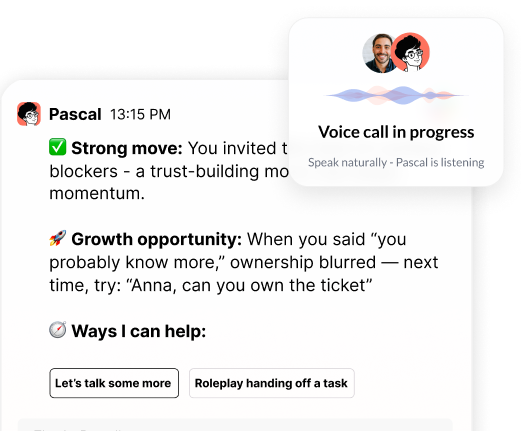
Integrate into tools managers use daily. Nudges must appear inside Slack, Teams, Zoom, or Google Meet. Managers won't open a separate app for coaching. We built Pascal to embed coaching directly into these platforms, delivering nudges as messages or meeting summaries that require zero context-switching.
Customize content around your culture. Generic nudges fail because they don't reflect your competencies or priorities. Effective nudge systems allow you to customize content around your leadership framework, values, and training materials. Pascal can be trained on company-specific competencies, ensuring nudges reinforce what your organization cares about.
Identify champion managers who will share their successes. Give them early access before full rollout. When their peers hear real stories ("Pascal reminded me to ask about career goals, and it changed my 1:1"), adoption accelerates. Senior leaders using and endorsing the tool creates permission for others to engage.
Track three levels of impact. First, adoption patterns: Are managers engaging with nudges consistently? Second, behavioral changes: Are managers applying what nudges suggest? Third, business outcomes: Are team engagement scores, retention rates, and manager effectiveness ratings improving? Pascal provides anonymized, aggregated insights that reveal what challenges managers face so you can stage thoughtful interventions.
Organizations that succeed with nudges connect the tool to existing pain points, demonstrate quick wins, and build habits over 90 days rather than expecting instant transformation.
Manager nudges deliver measurable impact across three timeframes.
Weeks 1-4: Immediate signals. Engagement rates matter first. Are managers opening nudges? Are they reacting to suggestions? If managers ignore nudges, the content isn't relevant or the timing is wrong. Pascal's approach (joining meetings and surfacing nudges at decision moments) drives higher engagement than on-demand tools that require managers to remember to ask for help.
Months 2-3: Behavioral changes. Observable improvements in manager actions become visible. Are managers asking for feedback more consistently? Are 1:1s covering development topics instead of just status updates? Are difficult conversations happening earlier instead of festering? We've seen 83% of managers show observable improvement as rated by direct reports within 90 days. Manager Net Promoter Scores increase an average of 20% among high-engagement users.
Months 4-12: Organizational outcomes. Business metrics shift as manager behavior compounds. Team engagement scores improve. Retention rates for high performers increase. The time managers spend on administrative tasks decreases. One Pascal customer saved managers 150+ hours annually on meeting preparation because the AI surfaced relevant context automatically.
Unlike traditional training that measures completion rates, nudge systems measure actual behavior change in work contexts. Pascal's presence in meetings and communication channels creates a continuous performance dataset that reveals how managers show up against your culture and values in real-time. This is more valuable than annual engagement surveys or quarterly performance reviews.
Set realistic expectations. Nudges won't transform your worst managers into stars overnight. They will help your middle 60% (managers who want to improve but lack consistent guidance) become measurably more effective. That middle 60% represents your highest-leverage opportunity for organizational impact.
• Manager nudges deliver guidance at decision-critical moments, bypassing the forgetting curve that makes traditional training ineffective—nudges appear exactly when managers need them.
• Effective nudges fall into five categories: pre-conversation preparation, real-time communication coaching, recognition prompts, delegation guidance, and cultural reinforcement.
• Successful implementation requires integration into existing workflows (Slack, Teams, meetings) and customization around your specific competencies and culture—managers won't adopt another standalone tool.
• Measurable results appear across three timeframes: immediate engagement signals (weeks 1-4), observable behavioral changes (months 2-3), and organizational outcomes like improved retention and engagement (months 4-12).
• AI-powered nudge systems scale coaching to every manager at a fraction of the cost of human coaching while delivering measurable improvements in manager effectiveness.
Manager nudges represent a shift from training managers in classrooms to coaching them in the flow of work. Organizations that deploy contextual, timely guidance through platforms managers already use will develop leadership capability at a scale and speed that traditional approaches cannot match.
See how Pascal works inside Slack and Teams to deliver manager nudges that drive real behavior change.
Header photo by Vitaly Gariev on Unsplash

.png)
.webp)
“Thank you for setting the great foundation for my promotion; now I have a plan!"

Curious to see how AI Coaching can 10X the impact and scale of your development initiatives. Book a demo today for: