

Private coaching data and useful HR insight can coexist. The right approach is simple: individual coaching interactions stay confidential, while HR receives carefully designed aggregate patterns that guide manager development.
At Pinnacle, we believe managers learn best when they can ask honest questions, practice difficult conversations, and reflect without worrying that their coaching activity will become a performance record. At the same time, HR needs a responsible way to understand where leadership support is needed across the organization.
Confidential coaching gives managers the safety to practice before the stakes are high. When a manager knows their prompts, role-plays, and feedback are private, they are more likely to ask for help with the real moments that shape team performance.
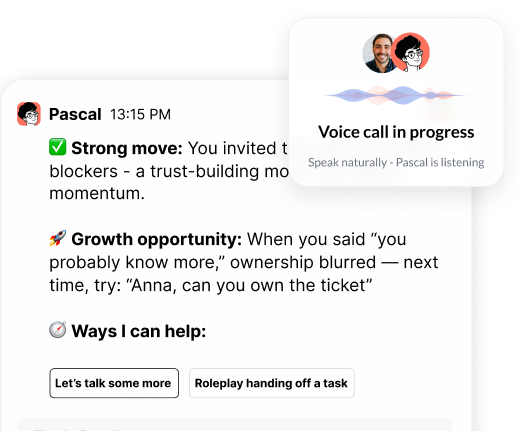
A manager might use Pascal to prepare for a hard feedback conversation, rethink how they will handle missed deadlines, or practice a response before a tense 1:1. That work should be a space to learn, not a transcript that is automatically visible to their leader or HR partner.
We see privacy and organizational insight as two separate needs, not competing goals. Managers need room to improve in the flow of work. HR needs a broad view of recurring development themes, such as delegation, expectation setting, performance conversations, or cross-functional communication.
An AI coaching platform with confidential individual data and aggregate reporting can support both needs when the boundaries are clear from the start.
Identifiable coaching interactions should remain confidential individual data. That includes the content a manager shares, the practice they complete, and the personalized guidance they receive.
By default, private coaching activity should not become visible to HR or a manager’s leader. This includes:
For example, a VP of Engineering with 12 direct reports may ask Pascal for help addressing a pattern of missed deadlines. That request should not become an identifiable signal during a talent review. The manager may be working thoughtfully on a real leadership challenge. Asking for help should be encouraged, not treated as evidence of poor performance.
Confidential does not mean managers cannot share their own learning. A manager may choose to bring a coaching plan to a mentor, leader, or HR partner. The difference is choice. We want individuals to control what they share, rather than having private coaching activity surfaced automatically.
Before a rollout, we recommend explaining these rules in plain language. Managers should understand what is collected, who can access it, how long it is retained, and what will never be used for performance evaluation.
HR can use aggregate insights safely when reports show patterns across meaningful groups, not activity or content connected to named people. The goal is manager enablement, not surveillance.
Individual reporting asks, “Which manager requested help with feedback?” Aggregate reporting asks, “Are managers across this business unit repeatedly seeking support with feedback conversations?” The first question can damage trust. The second can help HR make smarter decisions about development programs.
Responsible aggregate reporting should include clear safeguards:
If only a small number of managers in one department use a coaching feature, that group should not appear as a separate report. Broad patterns are useful. Tiny slices are not.
During annual planning, HR may see a common need across several functions for help setting expectations, handling performance conversations, or prioritizing workloads. Rather than identifying who asked for support, the team can respond with manager workshops, internal playbooks, or timely guidance before the next review cycle.
That is the practical value of an AI coaching platform with confidential individual data and aggregate reporting. We can help organizations understand where managers want more support without turning individual learning into a monitoring system.
Enterprise AI coaching needs more than a general privacy statement. It needs clear commitments about data use, meaningful access controls, secure integrations, and governance that people can understand.
Our core commitment is direct: customer data is never used to train models. Managers often bring real workplace context into coaching, whether they are preparing for a 1:1, practicing a difficult conversation, or asking for feedback during a meeting. That internal context should remain the customer’s data, not training material for a broader model.
When evaluating a platform, we recommend that HR, IT, legal, and security teams look for clarity on:
Privacy is a product-design decision, not just a legal review item. Managers should be able to use coaching regularly without wondering who might read their interactions later. If confidentiality is unclear, adoption will be limited before the program has a chance to help.
Year-end aggregate insights should inform next year’s manager development priorities, not influence individual performance ratings. November is a useful time to look for recurring themes before planning, review cycles, and manager programs are finalized.
An HR team may notice broad demand for support with performance conversations, goal setting, or workload prioritization. Those patterns can help the team decide where to invest in facilitator-led sessions, manager resources, or leadership guidance for the coming planning cycle.
Aggregate coaching themes are most useful when considered alongside other organizational signals. We recommend comparing them with engagement survey findings, manager listening sessions, attrition trends, and current business priorities. Coaching activity is not a complete diagnosis. It is one practical source of evidence about where managers want help in their daily work.
The boundary should remain firm: prompts, role-plays, and coaching activity should not be used to rate an individual manager. Organization-level trends can improve systems and learning opportunities. Individual private practice should stay private.
Clear confidentiality, access, and reporting rules should be defined before AI coaching reaches managers across the organization. When people understand the boundaries, they can use coaching more honestly, and HR can act on broader trends with confidence.
We recommend that HR, IT, legal, security, and leadership development teams agree on a short set of governance decisions before launch. Define what counts as confidential coaching data, who can view aggregate reports, what group-size rules apply, how long information is retained, and which decisions must never use coaching activity.
Communication matters just as much as policy. Managers need a direct explanation: they can prepare for a 1:1, practice a hard conversation, or receive a real-time nudge in Slack or Teams without creating an individual report for HR. When privacy is clear, coaching becomes easier to trust, easier to use, and more helpful at enterprise scale.
See how an AI coaching platform with confidential individual data and aggregate reporting can help leaders build stronger habits while giving HR clear, organization-level signals. Our guide explains how coaching can fit into Slack, Teams, and everyday manager conversations without adding another program to maintain. At Pinnacle, we help enterprises make manager development more consistent, practical, and ready for the moments that matter.



“Thank you for setting the great foundation for my promotion; now I have a plan!"

Curious to see how AI Coaching can 10X the impact and scale of your development initiatives. Book a demo today for: