

Most managers need help at 4 PM on Tuesday—not in next week's workshop. Pascal delivers leadership coaching inside Slack and Teams, providing guidance when it matters. At Acme Corp, 83% of direct reports noticed manager improvements within 90 days. Engineering managers at Beta Inc saved 150+ hours annually.
Traditional coaching fails mid-level managers because it's disconnected from the moments when guidance matters. A manager preparing for a difficult performance conversation doesn't benefit from a workshop they attended three months ago.
Human coaching costs $200-500 per hour and serves only senior executives. Mid-level managers get generic LMS modules that ignore individual styles, team dynamics, and organizational culture. Standalone coaching portals require managers to remember another login, creating friction that kills adoption.
"Managers rarely need help in a workshop—they need it when preparing for a tough 1:1 or in the middle of a team conflict." — Melinda Wolfe, Former CHRO at Bloomberg, Pearson, and GLG
Fortune reports that 70% of team engagement variance comes down to the manager (based on Gallup research). This makes accessible, in-the-moment coaching critical for organizational performance.
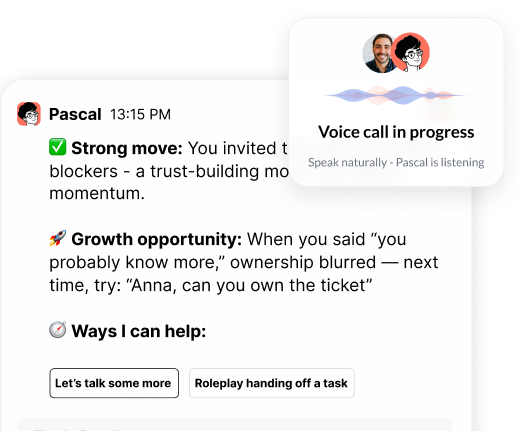
Pascal provides leadership guidance inside Slack and Teams. Instead of requiring managers to log into a separate platform, the AI coach appears in channels, direct messages, and meetings where work happens.
A manager types "Help me prepare for a difficult conversation about missed deadlines" in a Pascal DM. Pascal asks clarifying questions about the situation, the employee's context, and past performance. It then provides a conversation framework, suggests specific language, and offers to role-play the conversation. After the actual 1:1, the manager can debrief with Pascal to refine their approach for next time.
Pascal stores a record of team interactions (with appropriate permissions). It understands communication patterns and relationship dynamics to deliver personalized guidance. The coaching becomes proactive. Pascal joins meetings, observes team dynamics, and surfaces coaching moments in real-time or immediately after key interactions.
The system uses coaching frameworks adapted from International Coaching Federation (ICF) standards—the same methodologies human executive coaches use.
Pascal functions identically in both environments, maintaining the same coaching quality regardless of platform. The choice depends on where your managers spend their time.
Teams integrates more tightly with Microsoft's ecosystem (Outlook, SharePoint, Office). Slack connects better with diverse SaaS tools. Both platforms support Pascal joining video calls—Teams meetings or Zoom/Google Meet via Slack—observing dynamics and providing post-meeting feedback.
Data Breakdown:
• Feature: Direct messaging with AI coach | Slack Implementation: Native DM channel | Teams Implementation: Bot conversation
• Feature: Meeting integration | Slack Implementation: Zoom/Google Meet join | Teams Implementation: Native Teams meetings
• Feature: Ecosystem fit | Slack Implementation: Best for diverse SaaS stacks | Teams Implementation: Best for Microsoft 365 shops
• Feature: Adoption pattern | Slack Implementation: Higher in tech/startup environments | Teams Implementation: Higher in enterprise/regulated industries
Organizations with strong Microsoft 365 adoption see faster Teams-based coaching uptake. Companies using diverse tools prefer Slack's flexibility.
Week 1: Identify Your Pilot Population
Target 20-50 first-time managers, newly promoted leaders, or teams with identified coaching needs from engagement surveys. Secure executive sponsorship from functional leaders (CTOs, VPs of Engineering), not just HR.
Week 1-2: Configure and Connect
You'll work with Pinnacle's implementation team to input your leadership competency model, company values, and specific coaching scenarios relevant to your culture. This takes 2-3 hours of setup time, typically done by an HR leader or L&D manager.
Pascal connects to your HRIS (Lattice, Workday) to understand org structure (who reports to whom). You can optionally enable access to performance review data. In Slack or Teams, Pascal only accesses channels it's explicitly invited to and direct messages with individual managers. It does not monitor all company communications.
Week 2-3: Launch with Specific Use Cases
Frame the launch around concrete scenarios: preparing for 1:1s, drafting performance feedback, goal-setting conversations. Provide managers with 3-5 starter prompts:
• "Help me prepare for a difficult conversation about missed deadlines"
• "Review this performance feedback draft"
• "How do I delegate this project to a junior team member?"
Host a 30-minute live demo showing real examples, not generic capabilities.
Week 3-4: Integrate into Existing Rituals
Embed Pascal into quarterly check-ins, performance review cycles, and management training programs. Create Slack reminders that prompt managers to use Pascal before scheduled 1:1s or performance conversations. Build custom exercises for leadership development programs that managers complete through Pascal.
Ongoing: Measure and Iterate
Track adoption metrics: active users, questions asked, return usage rates. Collect qualitative feedback through manager surveys and direct report observations. Expand to additional populations based on demonstrated value and refined use cases.
Days 1-30: Adoption and Engagement Building
Early indicators appear in weeks 2-4: adoption metrics, manager engagement rates, and qualitative feedback from pilot participants. Track active users, questions asked, and return usage rates.
Days 30-60: First Behavioral Improvements
Direct reports begin noticing changes—improved 1:1 quality, clearer feedback, better delegation. Survey questions like "Has your manager's communication improved in the last quarter?" reveal whether coaching translates to observable change.
Days 60-90: Measurable Business Outcomes
The 90-day mark reveals sustained behavior change and business impact. At Acme Corp, managers using Pascal saw a 20% lift in Manager Net Promoter Score (mNPS). At Beta Inc, engineering teams reported higher retention rates among direct reports of Pascal users.
Organizations that integrate Pascal into existing rituals—performance reviews, quarterly check-ins, leadership development programs—see faster results than those treating it as a standalone tool.
Measuring Pascal's impact requires looking beyond adoption numbers to behavioral change indicators and business outcomes.
Key Metrics Framework:
Adoption: Active users, questions asked, return usage rates
Behavioral Change: Direct report surveys, 360 feedback improvements, mNPS lifts. Survey questions: "Has your manager's communication improved in the last quarter?" or "Do you receive more actionable feedback now?"
Business Outcomes: Retention rates, engagement scores, performance metrics. Track how Pascal usage correlates with team performance outcomes.
Efficiency: Time saved on management tasks, reduced HR escalations. At Beta Inc, managers saved 150+ hours annually through faster preparation for difficult conversations, performance reviews, and feedback sessions.
Manager Net Promoter Score (mNPS) captures team sentiment about leadership quality. A 20% lift in mNPS among managers using Pascal indicates meaningful impact.
Pascal sees only the conversations individual managers have with it in direct messages and channels where it's explicitly invited. It does not monitor all company communications. When providing aggregated insights to HR (for example, "30% of managers are asking about delegation"), Pascal strips all identifying information. Individual conversations are encrypted and accessible only to the manager and Pinnacle's security team for moderation purposes.
Critical Security Features:
• SOC2 Type 2 certification
• Data encryption in transit and at rest
• Clear data retention policies (conversations stored for 90 days, then deleted)
• No training on customer data
• Anonymous aggregated reporting only
• Sensitive topic detection and escalation
Pascal includes moderation for harassment, discrimination, threats, or requests for therapy/medical advice. When detected, these conversations are escalated to HR with the manager's knowledge. Pascal is not a surveillance tool—it's designed to support managers, not monitor them.
Organizations in regulated industries (financial services, healthcare, government) require these protections before rolling out AI coaching at scale. Pascal meets HIPAA, GDPR, and SOC2 requirements.
• Pascal delivers coaching inside Slack and Teams, eliminating the context switching that kills adoption in standalone portals. At Acme Corp, managers engaged with Pascal 3-5x more than with their previous coaching platform.
• Implementation takes four weeks: identify pilot population (20-50 managers), configure organizational context, launch with specific use cases, integrate into existing rituals.
• Results appear in stages: adoption metrics in days 1-30, behavioral improvements in days 30-60, business outcomes in days 60-90. At Acme Corp, 83% of direct reports observed manager improvements. At Beta Inc, engineering managers saw 20% lifts in Manager Net Promoter Score.
• Success measurement requires tracking adoption, behavioral change, and business outcomes. Direct report feedback and mNPS provide clearer signals than usage metrics alone.
• Privacy protections (SOC2 compliance, no training on customer data, sensitive topic guardrails) determine whether managers trust Pascal enough to use it for difficult conversations and performance management.
Ready to see how Pascal works inside your team's workflow? Schedule a demo at https://heypinnacle.com to explore how real-time coaching transforms manager effectiveness.
Header photo by Vitaly Gariev on Unsplash



“Thank you for setting the great foundation for my promotion; now I have a plan!"

Curious to see how AI Coaching can 10X the impact and scale of your development initiatives. Book a demo today for: