

Extending coaching beyond executives improves manager effectiveness at scale, reduces turnover costs, and accelerates skill development across the workforce. AI platforms make this economically viable by delivering guidance at a fraction of traditional coaching costs.
Democratizing coaching means extending personalized development support to all managers and employees, not just senior executives. This transforms coaching from an exclusive perk into an organizational capability that reaches frontline managers, individual contributors, and emerging leaders.
Traditional executive coaching costs $300–$500 per hour, limiting access to less than 5% of employees. AI coaching platforms reduce these costs while maintaining quality and reaching 100% of managers.
The shift addresses a fundamental gap. Gallup research shows 70% of team engagement variance originates at the frontline manager level. Yet 60% of first-time managers report feeling unprepared for their roles while receiving minimal development support.
Restricting coaching to the C-suite ignores where it delivers the highest return: frontline and mid-level managers who directly influence team performance, retention, and daily execution. These managers face the steepest learning curves, make the most frequent people decisions, and have the greatest multiplier effect on organizational outcomes.
Manager quality accounts for 70% of variance in team engagement. When managers struggle, the costs compound: turnover averages 1.5–2× annual salary, and improving manager effectiveness reduces regrettable attrition by 15–25%.
Organizations that democratize coaching see measurable results. Managers receive guidance during actual decisions (preparing for difficult conversations, navigating team conflicts, coaching their own direct reports) rather than hoping they remember workshop content from three months ago.
"If we have an innovation right now, it's incumbent upon us as HR leaders to show our companies an economic and effective way to help managers," says Melinda Wolfe, Former CHRO at Bloomberg, Pearson, and GLG.
Democratized coaching creates a continuous learning layer across the organization, turning every management challenge into a development opportunity. When coaching reaches all managers, organizations see faster decision-making, higher-quality feedback conversations, improved cross-functional collaboration, and measurable culture change.
The shift from scheduled training to continuous coaching changes how organizations develop talent. Instead of hoping managers remember workshop content, they receive contextual guidance during actual decisions. Real-time coaching in the flow of work drives sustained behavior change versus forgotten training content.
AI coaching platforms trained on company-specific frameworks ensure consistency across the organization. Platforms can embed your organization's competencies, training materials, policies, and culture documentation, making coaching customized to both your company and individual users. Aggregated insights reveal training needs and culture gaps without compromising individual privacy.
Companies implementing democratized AI coaching see returns within 18 months through reduced turnover costs, improved manager effectiveness, and eliminated spending on underutilized learning platforms. The economics are compelling: traditional coaching costs $300–500 per hour and reaches less than 5% of employees, while AI coaching scales to 100% of managers at significantly lower costs.
Turnover reduction alone often justifies the investment. Saving 10 managers from leaving saves $1.5M–$3M annually when you factor in replacement costs, lost productivity, and team disruption.
AI coaching replaces or supplements expensive coaching programs, low-utilization LMS platforms, and unfilled HRBP positions. Forward-thinking organizations are shifting budgets: instead of spending $500,000 to coach 20 executives, they're spending the same amount to provide AI coaching to 2,000 managers while maintaining human coaching for complex, high-stakes situations.
ROI Comparison: Executive-Only vs. Democratized Coaching
Data Breakdown:
• Metric: Cost per employee | Executive-Only Coaching: $15,000–$30,000 annually | Democratized AI Coaching: $150–$300 annually
• Metric: Reach | Executive-Only Coaching: <5% of workforce | Democratized AI Coaching: 100% of managers
• Metric: Time to impact | Executive-Only Coaching: 3–6 months | Democratized AI Coaching: Immediate, in-flow
• Metric: Scalability | Executive-Only Coaching: Limited by coach availability | Democratized AI Coaching: Unlimited, 24/7 access
AI coaching delivers contextual guidance in the flow of work, while traditional alternatives (human coaching, LMS platforms, performance management tools) operate on scheduled cadences disconnected from real decisions. Human coaching remains valuable for complex, emotionally charged situations, but AI coaching handles routine coaching moments that don't require human judgment.
Traditional LMS platforms see 5–15% engagement with generic content and no personalization. Human coaching offers high quality but costs $300–500 per hour with scheduled sessions and limited scale. Performance management tools look backward with annual cadences and no real-time support.
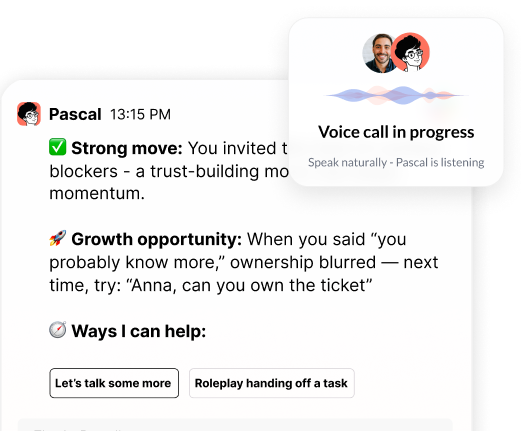
AI coaching platforms can integrate with existing tools (Slack, Teams, Zoom, Google Meet), meeting managers where work happens rather than adding another tool to their stack. ICF-certified coaches train leading AI coaching models, ensuring quality guidance that adapts to individual goals, company competencies, and real-time context.
"So much of the real learning and value that comes from this comes from in-context coaching in the moment to drive performance and to solve problems in the moment," says Jeff Diana, Former CHRO at Calendly, Atlassian, and SuccessFactors.
AI coaching complements rather than replaces human coaches. Organizations increasingly deploy hybrid models: AI coaching for routine guidance and skill development, human coaching for career transitions, executive presence, and complex interpersonal dynamics. This combination maximizes both reach and impact while controlling costs.
HR leaders must overcome three primary objections: proving ROI to finance teams accustomed to low L&D engagement, addressing privacy and data security concerns, and demonstrating that AI coaching delivers genuine behavior change rather than becoming another abandoned tool.
Finance teams question L&D investments because traditional platforms show dismal engagement. Frame AI coaching as replacing multiple line items (coaching programs, LMS subscriptions, unfilled HRBP roles) rather than adding net-new expense. Pilot programs with measurable manager improvement provide the evidence finance teams need.
Privacy concerns require transparent answers about data handling. Leading platforms maintain SOC2 compliance, never train models on customer data, and provide organization-specific controls for sensitive topics. Anonymous aggregated insights give HR leaders visibility into trends without compromising individual privacy.
Skepticism about behavior change stems from failed technology rollouts. The difference is deployment strategy. Organizations that succeed integrate AI coaching into existing workflows rather than requiring separate logins. They customize the coaching with company competencies and values rather than deploying generic content. They measure leading indicators (session frequency, manager feedback quality) rather than waiting for lagging metrics.
Start with high-impact populations (new managers, distributed teams, sales leaders) to prove value quickly. Use their results to build organizational momentum and expand strategically. Democratized coaching isn't a nice-to-have perk but a scalable solution to persistent people challenges.
• Democratizing coaching beyond executives improves manager effectiveness, reduces turnover, and scales development at a fraction of traditional coaching costs
• Frontline and mid-level managers see the fastest returns because they face the steepest learning curves, make the most frequent people decisions, and have the greatest multiplier effect on team performance
• AI coaching delivers guidance in the flow of work rather than requiring separate logins and scheduled sessions, driving higher engagement than traditional LMS platforms
• Organizations can save significant time per manager annually through coaching that prevents mistakes rather than correcting them after the fact
• Purpose-built platforms integrate with existing tools (Slack, Teams, Zoom), customize to company competencies, and maintain SOC2 compliance while providing aggregated insights to HR leaders
The shift from executive-only to democratized coaching isn't about replacing human coaches. It's about scaling what they do best to every manager who needs support. Organizations that move quickly gain competitive advantage in manager effectiveness, retention, and culture development.
Pinnacle's Pascal works inside Slack, Teams, and your existing workflows. See how it works at heypinnacle.com.
Header photo by Memento Media on Unsplash

.png)
.webp)
“Thank you for setting the great foundation for my promotion; now I have a plan!"

Curious to see how AI Coaching can 10X the impact and scale of your development initiatives. Book a demo today for: