

Extending coaching beyond executives improves manager effectiveness at scale, reduces turnover costs, and accelerates leadership development at the frontline and mid-level where most team engagement is determined.
Executive coaching delivers strong returns, but restricting it to the C-suite misses the leverage point where coaching drives the greatest impact: frontline and mid-level managers. Gallup research shows that 70% of team engagement variance comes down to the manager, yet 60% of new managers never receive formal training.
Traditional executive coaching costs $15,000–$50,000 per engagement. Extending this to 200+ managers is economically impossible. Executives make strategic decisions, but managers make daily decisions that directly affect team performance, retention, and culture. Companies invest heavily in C-suite development while the managers executing strategy struggle without support.
One ineffective manager impacts 8–12 direct reports. Poor manager effectiveness cascades through teams, creating retention problems, performance gaps, and cultural erosion that cost far more than coaching would have.
"If we can finally democratize coaching—make it specific, timely, and integrated into real workflows—we solve one of the most chronic issues in the modern workplace," says Melinda Wolfe, former CHRO at Bloomberg, Pearson, and GLG.
Organizations that extend coaching beyond executives see four returns: faster manager ramp time, higher-quality feedback conversations, improved retention, and team engagement lifts.
Manager effectiveness metrics show improvement. Time to first quality 1-on-1 drops from 6 months to 6 weeks. Frequency of developmental conversations increases from quarterly to weekly. Manager confidence scores improve within 90 days.
Team-level outcomes compound these gains. Direct report engagement lifts in the first year. Voluntary turnover in manager-led teams drops. Performance ratings show more "exceeds expectations" when managers receive consistent coaching support.
Organizational impact extends beyond individual teams. Leadership pipeline depth increases with more "ready now" internal candidates. HR teams save hours previously spent on manager escalations. Real-time behavioral data replaces quarterly surveys, giving leaders insight into cultural alignment.
Manager Effectiveness Comparison
Data Breakdown:
• Metric: Cost per person/year | Executive-Only Coaching: $15,000–$50,000 | Scaled Coaching Programs: $150–$1,200
• Metric: Managers reached | Executive-Only Coaching: 5–10 executives | Scaled Coaching Programs: 200+ managers
• Metric: Time to impact | Executive-Only Coaching: 3–6 months | Scaled Coaching Programs: 2–4 weeks
• Metric: Availability | Executive-Only Coaching: Scheduled sessions | Scaled Coaching Programs: On-demand
• Metric: Cultural alignment | Executive-Only Coaching: Limited visibility | Scaled Coaching Programs: Real-time behavioral data
Scaled coaching programs cost a fraction of traditional executive coaching while delivering on-demand availability and real-time guidance in the flow of work. This economic shift transforms coaching from a scarce resource reserved for executives into an organizational capability accessible to every manager.
Traditional executive coaching runs $15,000–$50,000 per person annually. Group coaching programs cost $3,000–$8,000 per person annually. Technology-enabled coaching costs $150–$1,200 per person annually. The ROI threshold is clear: break-even happens when you prevent one regrettable departure (typically $50,000–$150,000 in replacement expenses).
Scale advantages are fundamental. Human coaches can handle 15–20 active clients maximum. Technology-enabled solutions support unlimited simultaneous users. Human coaches offer scheduled sessions; digital platforms provide 24/7 availability. Human coaches rely on session notes; digital systems maintain perfect memory of all interactions and organizational context.
The economics work because scaled coaching doesn't replace human coaches—it extends what they do best to reach everyone who needs it.
The critical comparison isn't new coaching versus traditional coaching—it's new investment versus doing nothing, or versus low-engagement learning platforms that deliver under 15% utilization. Evaluate solutions based on five factors: coaching expertise (trained models versus generic chatbots), contextual awareness (integration with performance data, culture, and workflows), proactive engagement (real-time guidance versus reactive Q&A), organizational customization (trained on your competencies versus one-size-fits-all), and privacy architecture (compliance and data handling).
Coaching Solution Comparison
Data Breakdown:
• Capability: Cost per manager/year | Generic Chatbot: $0–$50 | Learning Platform: $500–$1,200 | Traditional Coaching: $15,000–$50,000 | Technology-Enabled Coaching: $150–$1,200
• Capability: Coaching expertise | Generic Chatbot: None | Learning Platform: Variable | Traditional Coaching: High | Technology-Enabled Coaching: Trained frameworks
• Capability: Real-time availability | Generic Chatbot: Yes | Learning Platform: No | Traditional Coaching: Scheduled only | Technology-Enabled Coaching: Yes
• Capability: Organizational context | Generic Chatbot: No | Learning Platform: Limited | Traditional Coaching: Yes | Technology-Enabled Coaching: Deep integration
• Capability: Proactive guidance | Generic Chatbot: No | Learning Platform: No | Traditional Coaching: Yes | Technology-Enabled Coaching: Yes
• Capability: Privacy/compliance | Generic Chatbot: Unknown | Learning Platform: Varies | Traditional Coaching: High | Technology-Enabled Coaching: Certified
The "do nothing" cost is substantial. Calculate the annual cost of manager-related turnover, poor performance conversations, and HR escalations (typically $500,000–$2M for a 500-person company). Most companies already pay for LinkedIn Learning, Udemy, or similar platforms with under 15% engagement. Traditional coaching serves 5–10 executives while 200+ managers struggle.
"If we have an innovation right now, then it's incumbent upon us as HR leaders to show our companies an economic and effective way to help managers," says Wolfe.
First-time managers, mid-level managers in high-turnover functions, and distributed team leaders see the fastest ROI because they face frequent, high-stakes decisions where real-time feedback compounds advantage within weeks. Start with these populations to prove value quickly.
New managers represent the highest-leverage population. They make consequential decisions weekly without frameworks or support. Coaching provides real-time guidance during their first difficult conversation, their first performance review, their first conflict mediation. The impact shows immediately in direct report feedback and team engagement scores.
Sales leaders benefit from coaching on pipeline conversations, deal negotiations, and forecast accuracy. Coaching can support customer calls, provide post-meeting feedback, and help managers refine their approach.
Distributed team managers face unique challenges: building trust remotely, reading virtual room dynamics, maintaining culture across time zones. Coaching helps them navigate these complexities with specific guidance on async communication, virtual 1-on-1s, and remote team rituals.
High-performers and technical individual contributors also benefit. High-performers use coaching to accelerate their trajectory, preparing for leadership roles before they're formally assigned. Technical ICs use it to navigate cross-functional collaboration, stakeholder management, and influence without authority.
• Democratizing coaching addresses the leverage gap: Most engagement variance comes from managers, yet most new managers receive no formal training. Scaled coaching extends proven frameworks to everyone who needs them.
• The economics are compelling: Technology-enabled coaching costs 1–10% of traditional executive coaching while delivering on-demand availability and real-time guidance in the flow of work.
• Outcomes justify investment: Organizations see faster manager ramp time, reduced regrettable attrition, team engagement lifts, and improved manager effectiveness within the first year.
• Not all solutions are equal: Purpose-built platforms trained on coaching frameworks, integrated with organizational context, and designed for proactive engagement deliver higher utilization than generic chatbots.
• Start with high-impact populations: New managers, sales leaders, and distributed team managers show the fastest ROI, proving value within 60–90 days and building organizational momentum for broader rollout.
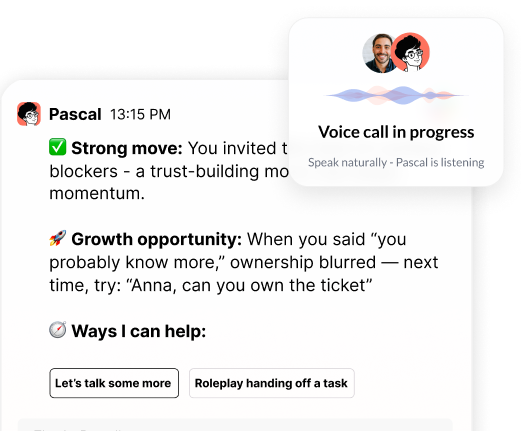
Ready to scale manager effectiveness across your organization? See how we help companies extend coaching beyond the C-suite with real-time guidance trained on your culture and customized to your competencies.
Header photo by Vitaly Gariev on Unsplash

.png)
.webp)
“Thank you for setting the great foundation for my promotion; now I have a plan!"

Curious to see how AI Coaching can 10X the impact and scale of your development initiatives. Book a demo today for: