

The answer depends on whether your managers will actually use it. Proactive AI coaches that initiate contact based on observed work patterns achieve 75 percent regular usage. Reactive coaches that wait for managers to ask for help stall at 51 percent adoption—they require activation energy busy managers rarely have.
But proactive coaching introduces new risks: notification overload, privacy concerns, and the possibility of tone-deaf guidance at the wrong moment. This piece examines when proactive coaching makes sense, when it doesn't, and how to evaluate whether your organization is ready for it.
A proactive AI coach initiates contact based on observed patterns and upcoming events. It joins meetings, sends post-conversation feedback, and surfaces guidance before managers realize they need it. A reactive coach sits idle until a manager remembers to ask a question.
Proactive systems observe real work (meetings, Slack conversations, calendar events) and push timely guidance. Reactive systems require managers to open an app, describe their situation, and articulate what help they need. The distinction mirrors the difference between a coach who shadows you and one you must schedule and brief.
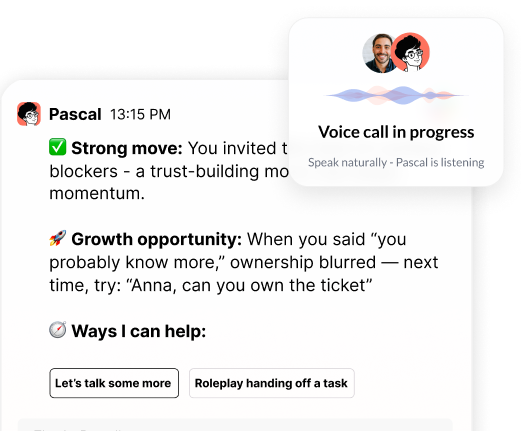
Proactive coaching addresses blind spots managers don't know they have. Reactive coaching only helps with known challenges. Pascal (Pinnacle's AI coaching platform) exemplifies the proactive approach: it joins Zoom meetings, monitors Slack and Teams, and sends feedback after each interaction without requiring manual input.
On-demand AI coaching fails because it requires managers to remember the tool exists, carve out time to use it, and possess enough self-awareness to know what guidance they need. These three barriers eliminate nearly half of potential users within the first month.
Managers face 150-plus daily decisions. Remembering to consult a coaching tool ranks low on priority lists. Traditional learning platforms achieve only 20 to 30 percent utilization rates because they require deliberate activation.
On-demand models assume managers know their development gaps. But blind spots are, by definition, invisible. Every use requires opening an app, explaining context, and formulating questions. This activation energy problem compounds over time.
The data shows the gap. Proactive platforms maintain 94 percent monthly retention. On-demand tools achieve 51 percent. Proactive systems average 2.3 coaching sessions per week. Reactive systems average 0.7.
Data Breakdown:
• Metric: Monthly Active Usage | Proactive AI Coaching: 75%+ | On-Demand AI Coaching: 51%
• Metric: Monthly Retention | Proactive AI Coaching: 94% | On-Demand AI Coaching: 51%
• Metric: Average Sessions Per Week | Proactive AI Coaching: 2.3 | On-Demand AI Coaching: 0.7
• Metric: Time to First Value | Proactive AI Coaching: Same day | On-Demand AI Coaching: 2-3 weeks
• Metric: Context Input Required | Proactive AI Coaching: None (observes meetings) | On-Demand AI Coaching: Manual (manager describes situation)
Pascal eliminates activation energy by automatically attending meetings and providing feedback in Slack and Teams where managers already work.
Proactive coaching works best in organizations with three characteristics: managers who are overwhelmed but coachable, clear norms around feedback, and technical infrastructure that supports integration with existing tools.
When it works:
• Your managers are drowning in tactical work and won't seek out development resources on their own
• Your organization already has a feedback culture (proactive coaching amplifies existing norms, it doesn't create them)
• Your managers use Slack, Teams, or similar platforms where an AI coach can integrate naturally
• You have budget for a 90-day pilot with 20 to 50 managers before committing to enterprise rollout
When it doesn't work:
• Your managers are skeptical of AI or resistant to feedback (proactive outreach will feel like surveillance)
• Your organization lacks basic performance management infrastructure (fix that first)
• Your managers work primarily offline or in roles where meetings aren't the primary work mode
• You're looking for a silver bullet to fix deeper cultural or leadership problems
Jeff Diana, former CHRO at Calendly and Atlassian, notes: "So much of the real learning and value that comes from this comes from in-context coaching in the moment to drive performance and to solve problems in the moment." But he's describing organizations where managers are already open to coaching. Proactive AI won't fix a broken culture.
Proactive coaching introduces three genuine risks that reactive systems avoid:
Notification fatigue. Poorly designed systems spam users with irrelevant suggestions. If your AI coach sends five notifications a day, managers will mute it within a week. The solution is intelligent timing algorithms and user controls that let managers set boundaries. But this requires sophisticated design—not all vendors get it right.
Privacy boundaries. Managers may feel monitored if observation isn't transparent and consent-based. The AI is joining meetings, reading Slack messages, and analyzing conversation patterns. If managers don't understand what's being observed and how it's being used, trust erodes quickly. Mitigation requires explicit opt-in, SOC2 compliance, and clear data policies.
Context misreads. AI can offer guidance based on incomplete understanding of sensitive situations. A manager having a difficult conversation about a personal issue might receive coaching about "direct feedback" when empathy was the right move. The solution is guardrails: moderation flags, sensitive topic escalation to human HR, and organization-specific controls.
These risks are manageable, but they're real. Organizations deploying proactive coaching need clear protocols for each one.
Melinda Wolfe, former CHRO at Bloomberg and Pearson, observes: "When it comes to helping first-time or mid-level managers, the risk of doing nothing can be just as high as the risk of trying something new." But "doing something" isn't the same as "doing this specific thing." The question is whether proactive coaching is the right intervention for your organization right now.
Proactive AI coaching isn't the only option. Here's how it stacks up against traditional approaches:
Data Breakdown:
• Approach: Executive Coaching | Cost per Manager: $5,000-15,000/year | Availability: Scheduled sessions | Context Awareness: Relies on manager's recollection | Engagement Rate: High (for participants) | Scalability: Low (senior leaders only)
• Approach: LMS Platforms | Cost per Manager: $50-200/year | Availability: On-demand | Context Awareness: None | Engagement Rate: 20-30% | Scalability: High
• Approach: Manager Training Workshops | Cost per Manager: $500-2,000/program | Availability: Quarterly/annual | Context Awareness: None | Engagement Rate: 40-60% initial, <20% sustained | Scalability: Medium
• Approach: Proactive AI Coaching | Cost per Manager: $50-150/year | Availability: 24/7, in-the-flow | Context Awareness: Observes actual meetings/conversations | Engagement Rate: 75%+ | Scalability: High (all managers)
Traditional executive coaching is effective but economically limited to senior leaders. LMS platforms are scalable but suffer from low engagement and lack contextual relevance. Workshop training creates temporary enthusiasm but fails to drive sustained behavior change (research on the forgetting curve shows 70 percent of rote memorization fades within a week, though the application to skill development is less clear-cut).
Proactive AI coaching combines the personalization of human coaching with the scalability of digital platforms. But it's not a replacement for human coaching in high-stakes situations. It's a middle layer: more personalized than an LMS, more scalable than 1:1 coaching, and more consistent than workshops.
Measure proactive AI coaching through three categories: adoption metrics that prove engagement, leading indicators that predict outcomes, and business impact that demonstrates value.
Adoption metrics include monthly active users, session frequency, and retention rates. If your proactive platform isn't hitting 75 percent monthly active usage within 90 days, something is wrong. Either the guidance isn't relevant, the notifications are annoying, or managers don't trust the system.
Leading indicators track behavior changes before they show up in annual surveys. These include feedback conversation frequency, 1:1 meeting consistency, and goal-setting completion rates. Pascal customers report managers holding 30 percent more regular 1:1s within the first quarter. This is a leading indicator—it predicts future engagement improvements but doesn't prove them yet.
Business impact metrics connect coaching to organizational outcomes: reduced regrettable attrition, faster time-to-productivity for new managers, and improved engagement scores. One Pascal customer saw manager-related turnover decrease by 25 percent in the first year. But correlation isn't causation—organizations that adopt proactive coaching may already have higher management maturity or better HR infrastructure.
The honest answer: it takes 12 to 18 months to know if proactive coaching is driving real business impact. Adoption metrics show up in 90 days. Leading indicators appear in six months. Business outcomes take a year or more.
Evaluate vendors on five criteria: foundational coaching expertise, contextual awareness depth, workflow integration breadth, sensitive topic handling, and measurable business outcomes.
Foundational expertise means the AI is trained by certified coaches using structured frameworks, not just large language models trained on internet text. Ask vendors: Who designed your coaching methodology? What frameworks guide the AI's responses? If they can't name specific coaching models or the credentials of their design team, walk away.
Contextual awareness separates useful tools from chatbots. Does the AI observe real meetings and conversations, or does it rely on managers to describe situations? Pascal joins Zoom meetings, monitors Slack threads, and builds a knowledge graph of interactions. This is technically complex—most vendors can't do it.
Workflow integration determines adoption. Does the coach meet managers where they work, or does it require opening a separate app? Pascal integrates with Slack, Teams, Zoom, and Google Meet. Managers receive feedback without changing their routines. If a vendor requires managers to log into a separate platform, adoption will suffer.
Sensitive topic handling protects your organization. What guardrails prevent the AI from giving advice on harassment, discrimination, or mental health issues? Pascal escalates sensitive topics to human HR and includes moderation flags for inappropriate content. Ask vendors for specific examples of how their system handles edge cases.
Measurable outcomes prove value. Request case studies with specific metrics: adoption rates, behavior change indicators, and business impact. Be skeptical of vendors who only share testimonials or vague success stories. Ask for sample sizes, timeframes, and methodology.
Start with a focused pilot among high-impact manager populations, establish clear success metrics before launch, and expand based on demonstrated value rather than arbitrary timelines.
Select pilot participants who are open to feedback, manage critical teams, and have influence across the organization. Early adopters become champions who drive broader adoption through peer recommendations. But don't only choose your best managers—include some who are struggling. You need to know if the tool works for managers who actually need help, not just those who would succeed anyway.
Define success metrics upfront: engagement rates, behavior change indicators, and business outcomes. Track weekly rather than waiting for quarterly reviews. Proactive systems generate real-time data that allows rapid iteration.
Communicate transparently about what the AI observes, how it uses data, and what guardrails protect privacy. Pascal is SOC2 compliant and never trains models on customer data. This transparency builds trust. If managers feel monitored rather than supported, the pilot will fail regardless of the technology's quality.
Run the pilot for 90 days minimum. Adoption metrics will be clear by day 30. Leading indicators will emerge by day 60. Business impact takes longer, but you'll have enough signal by day 90 to decide whether to expand.
Taylor Malmsheimer, COO of Section, identified 10 to 15 consistent barriers that prevent companies from capturing AI value at Section's AI:ROI Conference. The most common: organizations pilot endlessly without committing to scale. Set a decision date before you start. If the pilot hits your success metrics, expand. If it doesn't, kill it.
• Proactive AI coaching achieves higher usage than on-demand tools (75 percent vs. 51 percent) because it eliminates activation energy, but it only works in organizations with coachable managers and existing feedback norms
• The real risks (notification fatigue, privacy concerns, context misreads) are manageable with good design, but they're genuine—proactive coaching isn't appropriate for every organization
• Proactive coaching sits between human executive coaching (high-touch, expensive, limited scale) and LMS platforms (scalable, cheap, low engagement)—it's not a replacement for either
• Evaluate vendors on coaching expertise, contextual awareness, workflow integration, sensitive topic handling, and proven outcomes—not just AI capabilities
• Run a 90-day pilot with 20 to 50 managers, set clear success metrics upfront, and commit to a decision date before you start
The choice between proactive and reactive AI coaching isn't about which technology is better. It's about which approach fits your organization's readiness, culture, and specific management development needs right now.
See how Pascal works inside Slack to deliver proactive coaching at heypinnacle.com.
Header photo by Jakub Żerdzicki on Unsplash

.png)
.webp)
“Thank you for setting the great foundation for my promotion; now I have a plan!"

Curious to see how AI Coaching can 10X the impact and scale of your development initiatives. Book a demo today for: