

Managers abandon on-demand coaching tools because they require effort at the worst possible moment. When facing a difficult conversation, busy leaders default to existing habits rather than opening a separate app to describe their situation from scratch. Proactive AI coaches that initiate contact based on observed work patterns solve this problem by meeting managers where they already work.
On-demand coaching dies from activation energy. Managers must remember the tool exists, context-switch during high-pressure moments, and explain their situation to a system that knows nothing about them. This friction compounds when cognitive load is highest—when coaching would help most.
The timing problem kills effectiveness. By the time a manager remembers to seek coaching, the critical moment has passed. The difficult conversation already happened. The feedback opportunity was missed.
Proactive coaching eliminates this barrier. The system observes real work in meetings, Slack conversations, and calendar patterns, then surfaces guidance when it matters. No context-switching. No explaining your situation. No remembering to engage.
A proactive AI coach initiates conversations based on observed work patterns. It joins meetings (with participant consent), analyzes communication dynamics, and reaches out with timely guidance without being asked. A reactive coach waits for managers to remember it exists and manually request help.
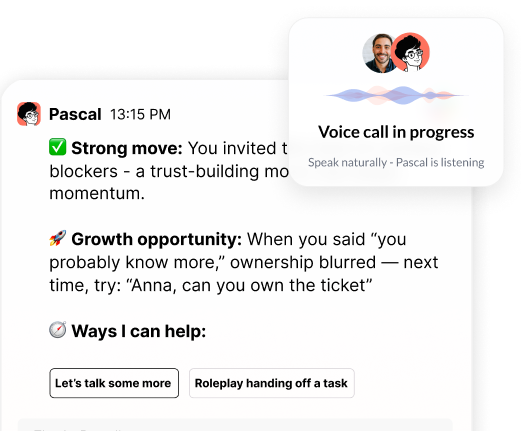
Here's what this looks like: Sarah finishes a tense 1:1 with an underperformer. Five minutes later, her AI coach sends a Slack message: "I noticed you gave corrective feedback in today's meeting. Want to talk through how to follow up?" The coach observed the meeting (Sarah enabled this feature), detected the feedback moment, and reached out while the conversation is fresh in her mind.
Compare this to reactive coaching: Sarah would need to open a separate app, describe the meeting, explain the context, and request guidance—all while juggling her next three meetings. The activation energy is too high. She doesn't do it.
The operational difference matters. Proactive systems sit where work happens (Slack, Teams, post-meeting feedback) rather than requiring adoption of new tools. Reactive systems require managers to open a separate tool, explain their situation, and remember to use it during high-pressure moments.
Proactive Coaching vs. Reactive Coaching
Data Breakdown:
• Feature: Initiation | Proactive Coaching: AI reaches out based on observed work patterns | Reactive Coaching: Manager must remember to open tool and request help
• Feature: Context Awareness | Proactive Coaching: Observes meetings, communications, and calendar patterns automatically | Reactive Coaching: Manager must manually explain their situation
• Feature: Timing | Proactive Coaching: Delivers guidance immediately after relevant moments | Reactive Coaching: Guidance comes only when manager seeks it (often too late)
• Feature: Integration | Proactive Coaching: Embedded in existing tools (Slack, Teams, meetings) | Reactive Coaching: Requires opening separate application
• Feature: Activation Energy | Proactive Coaching: Low - no action required from manager | Reactive Coaching: High - requires context-switching during high-pressure moments
• Feature: Habit Formation | Proactive Coaching: Creates routine through daily touchpoints | Reactive Coaching: Depends on manager remembering to engage
Proactive coaching creates habits by embedding guidance into daily workflows at moments when managers are most receptive. When feedback arrives immediately after a meeting or before a challenging conversation, managers apply it while context is fresh and motivation to improve is highest.
Habit formation happens through daily touchpoints. Morning calendar previews, post-meeting summaries, and weekly pattern insights create routine engagement that becomes automatic. This contrasts with traditional training: workshops and courses require managers to remember and apply lessons weeks later, when context has faded and urgency has passed.
Proactive coaching introduces concerns around notification overload, privacy boundaries, and the possibility of tone-deaf guidance at sensitive moments. Organizations must implement guardrails that balance proactive engagement with respect for user autonomy.
Notification fatigue represents the most immediate risk. Poorly designed proactive systems overwhelm managers with irrelevant messages, creating the opposite of engagement. Effective systems learn individual engagement patterns and respect user-controlled notification preferences. Managers should be able to set quiet hours, adjust frequency, and pause notifications entirely.
Privacy concerns require transparency about what the AI observes, how data is used, and who has access to coaching interactions. Managers need clear answers before they'll trust the system. Key questions to address:
• Does the AI record meetings or just analyze transcripts?
• Can HR see individual coaching conversations?
• Is data used to train AI models or evaluate performance?
• How long is interaction data retained?
SOC2 compliance provides baseline security, but doesn't address the fundamental question: do employees consent to having their work observed? Organizations should implement explicit opt-in for meeting observation, clear data retention policies, and anonymized aggregated insights that protect individual privacy.
Contextual awareness gaps create another challenge. Proactive outreach without deep understanding of organizational culture, individual communication styles, and team dynamics feels intrusive or generic. AI coaches must recognize when issues require human HR expertise (harassment, discrimination, mental health crises) and escalate appropriately rather than attempting to coach through them.
Effective proactive coaching requires deep integration of company values, competencies, and cultural norms. For example: if your organization uses Radical Candor as a feedback framework, the AI should coach managers using that specific model rather than generic feedback advice. If your culture values consensus-building, the AI shouldn't push aggressive decision-making tactics.
Reactive coaching works for specific scenarios: organizations with strong self-directed learning cultures, senior executives who prefer on-demand access, or companies piloting AI coaching with skeptical populations who need to control the engagement pace.
Self-directed learner populations, particularly senior leaders and executives, often prefer controlling when they engage with coaching tools. These individuals have established habits for seeking development resources and may find proactive outreach intrusive. For pilot programs testing AI coaching with skeptical user groups, reactive models reduce perceived surveillance concerns and give participants control over their experience.
Organizations with limited integration capabilities may also benefit from reactive approaches initially. If your tech stack can't support deep integration with communication platforms and calendars, a standalone reactive tool provides coaching value without requiring extensive IT resources. This comes with adoption trade-offs, but may be the right starting point.
The key question isn't whether reactive coaching has value—it does for specific use cases. The question is whether your organization's primary goal is broad manager development at scale or targeted support for self-motivated senior leaders.
Start by assessing your current manager development challenges and existing tool adoption patterns. If managers struggle to complete existing training programs or rarely use on-demand learning platforms, proactive coaching addresses the root cause: activation energy and timing misalignment.
Examine your technology ecosystem. Proactive coaching requires integration with communication platforms (Slack, Teams), meeting tools (Zoom, Google Meet), and potentially your HRIS for contextual personalization. Organizations with modern, API-friendly tech stacks can implement proactive coaching more easily than those with legacy systems requiring extensive custom integration work.
Consider your organizational culture around feedback and development. Companies with strong feedback cultures and psychological safety will see faster adoption of proactive coaching because managers already expect regular developmental conversations. Organizations working to build these cultural norms can use proactive coaching as a catalyst, but should expect a longer adoption curve.
Run a focused pilot with a willing manager cohort before full deployment. Track engagement metrics (session frequency, retention, time-to-value), behavioral outcomes (feedback quality, 1:1 effectiveness), and user sentiment. Compare these metrics against your existing development programs to quantify the value.
Implementation quality matters more than the technology itself. Organizations that succeed with proactive AI coaching invest in three critical areas: organizational customization, change management, and continuous optimization based on usage data.
Organizational customization means integrating your company's leadership competencies, values, and cultural norms into the coaching model. Generic AI coaches deliver generic advice that managers ignore. Work with your HR team to embed company-specific frameworks, ensuring coaching guidance aligns with how your organization defines effective leadership.
Change management determines whether managers embrace or resist proactive coaching. Successful implementations communicate clear value propositions, address privacy concerns transparently, and give managers control over notification preferences. Leaders who understand that the AI coach observes their work to provide better guidance (not to surveil them) engage more openly.
Continuous optimization requires monitoring engagement patterns and adjusting based on what works. Which types of proactive outreach drive the most valuable conversations? When do managers find notifications helpful versus intrusive? Organizations that treat AI coaching as an iterative product rather than a one-time implementation see sustained adoption improvements over time.
Integration depth also matters. Proactive coaches that only access calendar data provide less valuable guidance than those joining meetings, analyzing communication patterns, and understanding team dynamics. The richer the contextual data, the more relevant and timely the coaching becomes.
• Proactive AI coaching eliminates the "remember to use it" barrier that kills adoption of on-demand tools by meeting managers where they already work
• Effective proactive coaching requires deep organizational customization, transparent privacy policies, and automatic escalation to human HR for sensitive topics
• Risk mitigation strategies include user-controlled notification preferences, explicit opt-in for meeting observation, and integration of company-specific values and competencies
• Successful implementation depends on change management, continuous optimization based on usage data, and integration depth across communication platforms and meeting tools
• Reactive coaching works for self-directed senior leaders and pilot programs with skeptical populations, but proactive approaches drive broader manager development at scale
Pascal by Pinnacle delivers proactive coaching embedded in managers' daily workflow—in Slack, Teams, and meetings—without requiring them to remember to use it. Learn more at heypinnacle.com (https://www.heypinnacle.com).
Header photo by Vitaly Gariev on Unsplash

.png)
.webp)
“Thank you for setting the great foundation for my promotion; now I have a plan!"

Curious to see how AI Coaching can 10X the impact and scale of your development initiatives. Book a demo today for: