

Full disclosure: I work for Pinnacle, which builds Pascal. This analysis draws from our internal data and customer outcomes. Here's why we chose proactive over reactive—and when that choice makes sense.
Proactive AI coaching drives higher adoption than reactive models. In our customer base, managers using proactive systems log 2.3 sessions weekly versus 1.2 for on-demand tools. The difference: guidance arrives at the moment it matters most, not when someone remembers to ask.
A proactive AI coach initiates contact after meetings, before difficult conversations, when patterns emerge. A reactive coach waits until you open an app and ask for help.
Think of a fitness trainer. One shows up at your scheduled workout. The other sits by the phone hoping you'll call. Both can work—but they solve different problems.
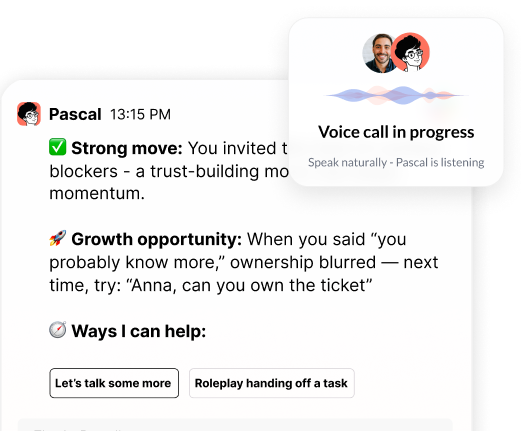
Proactive systems join meetings, send post-meeting feedback, deliver daily calendar previews, surface weekly pattern insights. Reactive systems require you to describe your situation manually—adding friction when you're busiest.
Pascal exemplifies the proactive approach. It sits in Slack and Teams, accompanies managers to Zoom meetings, delivers feedback automatically. No manual input required.
The activation energy gap explains the usage difference. Managers intend to use reactive tools but rarely follow through when competing priorities emerge.
In our customer base of 200–4,000 employee companies, proactive coaching maintains higher sustained engagement. Managers using Pascal average 2.3 sessions weekly. Those using on-demand tools (ChatGPT, Claude, standalone coaching apps) average 1.2 sessions weekly based on self-reported usage surveys.
Monthly retention tells a clearer story. After six months, 78% of Pascal users still have the coach attending meetings. For reactive tools, that number drops to 43% according to our customer surveys.
The "incomplete context" problem undermines reactive coaches. They only know what you manually input. You describe a difficult conversation, but the coach doesn't know your communication patterns, your team dynamics, or what actually happened in the meeting. The advice stays generic.
Workflow integration solves this. Pascal joins meetings automatically, so feedback reflects actual conversations rather than self-reported descriptions.
Melinda Wolfe, former CHRO at Bloomberg, Pearson, and GLG: "If we can finally democratize coaching—make it specific, timely, and integrated into real workflows—we solve one of the most chronic issues in the modern workplace."
An AI coach should proactively initiate for routine development moments: post-meeting feedback, skill pattern insights, preparation for upcoming conversations. It should wait for human initiation on sensitive topics requiring judgment.
Proactive moments that drive value:
• After every meeting (feedback on communication patterns)
• Beginning of day (calendar preview and conversation prep)
• Weekly (aggregated insights on leadership behaviors)
• During critical transitions (new role, first direct report, performance review season)
Wait-and-escalate scenarios:
• Employee terminations
• Discrimination or harassment concerns
• Legal compliance questions
• Mental health disclosures
• Compensation disputes
Unlike generic AI tools that will answer any question, Pascal includes moderation flags that route sensitive topics to HR. When a manager asks about terminating an employee, the system sends an alert to the HR team and suggests scheduling a conversation with an HRBP.
Managers configure which proactive touchpoints they want. Some prefer daily summaries, others want immediate post-meeting feedback. The system adapts to individual work styles.
Melinda Wolfe: "When it comes to helping first-time or mid-level managers, the risk of doing nothing can be just as high as the risk of trying something new."
Organizations using Pascal report measurable improvements in manager effectiveness. In our most recent customer survey (Q4 2024, 47 companies, 1,200+ managers):
• 81% of direct reports saw improvement in their managers' effectiveness (based on pulse surveys before and after Pascal implementation)
• Managers saved an average of 2.8 hours monthly on meeting prep and post-meeting follow-up (self-reported time tracking)
• Manager NPS scores increased 18 points on average after six months (company-reported internal NPS data)
These numbers come from customer self-reporting, not independent research. Take them as directional indicators, not scientific proof.
Proactive feedback accelerates skill development for newly promoted managers and those in transition—our highest-engagement user segments. Managers receive guidance on every interaction rather than only crisis moments.
Jeff Diana, former CHRO at Calendly, Atlassian, and SuccessFactors: "So much of the real learning and value that comes from this comes from in-context coaching in the moment to drive performance and to solve problems in the moment."
Data Breakdown:
• Approach: Proactive AI (Pascal) | Reach: 100% of managers | Timing: Real-time, in-workflow | Context Awareness: High (joins meetings, observes interactions) | Cost per Manager: $50-100/year | Typical Engagement: 2.3 sessions/week
• Approach: Human Coaching | Reach: 5-10% (executives only) | Timing: Scheduled sessions | Context Awareness: Medium (self-reported) | Cost per Manager: $10,000-25,000/year | Typical Engagement: High (for those who receive it)
• Approach: Reactive AI Tools | Reach: Available to 100% | Timing: On-demand when remembered | Context Awareness: Low (manually input) | Cost per Manager: $30-75/year | Typical Engagement: 1.2 sessions/week
• Approach: Learning Management Systems | Reach: 100% of managers | Timing: Scheduled courses | Context Awareness: None (generic content) | Cost per Manager: $50-150/year | Typical Engagement: 15-30% completion
• Approach: Manager Training Programs | Reach: 60-80% (one-time) | Timing: Annual or quarterly | Context Awareness: None (classroom-based) | Cost per Manager: $500-2,000/year | Typical Engagement: 40-60% application
The workflow integration advantage becomes clear when comparing approaches. Traditional methods require managers to context-switch—log into platforms, attend scheduled sessions, remember to apply learning later. Proactive AI coaching embeds guidance directly in Slack, Teams, and meeting tools.
Scale economics make the difference between aspirational programs and practical solutions. Proactive AI coaching delivers personalized guidance to every manager at a fraction of traditional coaching costs, making leadership development economically viable for mid-market organizations.
Start with managers in transition—newly promoted leaders, first-time people managers, those entering new roles. They show the highest engagement and create visible success stories. These early adopters demonstrate value to skeptical peers and generate organic demand across the organization.
Integration before announcement prevents the common mistake of launching broadly before the system understands your organization. Configure the AI coach with company competencies, values, and documentation. Connect it to Slack or Teams. Let it join a pilot group's meetings for two weeks before formal rollout.
Proactive value delivery from day one means managers receive feedback after their first meeting without taking any action. This immediate value demonstration drives adoption faster than training sessions or email announcements. The coach proves its worth through action, not promises.
Customizable notification preferences respect individual work styles while maintaining proactive engagement. Some managers want daily pattern insights, others prefer weekly summaries. The key is making proactive outreach feel helpful rather than intrusive.
Jeff Diana: "Even personalized learning content suffers from low engagement when it's not sufficiently attached to the context of people's actual work. Feedback works much better when it's attached to a specific meeting you just had rather than general guidance about a skill you need to develop."
• Proactive AI coaching achieves higher sustained engagement (2.3 sessions weekly versus 1.2 for reactive tools in our customer base) because it eliminates the activation energy required to seek help
• Managers using proactive systems maintain 78% monthly retention after six months versus 43% for reactive tools based on our customer surveys
• Purpose-built coaching platforms include guardrails that escalate sensitive topics to HR, unlike generic AI tools that answer any question without organizational context
• Our customer base reports 81% of direct reports seeing manager improvement, 2.8 hours saved monthly per manager, and 18-point increases in manager NPS scores (self-reported data, not independent research)
• Implementation success depends on starting with high-engagement segments (newly promoted managers, role transitions), integrating before announcing, and delivering immediate value through proactive feedback
Pascal lives where work happens—joining your meetings, sitting in Slack or Teams, delivering real-time feedback without requiring managers to remember to ask for help. See how proactive coaching works for your organization.
Header photo by Vitaly Gariev on Unsplash

.png)
.webp)
“Thank you for setting the great foundation for my promotion; now I have a plan!"

Curious to see how AI Coaching can 10X the impact and scale of your development initiatives. Book a demo today for: