

Mid-sized companies (200–4,000 employees) can scale leadership coaching to all managers by combining AI-powered platforms with structured rollout frameworks that prioritize adoption, measure behavior change, and integrate coaching into daily workflows.
Traditional executive coaching costs $10,000–$25,000 per person annually, limiting access to 2–5% of managers. This creates a gap: the managers who interact with employees daily get minimal development support, while executives who manage fewer people directly get premium coaching.
First-time managers receive minimal support during their most critical transition. Mid-level managers carry the heaviest coaching load but get the least development investment. Performance gaps compound as managers replicate ineffective behaviors across their teams.
HR teams face impossible ratios (1 HRBP per 150+ employees) trying to support manager development. Economic pressure demands better performance from existing talent. "We're asking more of managers with fewer resources," notes Melinda Wolfe, former CHRO at Bloomberg, Pearson, and GLG. "That's not sustainable without better support."
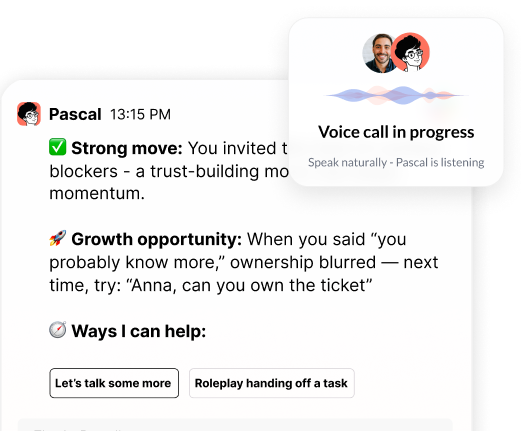
Before implementing any platform, understand what managers will experience. AI coaching platforms integrate into tools managers already use (Slack, Teams, email, calendar). A manager types a question ("How do I give feedback on missed deadlines?") and receives structured guidance based on coaching frameworks. Some platforms proactively surface guidance before scheduled 1:1s or after calendar events tagged as difficult conversations.
The experience differs from traditional coaching in three ways: it's available immediately (no scheduling), it's private (no fear of judgment), and it's integrated into workflow (no separate login to remember). The tradeoff: AI coaching lacks the nuanced relationship-building and intuition of human coaches. It works best for skill development and preparation, not complex interpersonal dynamics or career transitions.
Not every organization should scale coaching to all managers. This approach works when:
• You have 200+ employees with at least 20 people managers
• Manager quality varies widely (some teams thrive, others struggle)
• You've exhausted traditional training (workshops, e-learning) without sustained behavior change
• You have baseline engagement or performance data to measure against
• Leadership commits to tracking behavior change, not just completion rates
Skip this if you have fewer than 20 managers (traditional coaching or peer groups work better), if you lack basic performance management infrastructure (fix that first), or if leadership expects immediate ROI without tracking leading indicators.
Identify 3–5 measurable outcomes before launching. Examples: increase 1:1 frequency from monthly to weekly, improve feedback specificity scores (measured through team surveys), reduce time-to-promotion for high performers.
Select your pilot cohort strategically. Start with high-performing managers (they'll adopt quickly and model behavior) or intact teams (engineering, sales) rather than random sampling. Intact teams normalize the behavior faster because managers share experiences.
Establish baseline metrics from engagement surveys, 360 feedback, or performance data. Secure an executive sponsor from functional leadership, not just HR. When the CTO or VP of Sales champions the initiative, adoption accelerates.
Onboard 20–50 managers with clear expectations and specific use cases: preparing for difficult conversations, delegation coaching, performance review preparation. Integrate the platform into existing workflows (Slack, Teams, calendar) rather than creating another login.
Track weekly engagement: session frequency, topic patterns, manager satisfaction. Collect early feedback on what's working and what's missing.
Analyze behavioral data: Are managers having more 1:1s? Giving more feedback? Delegating differently? Collect qualitative feedback on gaps and needed support.
Identify power users and capture their use cases for broader rollout. One engineering manager using the platform to prepare for every 1:1 becomes a case study for the next cohort.
Victor Arguelles, VP of Learning Design at Marriott, emphasizes: "We only scale once employee satisfaction reaches defined thresholds." This deliberate approach prevents quality erosion during expansion.
Adjust customization by adding company-specific frameworks, values, and competencies based on pilot feedback.
Roll out to additional management layers based on pilot success data. Create manager champions who demonstrate value to peers through lunch-and-learns or team meetings.
Integrate coaching into existing programs: new manager onboarding, leadership development tracks, performance cycles. Provide aggregated insights to leadership showing common skill gaps and development themes. When the executive team sees that 60% of managers are working on delegation skills, they can align training resources accordingly.
Embed coaching into talent management processes: succession planning, high-potential development, promotion readiness assessments. Connect coaching data to business outcomes (team performance metrics, retention rates, engagement scores).
Establish continuous improvement cycles based on usage patterns and manager feedback. Consider expanding to individual contributors in technical roles or high performers who benefit from leadership development before formal promotion.
Manager Skepticism
Managers see coaching as remedial or another time-consuming program disconnected from their work. Position it as performance enablement, not deficit correction. Share specific use cases in the launch communication: "Get help preparing for a tough conversation in 5 minutes instead of spending 30 minutes searching Google or waiting for your next HRBP meeting."
Secure functional leader buy-in before launch. When the VP of Engineering says "I use this to prepare for my 1:1s," adoption follows.
Adoption Plateau
Initial excitement fades without integration into daily workflows. Platforms that integrate with Slack, Teams, and calendar systems maintain engagement better than standalone applications. The coaching needs to meet managers where they already work, not ask them to go somewhere new.
Proactive coaching (guidance that surfaces before scheduled 1:1s or after calendar events) maintains engagement better than reactive coaching (managers must remember to seek help).
ROI Ambiguity
Traditional L&D metrics (completion rates, satisfaction scores) don't demonstrate business impact. Track leading indicators (manager behavior changes) and lagging indicators (team outcomes):
Leading Indicators (Manager Behavior)
• 1:1 frequency and quality (measured through calendar data and team surveys)
• Feedback delivery patterns (frequency, specificity, timeliness)
• Delegation effectiveness (team member autonomy ratings)
Lagging Indicators (Team Outcomes)
• Team engagement scores (quarterly or pulse surveys)
• Retention rates (voluntary turnover by manager)
• Performance distribution (high-performer retention, low-performer improvement)
When you can show that managers using the platform conduct 40% more 1:1s and their teams report higher engagement, the ROI case builds itself.
Completion rates tell you nothing about impact. A manager can complete every module and still be ineffective. Focus on observable behavior changes that predict team outcomes.
Track both leading indicators (what managers do differently) and lagging indicators (how teams respond). Leading indicators provide early signals of program effectiveness. Lagging indicators confirm long-term impact but take longer to materialize.
Establish measurement cadence: leading indicators monthly, lagging indicators quarterly. This allows course correction before waiting six months to discover the program isn't working.
• Scale coaching to all managers (not just executives) to improve the daily interactions that drive team engagement and performance
• Understand what AI coaching is and isn't before implementing: it excels at skill development and preparation, struggles with complex interpersonal dynamics
• Follow a structured 5-phase rollout (foundation, pilot, measurement, expansion, integration) and don't skip the measurement phase
• Overcome adoption obstacles by securing functional leader buy-in, integrating into existing workflows, and tracking behavior change metrics
• Measure success through manager behavior changes (1:1 frequency, feedback quality) and team outcomes (engagement, retention), not completion rates
• This approach works for organizations with 200+ employees, 20+ managers, and leadership commitment to tracking leading indicators
See how Pascal integrates into Slack, Teams, and your existing workflows to deliver coaching to every manager. Explore Pascal's approach to scalable leadership development.
Header photo by Vitaly Gariev on Unsplash

.png)
.webp)
“Thank you for setting the great foundation for my promotion; now I have a plan!"

Curious to see how AI Coaching can 10X the impact and scale of your development initiatives. Book a demo today for: