

Effective 1:1 meetings require structured preparation, consistent cadence, and clear outcomes—not just calendar time. Managers who wing it waste hours on unproductive check-ins that feel like obligations rather than development opportunities.
A high-impact 1:1 agenda allocates most time to employee-driven topics, reserves space for manager coaching, and closes with alignment on next steps.
Start with an employee-owned agenda for 20-25 minutes. Let direct reports drive the conversation with their wins, challenges, development questions, and feedback requests. This signals the time belongs to them.
Transition to manager coaching for 10-15 minutes. Provide specific, behavioral feedback. Ask questions about career aspirations. Offer perspective on organizational dynamics they can't see from their position.
Close with alignment and action items in the final 5 minutes. Confirm mutual commitments, document decisions, and schedule follow-ups. Without this step, conversations become circular and revisit the same issues.
Use a shared agenda template that employees populate before the meeting. Include sections for wins, challenges, development goals, and feedback requests. Both manager and employee should leave with clear action items and revisit them at the next session.
Example agenda structure:
• Employee updates and questions (20 min)
• Manager feedback and coaching (10 min)
• Action items and next steps (5 min)
Effective 1:1s create space for development conversations, not status reports. Status updates belong in async tools or team meetings. Your 1:1 time should address career development, obstacles, feedback, and relationship-building.
The difference is structural. High-impact 1:1s follow a consistent format, focus on employee growth and challenges, and result in documented actions that both parties track between sessions. When managers dominate these conversations with project updates, they signal that employee development isn't a priority.
Create accountability by documenting and tracking commitments. This transforms one-off conversations into sustained development.
Data Breakdown:
• Status Update 1:1: Manager-driven agenda | Coaching 1:1: Employee-driven agenda
• Status Update 1:1: 80% project updates | Coaching 1:1: 70% development, 20% feedback, 10% alignment
• Status Update 1:1: Information transfer | Coaching 1:1: Growth commitments and action items
• Status Update 1:1: Rarely documented | Coaching 1:1: Tracked between sessions
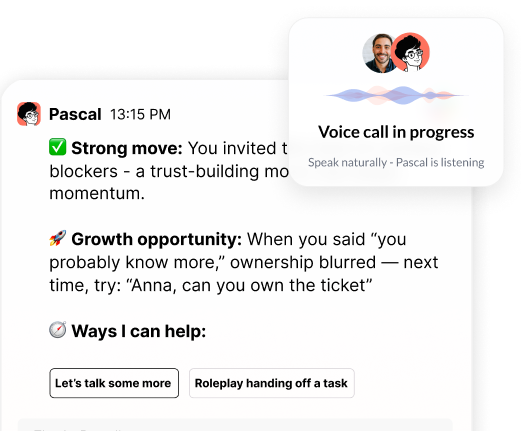
Pascal by Pinnacle helps managers prepare for 1:1s by analyzing communication patterns and suggesting discussion topics based on recent team dynamics—all within Slack or Teams before the meeting starts.
Treating 1:1s as optional when workload increases is the biggest mistake. Canceling or rescheduling frequently signals to employees that their development isn't a priority. This creates trust erosion over time. Even during high-pressure periods, maintaining the cadence matters more than extending the duration.
Dominating the conversation turns coaching sessions into monologues. The employee should drive the majority of airtime. When managers talk most of the time, they miss critical signals about team dynamics, individual challenges, and emerging issues.
Avoiding difficult topics compounds problems and damages credibility. Postponing performance concerns or career misalignment conversations doesn't make them disappear—it makes them worse. Address issues when they're small enough to fix.
Failing to ask for feedback creates a one-way development relationship. Make "What feedback do you have for me?" a standard agenda item.
Skipping documentation means 1:1s become circular conversations. Without written action items and progress tracking, you'll revisit the same topics without resolution. Use a shared doc or note-taking tool both parties can access.
Using generic questions like "How's it going?" and "Anything I can help with?" rarely surfaces meaningful insights. Prepare 2-3 specific questions based on recent work, team dynamics, or development goals.
Invest 10-15 minutes before each 1:1 reviewing recent interactions, identifying patterns, and preparing 2-3 specific coaching questions or feedback points. This preparation transforms generic check-ins into targeted development conversations.
Review recent communication by scanning Slack or Teams messages, email threads, and meeting notes for context on current projects, challenges, or team dynamics. Look for what's been said and what hasn't been said.
Identify behavioral patterns by watching for changes in communication frequency or engagement that might signal underlying issues. A normally responsive employee going quiet or a collaborative team member becoming isolated deserves attention.
Prepare specific feedback using the Situation-Behavior-Impact (SBI) model. Frame 1-2 observations with clear examples: "In yesterday's client meeting (Situation), you interrupted Sarah twice during her presentation (Behavior), which undermined her credibility with the client (Impact)."
Draft 2-3 coaching questions tailored to this employee's current challenges or goals. Instead of "How are things going?", try "What's the biggest obstacle you're facing on the product launch?" or "How are you thinking about your next career move?"
Review previous 1:1 notes to track progress on commitments. If you agreed to introduce them to the VP of Engineering last month, did that happen? If they committed to delegating more, what evidence have you seen?
Sample 10-minute prep routine:
• 3 minutes: Scan recent Slack/email for context
• 3 minutes: Review last 1:1 notes and action items
• 4 minutes: Draft 2-3 specific questions or feedback points
The quality of your questions determines the quality of your 1:1s. Powerful questions create space for reflection, surface hidden challenges, and drive employee ownership of their development.
Replace closed questions with open-ended exploration. Instead of "Did the project go well?", ask "What surprised you most about how the project unfolded?" The first gets a yes/no answer. The second gets insight.
Use questions that shift perspective. "If you were advising someone else in your position, what would you tell them?" helps employees step outside their immediate frustration and see options they've been missing.
Ask about energy and engagement, not just tasks. "What work energized you this week?" and "What drained you?" reveal patterns about role fit, team dynamics, and career trajectory that status updates never surface.
Probe for specifics when you hear generalizations. If an employee says "The team isn't collaborating well," follow with "Can you give me an example of what that looked like this week?" Concrete examples enable concrete solutions.
Create space for difficult truths with permission-based questions. "Can I share an observation?" or "Would you be open to some feedback on that?" signals respect and lowers defensiveness.
When 1:1s feel stuck, the problem is usually structural, not personal. Reset the format, renegotiate the agenda ownership, or address the underlying relationship issue directly.
Diagnose the root cause first. Are you dominating the conversation? Is the employee disengaged? Are you both avoiding difficult topics? Is the agenda too tactical? Name the pattern you're seeing.
Reset the format by proposing a new structure together. "Our 1:1s have felt more like status updates lately. What if we tried a different approach where you drive the first 20 minutes with whatever's on your mind?" Co-creating the change builds buy-in.
Renegotiate agenda ownership explicitly. Some employees need more structure; others need more freedom. Ask: "What would make this time more valuable for you?" Then honor their answer.
Address relationship issues directly when they're blocking progress. "I've noticed we both seem to avoid giving each other feedback. Can we talk about that?" Naming the dynamic often defuses it.
Consider external factors like workload, organizational change, or personal circumstances that might be affecting engagement. Sometimes unproductive 1:1s are a symptom of larger issues that need different solutions.
• Structure drives outcomes: Let employees drive most of the 1:1, reserve time for manager coaching, and close with documented action items
• Preparation matters: Invest 10-15 minutes before each 1:1 reviewing recent interactions and preparing specific coaching questions
• Consistency builds trust: Canceling or rescheduling 1:1s signals that employee development isn't a priority and correlates with disengagement
• Questions unlock insight: Replace generic check-ins with specific, open-ended questions that surface challenges, energy patterns, and development needs
• Documentation enables progress: Track commitments between sessions to transform circular conversations into sustained development
See how Pascal works inside Slack and Teams to help managers prepare for high-impact 1:1 conversations with personalized coaching and role-play scenarios tailored to each employee. Learn more about Pascal.
Header photo by TheStandingDesk on Unsplash

.png)
.webp)
“Thank you for setting the great foundation for my promotion; now I have a plan!"

Curious to see how AI Coaching can 10X the impact and scale of your development initiatives. Book a demo today for: