

For an enterprise, role-based access in a manager coaching tool should protect each person's coaching while giving a small administrative team what it needs to run the program. Pinnacle's AI coach, Pascal, uses two roles: admin and user. Users see their own coaching and evidence of their own progress, and the back end, including document uploads, user management and analytics, belongs to admins.
A role model is easiest to review when it has few moving parts. Pascal uses two roles, admin and user, and every person in a deployment holds one of them. Users see their own coaching and evidence of their own progress, which gives managers a clear record of how their behavior is developing over time.
The back end belongs to admins, and document uploads, user management and analytics all sit there. A small team can run the program from one place. Admins are usually a small L&D group, and they manage the deployment and see engagement metrics along with insights for the groups they oversee.
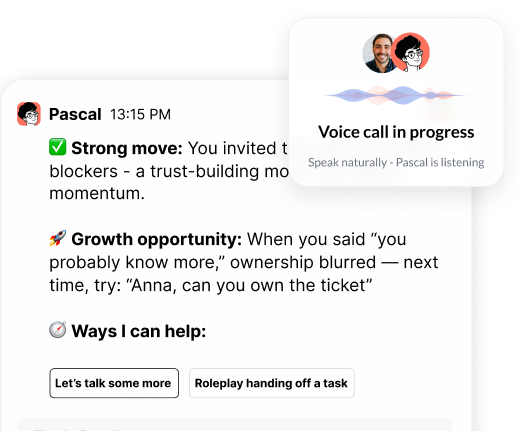
Pascal is an AI coach for every manager: a leadership companion who accompanies them in their meetings and work, and coaches from what actually happened.
Each person's coaching conversations with Pascal stay private. HR and executives see aggregated, anonymized insights, and only for groups large enough to protect anonymity.
Leaders work through the insights that admins share with HR leaders as appropriate. That arrangement gives executives the program-level view they need and leaves each manager's individual conversations in the hands of the manager.
Analytics are scored against a rubric of behaviors you define. Results can be sliced by cohort, function or level, so an L&D team can look at one group and see how a set of behaviors is developing. Because the rubric belongs to your organization, the analytics speak in the same terms your leaders already use.
Admins share these insights with HR leaders as appropriate, which lets the people responsible for talent decisions see progress at the group level. Engagement metrics sit alongside the behavior view, so admins can tell whether managers are using the coach regularly.
Enterprise buyers usually ask three practical questions about control. Each answer below can be confirmed in a live demo, and each one shapes how comfortable a security or HR team will be with the deployment.
A role model has to work for the administrators who run the program and for the managers who use the coach every week. Ask each provider how many roles exist, what each role can see, and where analytics and document uploads live. A short list of roles with clear boundaries is easier to explain to a security reviewer and easier to maintain as the program grows.
Ask also how analytics are scored and who defines the scoring. When the rubric is a set of behaviors your own team defines, the resulting numbers carry meaning for your leaders, and the slices by cohort, function or level answer the questions that executives tend to bring to program reviews.
Pinnacle is SOC 2 certified.



“Thank you for setting the great foundation for my promotion; now I have a plan!"

Curious to see how AI Coaching can 10X the impact and scale of your development initiatives. Book a demo today for: