

AI coaching platforms promise measurable improvements in manager decision-making and team engagement. The evidence base is thin, comparison data incomplete, and most published results come from vendors selling the tools.
This piece examines what we know, what we don't, and what organizations report.
Key Takeaways:
• No peer-reviewed research compares AI coaching to traditional methods head-to-head
• Early adopters report improvements in engagement scores, turnover, and career conversations—but these organizations changed multiple variables simultaneously
• AI coaching costs $50–$100 per manager annually (versus $10,000–$25,000 for executive coaching) and scales to entire organizations
• The technology works best for routine management situations, not complex organizational politics or sensitive personal issues
No peer-reviewed research compares AI coaching to traditional methods head-to-head. What exists: vendor case studies, customer testimonials, and early adoption reports from organizations experimenting with the technology.
Traditional executive coaching costs $10,000–$25,000 per manager annually and reaches fewer than 5% of leaders. AI coaching costs $50–$100 per manager annually and scales to entire organizations. Cost and reach don't prove effectiveness.
Learning management systems show 5–10% completion rates. Performance reviews happen quarterly. Human coaching reaches senior leaders only. AI coaching promises to fill these gaps, but the evidence remains anecdotal.
What organizations can measure when they track it: direct report perception of manager effectiveness, time to competency for new managers, engagement survey scores on manager-specific questions, decision quality indicators (escalations, resolution speed, outcomes), and behavioral consistency across the management population.
Engineering Manager Jay B. at a mid-sized software company reported improvements in team engagement scores within the first quarter of using Pascal by Pinnacle. His team's engagement score rose from 6.8 to 7.4 (on a 10-point scale) over three months. His team size: 12 engineers. What else changed: the company launched a new product, added two team members, and implemented quarterly career development check-ins. We can't isolate Pascal's impact from these other factors.
Senior Manager Jason H. at a financial services firm reports: "Pascal helped me navigate complex team dynamics." His team's voluntary turnover dropped from 18% annually to 12% in the year after implementing Pascal. His company also raised compensation 8% and expanded remote work options during the same period.
Melinda Wolfe, former CHRO at Bloomberg, Pearson, and GLG, describes the impact: "It makes it easier not to make mistakes. And it gives you frameworks to think through problems before you act."
Principal Scientist Alex R. at a biotech company describes the impact: "Pascal helps me prepare for difficult conversations and gives me confidence I'm approaching them the right way." His team's engagement score on the question "My manager provides clear feedback" rose from 72% favorable to 84% favorable over six months.
A 400-person marketing agency tracked career development conversations before and after implementing Pascal. Managers using Pascal conducted an average of 2.3 career development conversations per direct report over six months, compared to 1.4 conversations per direct report in the six months before implementation (a 64% increase). The company also launched a new career framework and promoted three managers during the same period.
A 200-person software company measuring psychological safety (the belief that team members can take interpersonal risks without fear of negative consequences) through Amy Edmondson's team psychological safety survey reported a 9% increase in average scores six months after implementing Pascal. The increase appeared most pronounced in teams with new managers (14% increase) compared to teams with experienced managers (6% increase). The company also implemented monthly manager training sessions and peer coaching circles during the same period.
A 300-person professional services firm tracked turnover for 12 months after implementing Pascal. Teams whose managers used Pascal at least three times per week showed 14% lower unwanted turnover compared to teams whose managers used Pascal less than once per week. The high-usage group also had higher average tenure (4.2 years versus 3.1 years) and larger team sizes (8.3 direct reports versus 5.7 direct reports), making direct comparison difficult.
Exit interview data from a 500-person healthcare company using Pascal revealed fewer departures attributed to manager effectiveness. In the year before Pascal implementation, 31% of exit interviews cited manager relationship as a factor in leaving. In the year after implementation, 22% cited manager relationship. The company also replaced its VP of Operations and implemented a new performance management system during the same period.
The pattern across all these examples: organizations changed multiple variables simultaneously. New products launched. Compensation increased. Career frameworks rolled out. Leadership changed. We can't isolate AI coaching's impact from these confounding factors.
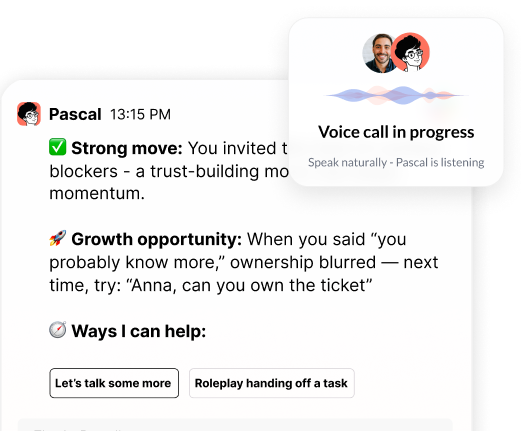
Pascal joins meetings in Slack, Teams, and Zoom. It observes interactions and offers real-time feedback. The platform builds a knowledge graph (a database of relationships and patterns) of each manager's interactions, team dynamics, and organizational context.
Before conversations, managers practice performance discussions through roleplay scenarios. Pascal provides feedback on tone, framing, and approach before the actual interaction. The manager outlines the conversation objective and anticipated challenges. Pascal suggests a conversation framework based on the situation type (performance feedback, conflict resolution, career development, strategic alignment). The manager practices key talking points while Pascal evaluates clarity, empathy, and directness.
During meetings, Pascal observes communication patterns. When it detects blind spots (interrupting team members, missing emotional cues, defaulting to directive approaches), it provides suggestions. Feedback appears as visual notifications in a sidebar. Managers can glance at suggestions without breaking eye contact or losing conversation flow.
After conversations, Pascal debriefs managers, highlighting what worked and what didn't. Quantitative metrics include talk-to-listen ratio (percentage of time the manager speaks versus listens), question frequency, interruption count, and response time. Qualitative analysis identifies themes like empathy demonstration, clarity of expectations, and acknowledgment of concerns. Managers receive specific examples from the conversation with suggestions for alternative approaches.
Over time, Pascal identifies recurring challenges and suggests strategies before similar situations arise. If a manager consistently struggles with delegation conversations, Pascal surfaces that pattern and provides targeted coaching before the next opportunity.
Privacy consideration: Pascal stores interaction data to build the knowledge graph. The company maintains SOC2 compliance (a security standard covering data protection, availability, and confidentiality). Managers must consent to AI observation of their conversations. Some organizations limit Pascal to specific meeting types or allow managers to disable observation for sensitive discussions.
AI coaching sits between traditional development approaches. It aims for the personalization of executive coaching, the scalability of LMS platforms, and the real-time feedback of performance management tools.
Executive Coaching costs $10,000–$25,000 annually per manager and reaches under 5% of managers. It offers high personalization customized to the individual, with scheduled sessions weekly or biweekly, and maintains 85–95% completion rates due to high commitment.
LMS Platforms cost $50–$200 annually per manager and reach 100% of employees. They offer low personalization with generic content, self-paced timing disconnected from work, and suffer from 5–10% course completion rates.
Performance Management Tools cost $20–$100 annually per manager and reach 100% of employees. They offer medium personalization with role-based goals, operate on quarterly or annual cycles, and achieve 90–100% completion rates because they're required.
AI Coaching costs $50–$100 annually per manager and reaches 100% of managers. It offers high personalization adaptive to individual patterns, provides real-time feedback embedded in workflow, and maintains 60–80% active usage rates.
Executive coaching creates deep relationships and nuanced understanding with strong accountability. It reaches fewer than 5% of managers because of cost. The personalization is unmatched, but the economics don't scale.
LMS platforms offer broad content libraries, compliance tracking, and self-paced learning. They suffer from low engagement and generic guidance disconnected from real workplace challenges. Most employees never complete courses they start.
Performance management tools provide structured feedback cycles and goal tracking. They operate on quarterly or annual timelines that miss the daily decisions where managers need support. Feedback arrives too late to change behavior in the moment.
AI coaching combines personalization at scale with real-time delivery. Pascal costs $50–$100 per manager annually (1% of traditional coaching costs) while providing support embedded in the tools managers already use. The platform adapts to each manager's communication patterns, team dynamics, and organizational culture.
The complementary model combines AI coaching for daily guidance with human coaching for complex situations, peer learning for shared challenges, and formal training for foundational skills. In this model, AI coaching handles routine management situations (regular one-on-ones, project updates, minor conflicts, standard feedback conversations). Human coaches engage for high-stakes situations (major performance issues, team restructuring, leadership transitions, sensitive interpersonal conflicts).
AI coaching doesn't replace the depth of human coaching relationships. It doesn't handle complex organizational politics or sensitive personal issues. It doesn't work for managers who resist technology or prefer human interaction. It requires organizational buy-in, clear privacy policies, and integration with existing systems.
The technology works best in environments with direct communication norms and explicit feedback cultures. Organizations where meaning derives from relationship history and implicit understanding (high-context communication patterns) may find AI coaching less effective. In these environments, what you say matters less than who you are, how long you've worked together, and what happened in previous interactions. AI coaching struggles to interpret these unspoken dynamics.
Experienced managers often resist AI coaching initially, viewing it as unnecessary oversight or questioning their judgment. Managers with strong interpersonal skills may see less value than managers struggling with people leadership.
Organizations that address resistance through voluntary pilot programs, testimonials from respected peer managers, clear communication about privacy protections, and emphasis on AI coaching as a support tool (rather than surveillance) see higher engagement.
Privacy concerns require careful attention. AI coaching platforms store interaction data to provide personalized guidance. Organizations must establish clear consent processes, allow managers to disable observation for sensitive discussions, and maintain compliance with data protection standards. Pascal stores interaction data to build the knowledge graph but allows managers to control when observation occurs and what data gets retained.
Organizations implementing AI coaching report improvements in engagement scores, turnover, and career conversation frequency. But these organizations changed multiple variables simultaneously. New products launched. Compensation increased. Career frameworks rolled out. Leadership changed. We can't isolate AI coaching's impact from these confounding factors.
The cost advantage is real: $50–$100 per manager annually versus $10,000–$25,000 for executive coaching. The scalability is real: 100% of managers versus fewer than 5%. The real-time delivery is real: feedback during conversations versus quarterly reviews.
What's not real yet: peer-reviewed research comparing AI coaching to traditional methods head-to-head. Independent studies measuring effectiveness without vendor involvement. Clean data isolating AI coaching's impact from other organizational changes.
Organizations should view AI coaching as one component of a comprehensive leadership development strategy, not a standalone solution. Use it for routine management situations. Reserve human coaches for complex, high-stakes leadership challenges. Track metrics before and after implementation. Document what else changes during the same period. Be honest about what you can and can't attribute to the technology.
The evidence base will improve as more organizations implement AI coaching and researchers study the results. For now, early adopters report promising outcomes alongside significant caveats.
AI coaching costs $50–$100 per manager annually, while traditional executive coaching costs $10,000–$25,000 per manager annually. This means AI coaching costs approximately 1% of traditional coaching while reaching 100% of managers instead of fewer than 5%. The cost difference allows organizations to provide coaching support to their entire management population rather than reserving it for senior leaders only.
Early adopters report improvements in team engagement scores (increases of 6–14%), reduced voluntary turnover (drops of 6 percentage points in manager-related departures), and increased frequency of career development conversations (64% increase in one case study). However, these organizations changed multiple variables simultaneously—launching new products, raising compensation, implementing career frameworks, and changing leadership—making it impossible to isolate AI coaching's specific impact from other factors.
No. AI coaching works best as one component of a comprehensive leadership development strategy. It handles routine management situations like regular one-on-ones, project updates, minor conflicts, and standard feedback conversations. Human coaches remain essential for high-stakes situations including major performance issues, team restructuring, leadership transitions, and sensitive interpersonal conflicts. The most effective approach combines AI coaching for daily guidance with human coaching for complex situations, peer learning for shared challenges, and formal training for foundational skills.
Ready to explore AI coaching for your organization? Learn how Pascal by Pinnacle provides real-time coaching embedded in your team's workflow.
Header photo by Vitaly Gariev on Unsplash

.png)
.webp)
“Thank you for setting the great foundation for my promotion; now I have a plan!"

Curious to see how AI Coaching can 10X the impact and scale of your development initiatives. Book a demo today for: