

Real-time coaching software delivers guidance during critical workplace moments (performance conversations, team meetings, delegation decisions) instead of weeks later in scheduled reviews. These platforms integrate into daily workflows to provide managers with coaching when they need it.
Real-time coaching software provides managers with guidance during actual work moments—before a difficult conversation, during a team meeting, or after a delegation decision—instead of weeks later in a scheduled review.
According to Gallup research, 70% of the variance in team engagement comes down to the manager. Traditional training approaches fail to develop this capability at scale. Quarterly reviews surface problems months after they occur. Scheduled coaching sessions can't address the specific moment a manager needs guidance.
In-the-moment feedback works differently. Guidance arrives during the actual situation—preparing for a performance conversation, navigating a tense team dynamic, deciding how to delegate. The best platforms integrate with existing workflows like Slack, Teams, and Zoom instead of requiring managers to access a separate tool.
Real-time coaching software captures behavioral data from actual interactions and delivers continuous feedback. Traditional performance reviews rely on self-reported snapshots taken quarterly or annually. The difference isn't just frequency—it's fidelity. Traditional methods ask managers to recall and synthesize months of interactions during a scheduled review cycle. Real-time platforms observe actual meetings, communication patterns, and decision points as they happen.
Traditional engagement surveys provide snapshots. Real-time platforms capture relationship dynamics and interaction patterns. Traditional coaching costs $200–$500 per hour and reaches less than 5% of employees. AI-powered real-time coaching operates at a fraction of traditional costs with 24/7 availability.
Data Breakdown:
• Approach: Traditional Reviews | Feedback Timing: Quarterly/Annual | Data Source: Self-reported | Coverage: 100%
• Approach: Human Coaching | Feedback Timing: Scheduled sessions | Data Source: Coach observations | Coverage: <5%
• Approach: Real-Time AI Coaching | Feedback Timing: Continuous/On-demand | Data Source: Behavioral data | Coverage: 100%
The best real-time coaching software doesn't wait for managers to ask for help—it anticipates high-stakes moments and surfaces guidance proactively. Some platforms join scheduled meetings, analyze calendar context, and deliver pre-meeting coaching for performance conversations, difficult feedback sessions, or delegation decisions.
This proactive approach addresses the core problem: managers don't know what they don't know. By the time they realize they need help, the moment has passed. AI can analyze upcoming calendar events, identify high-stakes conversations like performance reviews or conflict resolution, and deliver preparation guidance 30–60 minutes before the meeting.
Generic chatbots require managers to recognize they need help and articulate the right question. Most managers don't do this until after a conversation goes wrong. A manager preparing for a difficult performance conversation can receive talking points based on the employee's recent work patterns, communication style, and organizational competencies. Pre-meeting coaching allows managers to mentally rehearse, consider alternative approaches, and enter conversations with confidence instead of scrambling for the right words mid-conversation.
As Jeff Diana, former CHRO at Calendly and Atlassian, notes: "Real learning and value come from in-context coaching—solving problems in the moment, not in a classroom."
Real-time coaching platforms that integrate with communication tools capture behavioral patterns that managers can't see themselves—communication frequency imbalances, micromanagement tendencies, delegation gaps, or inconsistent feedback delivery. This observational data creates a foundation for coaching that self-assessment tools and traditional 360 reviews miss.
According to Qualtrics research, the question "How frequently does your manager solicit feedback from you?" correlates most strongly with overall manager effectiveness. Self-reported data perpetuates blind spots because managers overestimate their own performance.
Behavioral data reveals meeting attendance patterns showing who gets invited or excluded, communication style variations between formal and casual interactions with different reports, delegation frequency and quality, and response time patterns that signal availability or avoidance. Traditional 360 feedback happens once or twice per year and relies on memory. Real-time platforms track actual behaviors continuously.
Real-time coaching software that lives inside the tools managers already use achieves higher adoption than standalone platforms. When coaching appears in Slack after a team meeting or surfaces in Teams before a 1:1, managers don't need to remember to access a separate tool.
Integration determines whether coaching becomes habitual or forgotten. Platforms that require managers to log into a separate system see low engagement within six months. Tools embedded in workflow maintain higher retention. The difference comes down to friction.
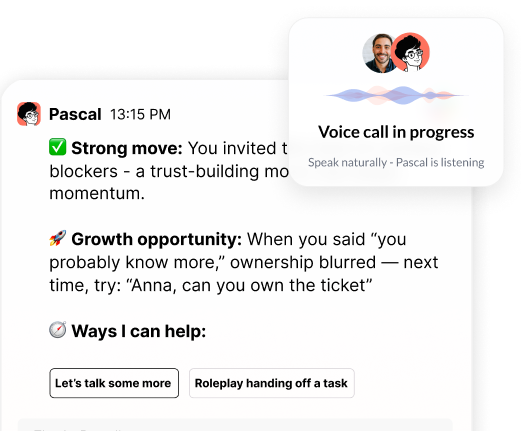
Some platforms (including Pascal by Pinnacle) integrate directly into Slack, Microsoft Teams, Zoom, and Google Meet. They join scheduled meetings, provide feedback during conversations, and offer coaching based on organizational competencies and training materials.
Real-time coaching platforms provide continuous reinforcement, creating behavior change instead of forgotten content. Traditional training delivers information once, then hopes managers remember to apply it weeks later. Real-time coaching reminds managers to apply learned frameworks in the specific moments when those skills matter.
When a manager enters a performance conversation, the platform can remind them to use the feedback framework they learned in training, then provide post-meeting coaching on how well they applied it. This continuous loop of preparation, practice, and feedback creates muscle memory. Managers develop consistency because they receive coaching every time they face a similar situation, not just once during a training session.
AI coaching adapts to individual context—role, goals, performance history, communication style, and organizational culture. Generic advice doesn't drive behavior change. Guidance that accounts for who you are, who you're managing, and what your company values creates trust and application.
Real-time coaching platforms need four layers of context to deliver trusted guidance: individual employee data (role, goals, performance history), organizational knowledge (values, competencies, culture), real-time work patterns (meeting dynamics, communication style), and temporal context (performance review cycles, goal-setting seasons).
Without this foundation, coaching remains generic and managers ignore it. With deep context, the platform understands your people, your culture, and the moments when guidance matters most. A first-time manager receives different coaching than a veteran leader. A manager in a high-growth startup receives different guidance than one in a regulated enterprise.
Real-time behavioral data provides organizations with continuous insights into culture and performance. Quarterly surveys provide static, self-reported snapshots. Real-time platforms capture what people are doing—how they lead, how they communicate, how they handle difficult moments.
This creates the ability to understand culture at scale. Continuous behavioral data shows specific behaviors and can help drive change across the company in measurable ways. Organizations can track cultural transformations and behavioral changes as they happen, not months after the fact.
Real-time coaching platforms provide continuous indicators of how teams function, transforming performance management from periodic reviews into ongoing improvement.
Real-time coaching software delivers ROI through time savings, manager effectiveness improvements, and reduced spending on underutilized tools. Organizations can save manager time by automating performance review writing, providing continuous feedback instead of scheduled coaching sessions, and reducing time spent on remedial conversations.
Manager effectiveness improvements show up in direct report engagement scores. Real-time coaching can replace or reduce spending on unfilled HR positions, underutilized learning platforms, traditional coaching and training programs, and engagement survey tools.
Traditional one-on-one coaching with human coaches costs $10,000–$25,000 per manager annually and reaches less than 5% of employees. Real-time AI coaching costs a fraction of that and covers 100% of the organization. This makes coaching accessible to every manager, not just senior executives.
• Real-time coaching software delivers guidance during actual work moments (before difficult conversations, during meetings, after delegation decisions) instead of weeks later in scheduled reviews
• Behavioral data from real-time platforms reveals blind spots managers can't self-diagnose (communication imbalances, micromanagement patterns, delegation gaps)
• Integration with existing workflows (Slack, Teams, Zoom) drives higher retention than standalone platforms that require separate logins
• Continuous reinforcement creates behavior change, with managers receiving coaching every time they face similar situations instead of once during training
• Organizations save manager time and improve effectiveness while operating at a fraction of traditional coaching costs
Ready to see how real-time coaching works in practice? Explore how Pascal delivers in-the-moment guidance inside the tools your managers already use.
Header photo by Vitaly Gariev on Unsplash

.png)
.webp)
“Thank you for setting the great foundation for my promotion; now I have a plan!"

Curious to see how AI Coaching can 10X the impact and scale of your development initiatives. Book a demo today for: