

The average employee has 14,640 workplace interactions annually. HR touches them 220 times—less than 1.5% of moments that shape how they work. This gap explains why manager development remains one of the hardest problems in organizations: traditional coaching can't scale to the moments that matter.
Two architectural approaches attempt to solve this. Purpose-built AI coaching platforms design systems from the ground up for leadership development. Embedded AI coaching adds general-purpose AI (ChatGPT, Microsoft Copilot) into existing workplace tools as a feature.
The architectural choice determines three outcomes: coaching quality, sustained engagement, and measurable behavior change. This guide examines how each approach works, where they succeed, and which problems they solve.
Purpose-built platforms integrate coaching frameworks, organizational context, and behavioral science into specialized systems. Embedded tools add conversational AI capabilities to existing software without leadership expertise.
Three technical differences drive different outcomes:
Coaching expertise. Purpose-built platforms use ICF-certified coaching methodologies and understand workplace dynamics. Embedded tools provide conversational AI without leadership training.
Organizational integration. Purpose-built systems ingest company values, competencies, and performance frameworks. Embedded tools lack access to company-specific data.
Engagement model. Purpose-built coaches proactively engage managers in workflow. Embedded tools wait for managers to initiate conversations.
Data Breakdown:
• Component: Core design | Purpose-Built: Leadership development system | Embedded: Productivity feature
• Component: Coaching expertise | Purpose-Built: ICF-certified frameworks | Embedded: General conversational AI
• Component: Organizational context | Purpose-Built: Values, competencies, culture | Embedded: Limited or no company data
• Component: Engagement model | Purpose-Built: Proactive (meeting observation, nudges) | Embedded: Reactive (user-initiated)
• Component: Memory architecture | Purpose-Built: Persistent relationship tracking | Embedded: Session-based or none
Pascal by Pinnacle represents the purpose-built approach. During onboarding, Pascal integrates organizational values, competency frameworks, career ladders, and role definitions. It pulls individual employee data (performance reviews, 360 feedback, development goals, personality assessments). It captures real-time work patterns through meeting dynamics, communication style, and interaction frequency.
Microsoft Teams Coach and ChatGPT represent embedded approaches. They provide conversational AI without organizational context. They can't tell you whether your feedback approach aligns with your company's leadership competencies or whether your delegation style matches expectations for your level.
Generic advice fails because organizations define leadership differently. "Give direct feedback" means different things at Netflix (radical candor) versus at a consensus-driven nonprofit. Without organizational context, AI coaching becomes a suggestion engine disconnected from how your company actually evaluates managers.
Purpose-built platforms ingest four layers of organizational data:
Company values and competencies. What leadership behaviors does your organization reward? How does your company define "effective delegation" or "strategic thinking"?
Role-specific expectations. What's expected of a director versus a VP? What does your career framework say about the transition from individual contributor to manager?
Performance cycles and priorities. What development goals has your manager set for you? What feedback appeared in your last 360 review?
Real-time behavioral patterns. How do you actually communicate in meetings? Who do you work with most? Where do tensions surface?
This context enables coaching that aligns with how your organization defines effectiveness. When Pascal tells a manager "Your delegation approach needs adjustment," it's referencing your company's specific competency framework, not generic best practices.
Melinda Wolfe, former CHRO at Bloomberg, Pearson, and GLG, frames the opportunity: "If we can finally democratize coaching—make it specific, timely, and integrated into real workflows—we solve one of the most chronic issues in the modern workplace."
Embedded tools lack this organizational layer. They provide advice based on general leadership principles, not your company's specific expectations. The coaching remains generic because the system doesn't know your company.
Managers need coaching during meetings, before difficult conversations, and after critical interactions. Reactive tools require managers to remember to seek help during high-pressure moments. This rarely happens.
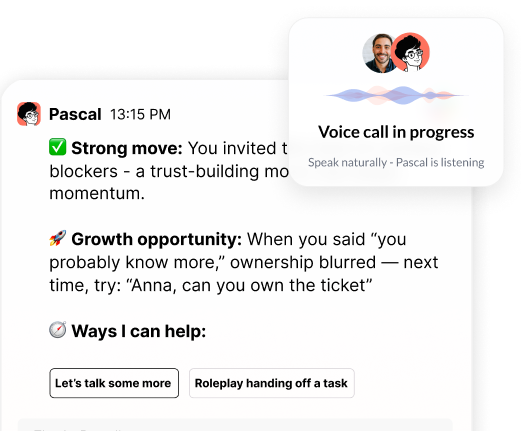
Proactive coaching delivers guidance when managers need it most. Pascal joins meetings, observes interactions, and provides feedback afterward. A manager receives specific guidance ("You interrupted Sarah three times during the product discussion—here's how to create more space for her contributions") within minutes of the meeting ending.
This creates consistent touchpoints. Embedded tools require managers to initiate every interaction. After a difficult conversation, a manager must remember to open the tool, explain the context, and request guidance. This workflow rarely survives competing priorities.
Jeff Diana, former CHRO at Calendly, Atlassian, and SuccessFactors, emphasizes: "Real learning and value come from in-context coaching—solving problems in the moment, not in a classroom."
The engagement model determines whether coaching becomes a habit or remains an underutilized resource. Proactive systems build muscle memory through consistent touchpoints. Reactive tools create no behavioral pattern because usage is sporadic.
Purpose-built AI coaching costs $50-100 per employee annually. Embedded tools often come included in existing platform licenses (Microsoft 365, Slack).
The "free" embedded tool becomes expensive when you calculate opportunity cost. If only 15% of managers use it consistently, you've failed to develop 85% of your leadership population. Gallup research shows managers drive 70% of team engagement variance. Failing to develop them isn't a cost savings—it's a missed investment in the capability that determines team performance.
Purpose-built platforms deliver measurable outcomes because high engagement rates compound over time. When 94% of managers use the system monthly, behavior change becomes predictable. When 15% use it sporadically, impact remains uncertain.
Traditional executive coaching costs $3,000-15,000 per person. AI coaching delivers a fraction of that cost while maintaining consistent engagement. The ROI calculation must account for engagement rates, not just licensing fees.
Purpose-built coaches maintain persistent memory across all interactions. They build a knowledge graph of relationships, communication patterns, and development progress over time. Embedded tools operate with session-based memory that resets between conversations.
Pascal tracks who you work with, how you interact with each person, what development goals you've set, and which coaching strategies have worked for you. When you ask for help preparing for a difficult conversation with a specific colleague, Pascal already knows your history with that person, your communication tendencies, and your manager's expectations for how you handle conflict.
Embedded tools require you to provide this context manually every time. You must explain who the person is, what your relationship has been, what's happened previously, and what you're trying to achieve. This context-setting takes time and cognitive energy—resources managers don't have during high-pressure moments.
The memory layer enables proactive coaching. Pascal notices patterns ("You've had three tense exchanges with David this week") and proactively offers guidance before the next interaction. Embedded tools cannot notice patterns because they don't maintain relationship context across sessions.
Purpose-built platforms include specialized guardrails for workplace topics, escalation protocols for sensitive issues, and organization-specific controls. Embedded tools apply general content moderation without understanding workplace context or when human expertise is required.
Pascal's guardrail system includes four layers:
Moderation flags identify sensitive topics in real-time.
Escalation protocols automatically route issues (harassment, discrimination, mental health concerns) to appropriate human resources.
Organization-specific controls allow companies to define boundaries around topics they want handled by humans.
Anonymous aggregated insights give leadership visibility into trends without compromising individual privacy.
When a manager asks Pascal about a situation involving potential harassment, the system recognizes this requires human expertise and escalates to HR while providing immediate guidance on next steps. Embedded tools lack this workplace-specific intelligence and may provide generic advice on topics that require specialized handling.
Melinda Wolfe notes: "When those moments go wrong, the costs ripple: broken trust, bad decisions, legal exposure, or disengaged teams." Purpose-built systems prevent these outcomes through specialized guardrails.
New managers face their steepest learning curve during the first 90 days—precisely when they need the most support but have the least bandwidth to seek it out.
Purpose-built platforms provide structured guidance without requiring the manager to initiate. After their first team meeting, Pascal offers feedback on facilitation skills. Before their first performance review, Pascal walks them through the company's specific framework. When they struggle with delegation, Pascal provides role-specific coaching based on their team's dynamics.
Embedded tools require new managers to recognize they need help, articulate the problem clearly, and request specific guidance. This assumes a level of self-awareness and coaching literacy that most first-time managers don't possess. They don't yet know what they don't know.
The architectural difference shows up in adoption curves. Purpose-built platforms see consistent engagement from day one because they proactively engage managers. Embedded tools see initial experimentation followed by abandonment as managers realize they must drive every interaction.
• Purpose-built AI coaching platforms design systems specifically for leadership development, integrating coaching expertise, organizational context, and proactive engagement that embedded tools cannot match
• Organizational context separates effective coaching from generic advice—purpose-built systems integrate company values, competencies, and real-time behavioral data that embedded tools cannot access
• Proactive engagement drives behavior change by delivering guidance when managers need it most, creating consistent touchpoints versus sporadic usage of reactive tools
• Real ROI accounts for engagement rates and measurable outcomes, not just licensing costs—low adoption rates make "free" embedded tools expensive through missed development opportunities
• Specialized guardrails and escalation protocols protect employees and organizations from liability risks that general-purpose AI tools cannot anticipate or handle
The choice between purpose-built and embedded AI coaching is an architectural decision. One approach designs systems specifically to develop managers through contextual, proactive, and safe guidance. The other adapts general AI capabilities to coaching as an afterthought.
See how Pascal works inside Slack and Teams to deliver proactive, contextual coaching at heypinnacle.com.
Header photo by Bluestonex on Unsplash

.png)
.webp)
“Thank you for setting the great foundation for my promotion; now I have a plan!"

Curious to see how AI Coaching can 10X the impact and scale of your development initiatives. Book a demo today for: